


 Invest ideas
News
23 May 2026, 11:27
UNI Fee Switch Reality Check: Why Token Burns Do Not Automatically Fix Value

Minutes after a buzzy governance forum post floated a fee-switch tweak, UNI’s chart flashed green. Twitter threads promised “automatic value” if the protocol started burning tokens. By the next day, the rally faded. If you’ve watched this cycle before, you know the drill: flip a switch, fund a burn, price goes up—until it doesn’t. The uncomfortable truth is that token burns are not a cheat code, especially when they are financed by diverting protocol fees that someone else currently earns. This article unpacks what Uniswap’s fee switch can and cannot do, where burn value really comes from, and how to weigh the trade-offs before voting on any proposal. The Big Picture: Why Fee Switch Talk Is Everywhere Uniswap remains the reference DEX for spot trading on Ethereum and several L2s, with concentrated liquidity and a large governance community. Revenue discussions flare up whenever markets turn, treasuries shrink relative to ambitions, or competitors dangle higher “real yield.” Two realities drive the current debate. First, governance wants sustainable funding and credible value accrual to UNI. Second, liquidity providers (LPs) expect that the bulk of fees compensate their inventory risk. Any fee diversion—to buy UNI, burn it, or pay delegates—reshapes this balance and can change how much liquidity sticks around. Burns reduce supply, but price only responds if net demand outpaces the new equilibrium of liquidity, expectations, and risk—especially after second-order effects on LP behavior. What the Uniswap Fee Switch Actually Does “Fee switch” is shorthand for a governance-controlled setting that directs a portion of pool trading fees to the protocol, rather than to LPs exclusively. Uniswap has included a protocol fee parameter since earlier versions and retained it in v3 on a per-pool basis with a configurable share. Version nuances that matter Uniswap v2 hard-coded a uniform swap fee and allowed governance to take a slice for the protocol. Uniswap v3 introduced multiple fee tiers and concentrated liquidity; governance can enable a protocol fee per pool up to a capped percentage of LP fees. In practice, large-scale activation has been approached cautiously because the impact varies by pool, chain, and market conditions. What a burn-funded switch would look like Turning on the switch is only step one. If the goal is a burn, the protocol needs a mechanism to convert collected fees into UNI and retire them. Enable a protocol fee on selected pools, directing a portion of swap fees to the protocol address. Accrue fees in the pool’s settlement assets (e.g., ETH, stablecoins). Periodically route accrued assets to a buyback contract or auction mechanism. Market-buy UNI across specified venues or via a TWAP/auction to limit slippage. Send purchased UNI to a burn address, or lock it irretrievably. Publish transparent accounting and cadence so markets can price expectations. Every step above carries design choices: which pools, what cadence, how to avoid frontrunning, how to minimize adverse selection, and how to ensure the program keeps working across L2s. Burn Mechanics: Where the Firewood Comes From Burns are not conjured value; they spend cash flows or treasury assets to remove float. With a fee switch, the “cash” is trading fees that would otherwise go to LPs. Alternatively, a protocol could allocate treasury holdings to buy and burn. Each path has different downstream effects. Source of funds There are three common sources for burn programs: Protocol fees redirected from trading activity (ongoing, variable). Treasury reserves (finite; reduces runway if not offset by future revenue). External revenue (e.g., licensing, front-end fees), if any. Using ongoing protocol fees ties burn intensity to market volumes. When volumes dip, burn slows. When volumes spike, burns accelerate—precisely when speculation is highest and frontrunning pressure rises. Execution realities On-chain buybacks can leak value through slippage, MEV, and sandwich attacks if not designed carefully. Popular mitigations include TWAP orders, batch auctions, or letting third parties compete to deliver the most UNI for the least input via auctions. Transparent schedules help markets price flows but can also invite opportunistic positioning. Float vs. fully diluted supply Even aggressive burns may barely dent fully diluted supply if large allocations remain locked or vesting. Markets usually price the tradable float. If burns are smaller than net unlocks or market-maker inventory growth, the price impact can be muted. Why Burns Don’t Guarantee Higher UNI Prices Burns can be part of a healthy token economy, but their impact is conditional. Here are the core reasons value is not automatic: Demand still rules Price is set at the margin. If the expected buyback flow is small compared to daily trading volume, speculative swings, or liquidity provider re-hedging, price effects are often lost in the noise. Conversely, if demand for governance, staking, or ecosystem participation grows, price can rise even without burns. LP response can shrink the pie Diversion of fees away from LPs can reduce the incentive to deploy capital, leading to thinner books, wider spreads, and lower volume. That feedback loop can shrink total fees, which in turn shrinks the pool of assets available for buybacks or treasury. A burn that triggers LP flight can be self-defeating. Expectations get priced in early Governance discussions and temperature checks invite speculation. If traders buy UNI ahead of expected burns, actual execution can become a “sell the news” event. Unless buybacks are both sizable and sustained, the one-time narrative pop rarely persists. Accounting sleight of hand doesn’t create cash flows Eliminating tokens is not the same as earning income. A protocol without durable revenues won’t find lasting value in burns. Markets increasingly look for net cash flow to stakeholders (even if indirect) or tangible utility that drives recurring demand. Regulatory constraints limit direct value sharing Designs that pay token holders directly from protocol fees are more legally sensitive in some jurisdictions. That’s one reason some protocols route fees to treasuries, buybacks, or grants rather than explicit dividends. The path chosen affects perceived value and risk premia. Fee PolicyWho PaysWho BenefitsLP ImpactRegulatory Exposure (qualitative)Operational ComplexityLP-only (status quo)Traders via swap feesLPsStrong LP incentivesLowerLowFee to TreasuryLPs (reduced share)Treasury, grants, runwayModerate; depends on cutLower to moderateMediumBuyback & BurnLPs (reduced share)Tokenholders (indirect)Potentially adverse if too highModerate (varies by jurisdiction)Medium to high (execution)Fee to Stakers/DelegatesLPs (reduced share)Active governance participantsDepends on share and lockupsHigher in some jurisdictionsHigh (staking infra) LP Behaviour And Market Structure If Fees Are Diverted Even a small protocol fee can alter LP calculus, especially in volatile pairs. LPs think in net terms: returns after impermanent loss, gas, rebalancing, and alternative opportunities (including on other DEXs). If their net expected APR falls below rivals, capital moves. The LP calculus Concentrated liquidity means LPs choose narrow tick ranges to enhance fee capture. A protocol fee reduces their gross intake. If fewer LPs provide depth at key ticks, traders face more slippage and route to other venues. That reduces volumes and the fee base—lowering both LP earnings and protocol revenue in a feedback loop. Competitor and L2 dynamics Competing DEXs advertise fee rebates, token incentives, or revenue shares to attract LPs. They can also react tactically if Uniswap activates a meaningful protocol fee by cutting fees or adding incentives, at least temporarily. On L2s, where gas is lower and bootstrapping is easier, liquidity can migrate quickly. MEV and order flow Routing and order flow are shaped by aggregators and private relays. If a protocol fee widens effective spreads, more flow can end up in private order flow agreements or alternative pools that optimize for lower total cost including MEV rebates. That further fragments liquidity. Legal, Operational, And Accounting Realities Token economics live in the real world of law and operations. This is where optimistic burn math often meets constraints. Regulatory posture In April 2024, Uniswap Labs publicly disclosed receiving a Wells notice from the U.S. SEC. While a Wells notice is not a final action, it underscores the sensitivity around designs that resemble fee sharing or dividends. Many protocols avoid direct distributions to token holders in the U.S., opting for treasury funding, grants, or non-custodial staking designs outside specific jurisdictions. Governance separation and custody Uniswap governance involves community voting, delegates, a foundation, and development entities. Any buyback-and-burn process must respect this separation and custody requirements. Multi-sig controllers, timelocks, auditable policies, and well-defined emergency procedures are non-negotiable for credible execution. Tax and accounting Jurisdictions differ on whether buybacks, burns, or staking rewards create taxable events for the protocol, its entities, or token holders. Poorly scoped policies can create unforeseen liabilities, especially if burns are financed from entity-controlled revenue rather than autonomous smart contracts. Cross-chain logistics Protocol fees accrue across Ethereum mainnet and L2s. Consolidating them for periodic buybacks without value leakage requires reliable bridges or on-chain auctions per domain. Each added domain increases operational risk and monitoring overhead. A Framework To Evaluate Any Fee-Switch Proposal When a new proposal surfaces, run it through a simple rubric before you anchor on the headline burn rate. Quantify the base: estimate protocol-fee capture in stable market conditions per pool and chain. If the estimate is opaque, ask for historical simulations. Model LP response: sensitivity-test how a 5–25% fee diversion affects TVL, spreads, and volumes. Demand that authors share assumptions. Specify execution: will buybacks use TWAPs, auctions, or RFQs? What’s the cadence? How are frontrunning and MEV handled? Governance safeguards: identify who can pause, adjust parameters, or rotate executors. Require timelocks and public dashboards. Legal review: clarify where the funds flow, who is the counterparty (if any), and whether distributions touch entities in sensitive jurisdictions. Metrics and kill-switch: define success metrics (e.g., sustained liquidity depth, net revenue growth, reduced volatility of slippage) and conditions for rollback. Transparency: publish monthly reports including realized buyback amounts, slippage paid, and net effect on circulating supply. Proposals that skip these basics trade rigor for narrative. That’s usually a tell. Risks & What Could Go Wrong LP flight and thinner books: diverting too much too fast can push liquidity to rival DEXs, increasing slippage and reducing volumes. Underwhelming buy pressure: buybacks may be too small relative to market depth to move price, especially in downturns. MEV leakage: naïve on-chain purchasing leaks value to arbitrageurs, reducing effective burn. Regulatory stress: designs resembling dividends heighten legal risk; adverse developments can overwhelm any tokenomic benefit. Operational errors: cross-chain fee consolidation, executor bugs, or paused bridges can stall the program. Perverse incentives: short-term burns starve the treasury, limiting future development and competitiveness. Turning on a fee switch is easy; keeping liquidity, legal risk, and operations stable at the same time is the hard part. For ongoing, sober coverage of major governance and tokenomics changes across DeFi, Crypto Daily tracks these debates and their market impact. You can follow our latest analysis at cryptodaily.co.uk . Frequently Asked Questions Does Uniswap currently burn UNI as part of protocol operations? Uniswap’s historical design positioned UNI primarily as a governance token. While governance has discussed various fee mechanisms, large-scale, automated protocol buyback-and-burn has not been a standing feature across main pools. Any activation would require on-chain governance and public documentation. What exactly is the “fee switch” in Uniswap? It is a per-pool parameter that, when enabled by governance, directs a portion of trading fees to the protocol instead of solely to LPs. In Uniswap v3, this can be configured up to a capped share of LP fees on each pool. It is not a single global knob and is typically approached on a pool-by-pool basis. If the protocol burns UNI, won’t price obviously go up? Not necessarily. Price depends on demand, liquidity conditions, and expectations. Burns reduce circulating supply, but if LPs withdraw, volumes fall, or the market has already priced the burn, the net effect can be small or temporary. How does this differ from Ethereum’s EIP-1559 burn? EIP-1559 burns a portion of transaction fees tied to network demand for blockspace. It doesn’t divert income from a distinct stakeholder class in the same way a DEX fee switch does. Moreover, ETH demand drivers and issuance policies differ from a DEX governance token’s dynamics. Could a fee switch make Uniswap less competitive? It could if the diverted share is large enough to reduce LP incentives meaningfully. Thinner liquidity leads to higher slippage, which can send order flow to competitors or private venues, shrinking the overall fee pie. Is redistributing fees to stakers safer than burns? “Safer” depends on jurisdiction and design. Paying stakers directly can raise distinct legal questions compared with routing funds to a treasury or burning tokens. Many protocols tailor mechanisms to their risk profile and where contributors operate. How can I track governance and proposed changes? Monitor Uniswap’s official governance forum and Snapshot/Tally pages, follow reputable analytics providers, and read audits or risk assessments attached to proposals. Look for simulations, not just narratives. Disclaimer: This article is provided for informational purposes only. It is not offered or intended to be used as legal, tax, investment, financial, or other advice.
23 May 2026, 11:27
We Asked 3 AIs: Will XRP Ever Break Above $2? The Answers Were Not What We Expected
It’s hard to believe that it has been less than a year since Ripple’s cross-border token was riding high and tapped a new all-time high of $3.65. That was last July. A lot has changed since then, and the current landscape shows little to no indication that the bulls will reemerge and push XRP back to its former glory. That’s why we decided to ask three of the most popular AI chatbots about their opinion on whether the token will ever go back even above $2, let alone $3 or higher. Yes, but Not That Easy ChatGPT’s most likely answer was ‘yes, but not anytime soon.” It believes that going beyond $2 is definitely possible, especially since the asset spent more than a year there before it lost that level several months ago. However, it’s not guaranteed in the short-term as the broader market conditions remain underwhelming, to say the least. The AI model predicted a more “gradual and uncertain path” heavily dependent on external factors rather than pure hype. ChatGPT outlined what needed to change: Strong overall crypto market (led by bitcoin), clear regulatory environment (such as the passing of the CLARITY Act ), and sustained institutional demand. Interestingly, Gemini’s factors for a future XRP bull run were rather similar. The only difference is that the Google AI believes XRP would need more real-world settlement involving the network behind it. As such, it also concluded that XRP still has the “structural foundation” to jump past $2. However, the days of “rocketing upward purely on legal drama and speculative frenzy are over.” Perplexity, the last AI that we asked, shared the common opinion above, suggesting that going beyond $2 is “far from certain and may require better market conditions than investors are currently seeing.” “The worrying path is not that $2 is impossible, but that the token seems to need a lot of help to get there, and that makes the move feel fragile rather than inevitable.” Why $2 Matters So Much Perplexity and Gemini answered in tandem that the psychological level of $2 is “more than just a round number.” They believe it has become a massive threshold that “traders watch closely because breaking above it would suggest stronger momentum and renewed confidence in the token.” However, they outlined a significant problem, which has been more than evident for months: XRP has been rangebound since the February crash, and every breakout attempt has been halted at $1.6 or lower. This usually means that “the market is waiting for a major driver before making a decisive move,” which seems to be lacking at the moment. The post We Asked 3 AIs: Will XRP Ever Break Above $2? The Answers Were Not What We Expected appeared first on CryptoPotato .
23 May 2026, 11:25
Ethereum tests $2,000 support after 5 percent drop
🚨 Ethereum slides 5 percent to $2,030 in fresh sell-off. Key support for $ETH is now at the $2,000 level. 🟢 Critical data: If $ETH fails to hold above $2,000, the next stop could be $1,770. Continue Reading: Ethereum tests $2,000 support after 5 percent drop The post Ethereum tests $2,000 support after 5 percent drop appeared first on COINTURK NEWS .
23 May 2026, 11:25
Pump.fun USDC Pairs: How Stablecoin Liquidity Could Change Solana Memecoins

Memecoin launches on Solana have mostly been priced against SOL, which makes every trade a bet on two assets at once: the coin and SOL itself. As USDC-quoted pairs gain traction on Solana DEXs and launchpads, many are asking how stablecoin liquidity—potentially including support on or alongside Pump.fun —might change the game. This guide breaks down what USDC pairs mean in practice: how price discovery could shift, what it implies for creators and early LPs, and how traders can adapt. It’s designed to help you evaluate trade-offs, reduce avoidable mistakes, and navigate new liquidity options without the hype. None of this is financial advice. Crypto assets are volatile and speculative. Always do your own research and only risk what you can afford to lose. AspectWhat to Know Price QuoteUSDC pairs express price in dollars, removing SOL price fluctuations from the quote and simplifying valuation. Slippage DynamicsSlippage depends on pool depth; USDC can reduce "hidden" volatility from SOL moves but doesn’t eliminate thin liquidity risk. LP RiskImpermanent loss still exists; it’s referenced to USDC rather than SOL, which may clarify P&L for some LPs. Arbitrage & MEVUSDC quotes can tighten cross-venue arbitrage versus centralized exchanges, but MEV bots still compete for flow on Solana. On-Ramp SimplicityUSDC is widely used as a base asset; new users may find it easier to understand and size positions. Launch MechanicsBonding curves and migrations to DEXs can work with USDC or SOL; details depend on the launchpad’s implementation. Regulatory NuanceUSDC is issued by a centralized entity; compliance and blacklisting policies apply to stablecoins. Core Concepts: How USDC Pairs Fit Solana Memecoin Launches On Solana, new tokens often debut via a bonding curve or fair-launch mechanism on a platform like Pump.fun, then migrate to an AMM pool on a DEX such as Raydium. Historically, most of these markets quoted against SOL, meaning each token’s price was implicitly tied to SOL’s performance. When SOL rallies or dumps, it distorts memecoin charts even if the token’s own order flow is unchanged. USDC-quoted pairs decouple that effect by denominating price in a dollar-pegged stablecoin. For traders, that can make price action more intuitive and risk sizing more precise. For creators and LPs, it can simplify accounting and may attract participants who prefer stable-denominated exposure. That doesn’t mean risks disappear. Liquidity depth, fee tiers, sniping bots, and smart-contract risk still dominate outcomes—regardless of whether the base asset is SOL or USDC. Impermanent loss remains a factor for LPs whenever the token’s price moves relative to the quoting asset. As USDC pairs appear across Solana venues—and as launchpads experiment with or expand support—the mechanics of bonding curves, migrations, and pool incentives matter. Always verify the official pool and read the launchpad’s documentation to understand how USDC is integrated compared with SOL. Glossary you’ll actually use Bonding curve: A mechanism that mints and prices tokens along a predefined curve as liquidity enters, common in early launches. Quote asset: The currency in which a token’s price is expressed (SOL or USDC). It anchors P&L and arbitrage. LP (liquidity provider): A participant supplying assets to a pool in exchange for fees; exposed to impermanent loss. Slippage: The difference between the expected and executed price due to order size versus pool depth and volatility. Impermanent loss: The value difference between holding assets in a pool versus holding them separately when prices move. Migration: The step where a launched token is listed or moved from a curve to a DEX pool (e.g., on Raydium) for open trading. Step-by-Step Playbook: Trading or Launching with USDC Pairs Decide your base exposure: Choose whether you want P&L in SOL terms or in dollars. USDC pairs suit dollar-based sizing; SOL pairs add directional SOL risk. Verify the pool and token mint: Check the token’s mint address and official pool on the launchpad and DEX explorer. Beware lookalike pools and fake USDC mints. Assess depth and fees before trading: Review pool reserves, fee tier, and recent volume on a DEX or aggregator like Jupiter . Thin USDC pools can still slip hard. Use limit orders where available: If supported, set limits to control entry on volatile launches. Otherwise, break buys into smaller clips to reduce slippage. Plan your exits in USDC terms: With USDC quotes, set profit targets and stop levels as dollar amounts. Pre-define partial take-profit rules to avoid emotional decisions. For creators, match liquidity to demand: If launching with USDC, seed enough depth to tolerate early volatility. Consider phased adds rather than one big deposit. Monitor migration timing: Understand how and when the token transitions from a curve to a DEX pool (e.g., Raydium ). Liquidity can fragment around the switch. Track peg and stablecoin specifics: Confirm you’re using native USDC on Solana and watch for any depegs or issuer events via Circle’s docs . USDC Quotes and Price Discovery: What Actually Changes With SOL-quoted pools, token prices move both when the token is bought or sold and when SOL itself moves. If SOL rallies 10% while a memecoin is flat in USD terms, the SOL-quoted chart can still look strong—masking stagnation. USDC pairs strip out that second variable so order flow tells a cleaner story. That clarity can tighten arbitrage. Many centralized venues, OTC desks, and portfolio trackers reference USD. When a Solana token trades in USDC on-chain, its dollar price aligns more directly to off-chain references, potentially reducing cross-venue mispricings. Tighter spreads may help serious traders but also reduce the “free” volatility some memecoins rode during SOL’s big swings. For creators, USDC quotes can make fair-launch narratives more transparent: supporters see exactly how much USDC is entering the curve and what market cap that implies. That could encourage steadier participation—but it can also remove the tailwind from SOL bull moves, so hype may translate less efficiently into price. SOL Quote vs USDC Quote: Choosing What Fits Your Strategy Whether you’re trading or launching, the base asset affects slippage, risk perception, and audience. Here’s a practical comparison to help you choose: DimensionSOL-Quoted PairUSDC-Quoted Pair Price IntuitionHarder: price is in SOL; USD value changes with SOL moves.Easier: price is in dollars; no SOL conversion needed. ExposureToken + SOL directionality (double beta in bull runs and drawdowns).Token-only directionality in USD terms. ArbitrageWider spreads to USD venues during volatile SOL moves.Typically tighter to USD references; cleaner cross-venue pricing. LP AccountingP&L in SOL; USD value swings even if token is flat.P&L in USDC; simpler to track fees vs. IL in dollars. Marketing StoryCan benefit from SOL pumps inflating optics.Transparent growth unmasked by SOL volatility. User OnboardingRequires SOL for quotes and gas; mental math for USD value.USDC balances are intuitive; gas still paid in SOL. Risk PerceptionFeels “risk-on,” amplifying narratives.Feels more neutral; may attract cautious capital. Pro tip: If you’re a creator, consider offering both a SOL and a USDC pool post-migration, but designate one as “official.” This can widen your audience while reducing fragmentation and phishing risk. Scenarios: Bull, Sideways, and Drawdown Markets Market regime matters. The same token can behave very differently depending on whether liquidity is quoted in SOL or USDC. Bull market: SOL-quoted pools can turbocharge optics—prices ride positive SOL drift plus token demand. USDC pairs bring discipline: if buyers aren’t stepping in, the chart won’t moon on SOL alone. Traders who want pure token exposure may prefer USDC; hype traders may favor SOL quotes for momentum. Sideways market: USDC pairs often feel calmer. With SOL range-bound, the difference shrinks, but USDC pools can still tighten spreads and make fee farming steadier for LPs. Creators might benefit from clearer fundraising signals in this regime. Drawdown: SOL-quoted tokens can suffer double pain: token sells and SOL declines. USDC quotes shield the price from SOL’s fall, though liquidity can still vanish quickly. For risk management, dollar-denominated targets and stops are easier to maintain with USDC pairs. Pitfalls & Red Flags Fake USDC or wrong token standard: Only use native USDC on Solana and verify mint addresses. Avoid lookalikes labeled “USDC.e” or unofficial wrappers unless you accept bridging risk. Counterfeit pools: Scammers spin up pools with similar tickers. Always match the token mint and official links from the launchpad or the project’s verified channels. Thin early liquidity: USDC quotes won’t save you from slippage if depth is weak. Check reserves and recent volume before sending a market order. Migration traps: Be careful around bonding-curve closures and DEX go-live events. Bots and spoofed announcements try to front-run or redirect users. Stablecoin policy risk: USDC is centralized. While rare, issuer actions and blacklisting policies exist—understand the trade-offs versus SOL as base liquidity. Tax treatment: Dollar-quoted P&L can change how you calculate gains or losses. Consult a qualified professional in your jurisdiction. For ongoing coverage, market explainers, and practical crypto education, visit Crypto Daily . Frequently Asked Questions Are USDC pairs “safer” than SOL pairs? No quote asset makes a memecoin safe. USDC pairs remove SOL’s price swings from the quote, which can simplify risk management, but you still face volatility, liquidity shocks, smart-contract risk, and project-specific hazards. How do bonding curves work when the quote is USDC? The principle is the same: tokens are minted and priced along a curve as USDC flows in, with parameters defined by the launchpad. Instead of SOL entering the curve, USDC does. Always read the platform’s documentation to confirm fees, caps, and migration steps. Does USDC reduce impermanent loss for LPs? It doesn’t eliminate IL. It makes IL easier to measure in dollars because the reference is USDC. If the token rallies or falls versus USDC, IL still occurs; the difference is you’re not simultaneously exposed to SOL’s separate moves. Will USDC pairs make prices more stable? Not necessarily. They remove SOL’s influence on the quote, but the token can remain highly volatile based on order flow, liquidity depth, and narrative. Stability depends more on market participation than on the base asset alone. How can I verify I’m trading the correct USDC and token pool? Match the token mint address from the project’s official channel and confirm the pool via the launchpad’s page or a trusted DEX UI. On Solana, use explorers and aggregator warnings. Be cautious of links in social posts or replies. Do USDC pairs help with cross-exchange arbitrage? They can. Dollar-quoted on-chain prices align more directly with centralized exchange USD markets, which may tighten spreads. That said, MEV and bot competition on Solana can still capture a large share of the edge. What fees should I expect when trading USDC-quoted memecoins? Typical fees include AMM swap fees, potential launchpad or bonding-curve fees, and Solana network costs. Check the pool’s fee tier and the launchpad’s disclosures before trading or providing liquidity. Disclaimer: This article is provided for informational purposes only. It is not offered or intended to be used as legal, tax, investment, financial, or other advice.
23 May 2026, 11:18
ECB Blocks Euro Stablecoin Push, China Stocks Stagnant as Retail Rotates to Bitcoin
Crypto News The European Central Bank pushed back against a proposal at an informal EU finance ministers meeting in Nicosia, Cyprus, urging restraint on plans to widen euro-denominated stablecoin i...
23 May 2026, 11:16
Bitcoin Drops to $74,300 as Spot ETFs Bleed $2.26B, SEC Greenlights Nasdaq Options
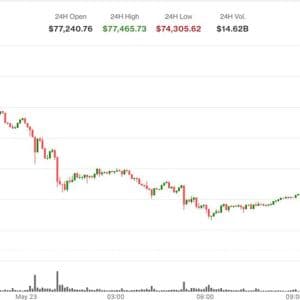
Bitcoin News Bitcoin sank to $74,305 in early Saturday trading, marking its lowest print since April 20 and capping a brutal stretch that has shaved roughly 10% off the cryptocurrency from a recent...


