


 Invest ideas
News
22 May 2026, 16:52
Tether Deepens Twenty One Bet, Crypto Funds Bleed $1B, Emmer Backs Clarity Act

Crypto News House Majority Whip Tom Emmer dismissed law enforcement concerns over crypto developer protections in the Clarity Act, calling the objections a "red herring" aimed at slowing the broade...
22 May 2026, 16:50
Michael Saylor: SATA Preferred Stock Emerges as Most Interesting Bitcoin Ecosystem Development

BitcoinWorld Michael Saylor: SATA Preferred Stock Emerges as Most Interesting Bitcoin Ecosystem Development Michael Saylor, founder of Strategy (formerly MicroStrategy), has identified the emergence of SATA preferred stock in the credit market and ASST common stock as the most significant development currently unfolding within the Bitcoin ecosystem. Saylor’s remarks, shared during a recent industry discussion, point to a growing intersection between traditional capital markets and Bitcoin accumulation strategies. What Are SATA and ASST? SATA represents the preferred stock of Strive, a company built around a core mission of accumulating Bitcoin. ASST is its common stock counterpart. The key differentiator for SATA is its dividend structure: it pays a cash dividend every business day, approximately 250 times per year, offering an annualized dividend rate (APR) of 13.00%. This daily payout schedule is unusual in the preferred stock market, where quarterly or semi-annual dividends are standard. The company sells SATA shares to investors to raise cash, which it then uses to purchase additional Bitcoin. This creates a direct pipeline from equity capital markets into Bitcoin accumulation, a model that Saylor has long championed through Strategy’s own treasury operations. Why This Matters for the Bitcoin Ecosystem Saylor’s characterization of SATA as the most interesting issue in the Bitcoin ecosystem signals a shift in how institutional capital may flow into digital assets. Traditional Bitcoin exposure has come through spot ETFs, futures, or direct holdings. SATA and ASST represent a hybrid approach: equity securities that are explicitly tied to a corporate Bitcoin accumulation strategy, with the added incentive of a high-frequency dividend. The 13.00% APR dividend is notably higher than yields available on most traditional preferred stocks or fixed-income instruments. This yield is funded by the company’s operations and capital structure, not by Bitcoin price appreciation directly, though the underlying value of Strive’s Bitcoin holdings remains a factor in the stock’s overall performance. Implications for Institutional and Retail Investors For institutional investors seeking yield within a Bitcoin-aligned framework, SATA offers a structured product that combines equity characteristics with regular cash distributions. Retail investors, meanwhile, gain access to a daily dividend stream that could appeal to those seeking frequent income. However, investors should understand that preferred stock carries different risks than common stock or direct Bitcoin holdings, including potential dilution, dividend suspension risk, and market price volatility tied to both the company’s performance and Bitcoin’s price movements. Saylor’s endorsement adds credibility to the product, given his track record of successfully integrating Bitcoin into corporate treasury strategy. Strategy itself holds billions of dollars in Bitcoin and has used convertible notes and equity offerings to fund its purchases. SATA and ASST appear to follow a similar playbook but with a distinct dividend-focused structure. Conclusion The emergence of SATA and ASST reflects the ongoing maturation of the Bitcoin ecosystem, where traditional financial instruments are being adapted to serve Bitcoin-centric strategies. Michael Saylor’s focus on these securities suggests that the market for Bitcoin-related equity products is expanding beyond simple holdings and ETFs. Investors evaluating these instruments should weigh the dividend yield against the inherent risks of preferred stock and the volatility of the underlying Bitcoin asset. FAQs Q1: What is SATA stock? SATA is the preferred stock of Strive, a company focused on accumulating Bitcoin. It pays a daily cash dividend at an annualized rate of 13.00%. Q2: How does SATA differ from ASST? SATA is preferred stock with a daily dividend, while ASST is common stock. Preferred stock generally has priority over common stock for dividend payments and liquidation but may have limited upside compared to common shares. Q3: Why is Michael Saylor interested in SATA? Saylor views SATA as a significant development because it represents a new way to channel capital market proceeds into Bitcoin accumulation, combining equity financing with a high-frequency dividend structure. This post Michael Saylor: SATA Preferred Stock Emerges as Most Interesting Bitcoin Ecosystem Development first appeared on BitcoinWorld .
22 May 2026, 16:50
Bitcoin Slips Below $77K as Waller Eyes Rate Hike, Pizza Day Stack Worth $777M
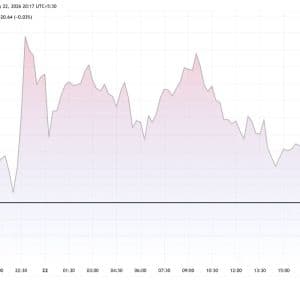
Bitcoin News Bitcoin slipped below $77,000 on Friday after Federal Reserve Governor Christopher Waller delivered a hawkish-leaning speech in Frankfurt titled "Policy Risks Have Changed." Waller, wh...
22 May 2026, 16:49
Bitcoin Unlikely to Hit $100,000 This Year: Kalshi

The possibility of Bitcoin hitting $100,000 before the year runs out has moved from 40% to zero on Kalshi as its traders increasingly turn bearish.
22 May 2026, 16:42
Bitcoin pizza day shows crypto’s global economic evolution today

Laszlo Hanyecz, a programmer, created history on May 22, 2010, when he spent 10,000 Bitcoin on two pizzas. The trade was valued at about $41(market cap under US$1M) at the time. According to Binance , the 10,000 Bitcoins would be valued well over $700m (market cap over US$1.5T) now. In August 2025, when BTC price was at an all-time high of $126k, the coins would be worth more than $1 billion. The amount now represents over 22 days of current issuance, given today’s block subsidy of approximately 450 BTC per day. Major price milestones for Bitcoin have been reached amid dwindling new supply. At Pizza Day, roughly 14% of the total BTC supply had been mined. By the time BTC first traded above US$100 in 2013, this had risen to around 53%. According to Binance, nearly 80% had been mined by US$10K in November 2017, and over 94% by US$100K in December 2024. This illustrates how Bitcoin’s issuance schedule is structurally diminishing. The supply curve flattens with each halving as daily issuance declines from 7,200 BTC per day during the Pizza Day era to 450 BTC presently and 225 BTC following the anticipated April 2028 halving. The remaining mineable Bitcoin represents a diminishing source of fresh supply versus any future growth in demand, since more than 94% of the total supply is currently in circulation. Bitcoin Pizza Day shows global Bitcoin purchasing power after 16 years To mark Bitcoin Pizza Day 2026, Binance used the initial pizza purchase as a lens to analyze the current crypto economy, highlighting how Bitcoin’s purchasing power has grown across major global cities. The comparison highlights how digital assets now interact with real estate, mobility, and daily consumption at scale, from Mumbai and Dubai to New York, London, and Tokyo . Binance said that 10,000 BTC in Mumbai could purchase tens of millions of cups of chai and extensive access to commuter rail systems with thousands of years of journeys. The coins could also have major commercial real estate space in the city’s business districts, In Dubai, the same sum could buy more than 12 million shawarmas, hundreds of luxury desert adventures, and dozens of ultra-luxury Palm Jumeira Villas. The 10,000 BTC could purchase approximately 22 million slices of pizza, over 3,000 of Manhattan studio apartments, and enough subway rides to circle the city for generations. In London, the same sum could purchase over 8 million pints at London pubs, several Premier League hospitality boxes for every match of the season, and purchase entire rows of townhouses in some boroughs. Binance further said that the coins could buy millions of sushi plates in Tokyo, purchase thousands of high-speed rail journeys across Japan, and could also purchase entire floors in some central Tokyo apartment buildings. Institutional adoption drives Bitcoin’s shift toward global infrastructure Beyond the illustrative analogies, the larger message is that Bitcoin has shifted from novelty to infrastructure. Adoption patterns are increasingly influenced by both institutional involvement and grassroots usage in both established and emerging nations as digital assets continue to become integrated into payments, investment, and remittance flows. SB Seker, Head of APAC at Binance, emphasized this evolution, noting, “Bitcoin Pizza Day has become one of crypto’s most celebrated traditions because it captures something essential: innovation happens when someone is willing to try something new, even if it seems impractical at the time. In 2010, Laszlo Hanyecz used Bitcoin to buy pizza because he believed digital currency should have use cases, not just sit in a wallet. Today, we are seeing that vision materialize at scale. Stablecoins are processing trillions in monthly volume, and users in markets like India are discovering crypto’s practical applications-from everyday transactions to wealth creation and preservation. Bitcoin Pizza Day celebrates the moment crypto moved from theory to practice, and reminds us that the real work is making that utility accessible to everyone.” Binance said that institutions hold about 3.88 million BTC, or 18.5% of the 21 million hard cap. Strategy alone accounts for ~844K BTC, or 4% of total BTC, while public corporations narrowly lead all categories at ~1.24M BTC (5.9%). ETFs trail closely behind with ~1.32M BTC (6.3%), with BlackRock’s IBIT leading at ~811K BTC. An additional ~650K BTC (3.1%) is held by governments. The crypto exchange explained that, excluding DeFi and other protocol holdings, pure institutional ownership is approximately 3.5 million BTC, or about one in six BTC. The adoption route is evolving. This is the first cycle in which the marginal buyer is an institution rather than a retailer. Approximately 1.24 million BTC (~US$95.7 billion NAV, ~5.9% of the circulating supply) are now held by 197 listed corporations. In the last 12 months alone, about half of that corporate accumulation occurred.
22 May 2026, 16:30
Bitcoin Bull Run ‘Not There Yet,’ Warns CryptoQuant Founder

The founder of on-chain analytics firm CryptoQuant has highlighted how the signals related to a Bitcoin bull run haven’t switched on yet. Bitcoin Bull Score Index Is Still Inside The Neutral Territory In a new post on X, CryptoQuant founder Ki Young Ju has shared the latest trend in the Bull Score Index for Bitcoin. This on-chain metric combines the data of several different indicators to give a single score for the network. Related Reading: XRP Declines 8%, But Whales Scoop Up 71 Million Tokens More specifically, the index makes use of ten metrics. Some of the popular ones part of it include the MVRV Z-Score, Trader Realized Price, and Stablecoin Liquidity. The Bull Score Index calculates its value in a simple manner: it counts up the number of metrics flashing a bullish signal for the cryptocurrency and multiplies the total by 10. When the indicator has a value greater than 60, it means more than six metrics are pointing to positive market conditions. Such a trend implies BTC may be in a bullish market phase. On the other hand, the index being lower than 40 suggests the majority of the indicators are bearish toward the asset. Now, here is the chart shared by Young Ju that shows how the trend in the Bitcoin Bull Score Index has fluctuated over the last few years: As displayed in the above graph, the Bitcoin Bull Score Index spent its days inside the red territory during Q4 2025 and Q1 2026. This means that the market was in a bearish phase from the perspective of this index. Recently, however, the recovery surge has meant that the indicator has experienced some days inside the neutral zone, corresponding to values between 40 and 60. The shift in the metric’s trend, though, may not correspond to the return of a bullish wave yet. “Once the real Bitcoin bull run begins, all signals will be very clear,” noted the analyst. “We are not there yet.” It now remains to be seen how long it will be before the Bull Score Index turns green for the cryptocurrency. In some other news, the Bitcoin supply held by the long-term holders (LTHs) has broken out of a downtrend recently, as analyst James Van Straten has highlighted in an X post. The LTHs refer to the BTC investors holding for more than 155 days ago. This cohort is considered to correspond to the diamond hands of the market. Related Reading: Bitcoin $78,000 Rebound Fizzles As Coinbase Premium Stays Red As the chart below shows, the total holdings of these investors have shot up recently. The latest surge in the Bitcoin LTH supply could mark the end of a 2.5-year long consolidation phase for the metric. “This cohort controls the market and this is why the four year cycle is over,” said the analyst. BTC Price At the time of writing, Bitcoin is floating around $77,300, down more than 4% in the past week. Featured image from Dall-E, chart from TradingView.com


