


 Invest ideas
News
25 Mar 2026, 15:05
Ethereum’s SuperTrend Turns Bullish But $2,400 Remains a Major Obstacle

Ethereum’s SuperTrend indicator turned bullish after months in a bearish phase. Bulls and bears remain divided over the significance of resistance and low trading volume. Continue Reading: Ethereum’s SuperTrend Turns Bullish But $2,400 Remains a Major Obstacle The post Ethereum’s SuperTrend Turns Bullish But $2,400 Remains a Major Obstacle appeared first on COINTURK NEWS .
25 Mar 2026, 15:05
Black Swan Capitalist to XRP Holders: 99% of People Have No Idea What’s Coming

Financial systems rarely transform in public view. They evolve quietly, layer by layer, until a tipping point forces the world to take notice. While most market participants focus on price charts and headlines, bigger structural changes often unfold unnoticed, shaping the next phase of global finance long before it becomes obvious. Versan Aljarrah, founder of Black Swan Capitalist, has reignited this perspective, warning that the vast majority of people remain unaware of what is developing beneath the surface. His message reflects a growing belief among XRP proponents that a fundamental shift in financial infrastructure is already underway, even if public understanding has yet to catch up. The Disconnect Between Perception and Reality Aljarrah emphasizes a critical gap between what people see and what actually matters. Many investors still rely on headlines, regulatory updates, and short-term price action to measure progress. These signals influence sentiment, but they rarely capture the full scope of systemic change. The truth is 99% of people have no idea what’s coming. They’re still measuring strength through headlines while the system underneath them is shifting. The illusion is easier to defend than reality. That’s why most won’t see it until it’s too late — Versan Aljarrah – Black Swan Capitalist (@VersanAljarrah) March 24, 2026 Behind the scenes, financial institutions continue to explore blockchain integration, tokenization, and real-time settlement systems. These developments often progress quietly through pilot programs, partnerships, and internal testing. As a result, the broader market underestimates both the pace and significance of these changes. XRP and the Infrastructure Narrative Within this evolving landscape, XRP supporters highlight the asset’s utility in cross-border payments and liquidity management . The XRP Ledger enables fast, low-cost value transfer, which positions it as a candidate for bridging fragmented financial systems. Aljarrah’s viewpoint aligns with this narrative. He suggests that once underlying infrastructure shifts reach maturity, assets tied to real utility could gain recognition rapidly. However, adoption remains gradual and depends on regulatory clarity, institutional trust, and seamless integration with existing financial networks. Why Most People Miss Early Signals Market participants often resist ideas that challenge established systems. Familiar frameworks provide comfort, even when they no longer reflect reality. Aljarrah argues that many individuals defend the “illusion” of stability rather than confront emerging change. We are on X, follow us to connect with us :- @TimesTabloid1 — TimesTabloid (@TimesTabloid1) June 15, 2025 This pattern has repeated across history. Early stages of technological and financial revolutions often face skepticism. By the time consensus forms, early positioning advantages tend to shrink or disappear entirely. Balancing Conviction With Evidence While Aljarrah’s warning captures attention, measurable progress remains the ultimate benchmark. XRP’s long-term trajectory will depend on real adoption , sustained development, and clear use cases within global finance. Markets require proof, not just belief. At the same time, his message underscores a key principle. Structural transformations rarely align with public awareness in real time. Those who identify shifts early often act before validation becomes obvious. The current moment reflects that tension. The system may indeed be evolving beneath the surface, but confirmation will emerge only as infrastructure, adoption, and market behavior converge. Disclaimer : This content is meant to inform and should not be considered financial advice. The views expressed in this article may include the author’s personal opinions and do not represent Times Tabloid’s opinion. Readers are urged to do in-depth research before making any investment decisions. Any action taken by the reader is strictly at their own risk. Times Tabloid is not responsible for any financial losses. Follow us on Twitter , Facebook , Telegram , and Google News The post Black Swan Capitalist to XRP Holders: 99% of People Have No Idea What’s Coming appeared first on Times Tabloid .
25 Mar 2026, 15:05
Shiba Inu (SHIB) Volume Falls 20%, Liquidity Crunch Coming?
Shiba Inu has recorded a positive shift in price action, but volume on exchanges remains low in the short term.
25 Mar 2026, 15:00
Bitcoin holds $71K – But $800 mln in liquidations tell a bigger story

Bitcoin holds $70K after a massive liquidation reset. However, weak whale support casts doubt on the rally’s strength.
25 Mar 2026, 15:00
Ethereum Staking Ratio Hits Record 31.4% As Exchange Supply Crashes To 2016 Lows
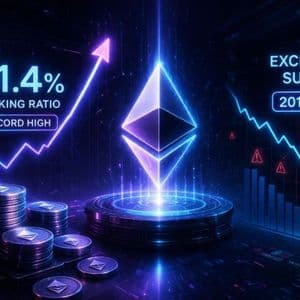
Ethereum is trading below $2,200. The market is volatile. And yet, quietly, the structural case for ETH has never looked more constrained on the supply side. A new CryptoQuant report reveals that 38.31 million ETH — roughly 31.4% of the total supply — is now locked in staking, an all-time high. That is not a footnote. It is the most significant supply development in Ethereum’s recent history, and the price has not caught up to it yet. Related Reading: Bitcoin Structure Has Changed: UTXO Data Challenges Traditional Cycle Narratives The data is unambiguous: the ETH 2.0 Staking Rate indicator just recorded its highest reading ever, meaning nearly one in three Ether in existence is off the market, unavailable for immediate sale, and contributing nothing to exchange liquidity. Simultaneously, the circulating supply of Ethereum on Binance has fallen to its lowest level since 2020 — a parallel compression that tightens the market from two directions at once. The analysis reveals a market hollowing out from the inside. Sellers have less to sell. Buyers face a thinner book. And volatility, for now, is masking a structural shift that the price has yet to fully price in. A Market Being Drained From Both Ends The report makes the consequence plain: nearly one third of all Ethereum in existence is no longer available for immediate sale. That is not a temporary dislocation. It is the cumulative result of a sustained behavioral shift — investors moving capital out of active trading and into long-term staking, with no indication of reversal. The exchange data sharpens the picture further. Ethereum’s circulating supply on exchanges has fallen to its lowest level since 2016. Not since last cycle. Not since the last correction. Since 2016, a figure that reframes the entire conversation about where this market stands structurally. What that number means in practice is straightforward: the book is thin. When available supply contracts to historic lows, the market loses its buffer. Modest buying pressure — the kind that would barely register in a liquid market — becomes capable of triggering outsized price moves. The mechanism for a supply shock is not theoretical. It is already assembled. Selling pressure is declining because sellers are becoming holders. Holders are becoming stakers. And stakers, by definition, are not selling. The market is not just tightening. It is being restructured in real time. Related Reading: Ethereum Price Divergence Signals Weak US Buying Pressure: Coinbase Premium Stays Negative The Chart Tells a Harder Story Ethereum is currently trading at $2,180, up 6.16% on the week but still navigating one of the more structurally precarious positions it has occupied since the 2022 bear market. The weekly candle opened at $2,053, tapped a high of $2,198, and has not yet reclaimed it — a detail that matters. The longer context is sobering. After peaking near $4,800 in early 2025, ETH has retraced more than 50% over roughly twelve months. The current price sits below all three major moving averages visible on the chart — the short-term blue, the mid-term green, and the long-term red — an alignment that technically defines a market still in distribution, not accumulation. Related Reading: Bitmine Locks 68% of Ethereum Holdings As Staking Position Surpasses $6.75B What the chart also shows is where support has historically lived. The $2,000 level has acted as a structural floor across multiple cycles, and last week’s wick to $1,700 — which was bought aggressively, as the volume spike confirms — suggests that floor is being defended. For now. The critical question is not whether $2,180 holds. It is whether ETH can reclaim $2,500 and put distance between itself and those moving averages. Until it does, every rally is a test, not a trend. Featured image from ChatGPT, chart from TradingView.com
25 Mar 2026, 15:00
Gold Price Recovery Surges as Oil Retreats on Crucial US-Iran Ceasefire Hopes

BitcoinWorld Gold Price Recovery Surges as Oil Retreats on Crucial US-Iran Ceasefire Hopes Global commodity markets witnessed a significant divergence on Tuesday, March 18, 2025, as gold extended its recovery rally while crude oil prices pulled back sharply. This pivotal shift stems directly from emerging diplomatic hopes for a ceasefire between the United States and Iran. Consequently, traders are rapidly reassessing their positions across major asset classes. Gold Price Recovery Gains Momentum Gold futures for April delivery climbed decisively, building on gains established earlier in the week. The precious metal found strong support above the $2,150 per ounce level. Market analysts attribute this resilience to several concurrent factors. First, the potential de-escalation in the Middle East reduces immediate safe-haven demand for the US dollar. Second, it reinforces expectations for a less aggressive Federal Reserve monetary policy stance. Historically, gold performs well in environments where real interest rates stabilize or decline. Furthermore, physical demand from central banks continues to provide a structural floor for prices. According to recent World Gold Council data, official sector purchases remained robust throughout the first quarter. This institutional buying offsets periods of weaker retail investment flows. The technical chart structure also turned supportive, with gold breaking above its 50-day moving average. This signals a potential shift in short-term momentum. Oil Price Pullback Reflects Geopolitical Shifts Conversely, Brent crude futures retreated by over 3% in European trading hours. The benchmark dropped below the $82 per barrel mark. This decline directly correlates with reports of constructive dialogue between US and Iranian envoys. A potential ceasefire would significantly reduce the geopolitical risk premium embedded in oil prices. That premium had inflated values by an estimated $8-$12 per barrel since tensions escalated last quarter. The market is now pricing in a higher probability of uninterrupted supply from the Strait of Hormuz. This critical chokepoint handles about 20% of global oil consumption. Additionally, traders are monitoring US inventory data. The Energy Information Administration reported a larger-than-expected build in crude stocks last week. This indicates adequate near-term supply, further easing price pressures. Expert Analysis on Market Dynamics Dr. Anya Sharma, Chief Commodity Strategist at Global Markets Insight, provided context. “We are observing a classic risk-rebalancing act,” she explained. “The gold rally is not merely a safe-haven play. It’s a recalibration against a potentially weaker dollar and lower real yields if tensions ease. The oil sell-off, meanwhile, is a direct unwind of war-risk pricing.” Sharma emphasized that fundamental supply-demand factors would reassert dominance if a ceasefire materializes. Market sentiment data supports this view. The CFTC’s Commitments of Traders report shows money managers reduced net-long positions in oil futures last week. Simultaneously, they increased exposure to gold. This positioning shift preceded the latest diplomatic headlines, suggesting some investors anticipated a de-escalation. Historical Context and Comparative Performance The inverse relationship between gold and oil during geopolitical events has historical precedent. During the 2015 Iran nuclear deal negotiations, similar patterns emerged. Gold initially strengthened as the dollar softened on diplomatic progress, while oil prices corrected. The table below illustrates key commodity movements during past diplomatic breakthroughs: Event Gold (30-day change) Oil (30-day change) 2015 Iran Deal Announcement +4.2% -9.8% 2020 US-China Phase One Deal +3.1% -5.5% Current Move (5-day) +2.8% -3.5% Several critical differences exist in the current environment. Global inflation rates are more elevated, altering the real value dynamics of commodities. Additionally, the strategic petroleum reserves of major consuming nations are at lower levels than in previous periods. This could limit the downside for oil despite diplomatic progress. Broader Market Impacts and Sector Rotation The commodity divergence triggered noticeable sector rotation in equity markets. The S&P 500 energy sector underperformed, while materials and mining stocks outperformed. This rotation reflects changing expectations for input costs and profit margins across industries. Airlines and transportation companies saw immediate gains from lower fuel cost projections. Conversely, gold mining ETFs recorded significant inflows. Currency markets also reacted. The US Dollar Index (DXY) edged lower, providing an additional tailwind for dollar-denominated gold. Emerging market currencies, particularly those of oil-importing nations, strengthened. The Indian rupee and Turkish lira both gained ground. This improves purchasing power for physical gold in key consumer markets. Monitoring the Diplomatic Front The core driver remains the fragile diplomatic process. Statements from both US and Iranian officials have been cautiously optimistic but lack concrete details. Key elements under discussion reportedly include: Nuclear program limitations and verification mechanisms. Regional security guarantees for Gulf Cooperation Council states. Sanctions relief timelines and economic normalization steps. Any breakdown in talks would likely trigger an immediate and violent reversal in the day’s commodity trends. Analysts warn that markets have priced in a high probability of success. Therefore, the risk of a “sell the fact” reaction exists even if an agreement is reached. Conclusion The ongoing gold price recovery alongside the oil price pullback presents a clear narrative of shifting geopolitical winds. Markets are actively discounting a reduction in Middle East conflict risk, as seen in the reaction to US-Iran ceasefire hopes. This dynamic highlights the deep interconnection between diplomacy and global commodity flows. Investors should monitor diplomatic developments closely, as they will dictate the sustainability of these nascent trends. The coming sessions will test whether this divergence marks a lasting regime shift or a temporary headline-driven fluctuation. FAQs Q1: Why does gold rise when geopolitical tensions ease? Gold’s rise in this context is less about safe-haven demand and more about currency and interest rate expectations. Easing tensions can weaken the US dollar and lower expectations for aggressive central bank policy, both of which are supportive for gold prices. Q2: How much of the oil price was due to a ‘risk premium’ from US-Iran tensions? Analysts estimate the geopolitical risk premium added $8 to $12 to the price of a barrel of Brent crude over recent months. This premium reflects the market’s compensation for the risk of supply disruption. Q3: Could the gold rally continue if a ceasefire is officially announced? Potentially, but the initial reaction might be volatile. The rally’s continuation would then depend more on subsequent Federal Reserve policy signals, dollar strength, and real bond yields, rather than the geopolitical news itself. Q4: What other commodities are affected by US-Iran relations? Natural gas prices, particularly in Europe and Asia, are sensitive to Middle East stability. Shipping and freight rates are also impacted, as tensions affect insurance costs and route safety in key waterways like the Strait of Hormuz. Q5: How do ceasefire hopes impact energy company stocks versus gold mining stocks? Typically, energy sector stocks face headwinds from falling oil prices, which can hurt profitability. Gold mining stocks often benefit from higher gold prices and lower energy input costs, creating a potential double tailwind. This post Gold Price Recovery Surges as Oil Retreats on Crucial US-Iran Ceasefire Hopes first appeared on BitcoinWorld .


