


 Invest ideas
News
25 Mar 2026, 13:05
Developer: If You’re An XRP Holder, Understand This Clearly

Crypto markets reward more than speculation. They reward activity, participation, and real usage. Behind every major price surge lies a network that people actively use—where developers build, users transact, and liquidity flows consistently. Without that foundation, even the strongest narratives struggle to sustain momentum. This reality drives a growing conversation within the XRP ecosystem. Developer Bird recently reinforced this perspective, urging holders to rethink their role in the network. He argues that long-term growth depends not just on holding XRP, but on actively engaging with the XRP Ledger itself. Utility Has Always Driven Price Expansion Blockchain history supports Bird’s position. Networks like Ethereum and Solana gained traction during periods of intense on-chain activity. Users traded NFTs, launched memecoins, interacted with decentralized applications, and created constant demand for block space. As activity increased, native token prices followed. The XRP Ledger has shown similar signals during past bursts of engagement. In late 2024, rising activity across NFTs and emerging applications brought renewed attention to the ecosystem. While the momentum did not immediately translate into a sustained rally, it demonstrated a clear relationship between usage and market interest. If you’re an XRP holder, understand this clearly. Every chain that has exploded in price had the same thing first > memes flying, NFTs trading, dApps active, people actually using the ecosystem. When the chain is busy, the native token runs. It’s been proven over and over, and… — Bird (@Bird_XRPL) March 24, 2026 The XRP Ledger Is Evolving Beyond Payments The XRP Ledger no longer operates as a single-purpose network. Developers have expanded their capabilities with features such as automated market makers, NFT standards, and improved tokenization tools. These upgrades allow users to trade, mint assets, and interact with decentralized liquidity directly on-chain. This evolution matters because it transforms XRPL into a multi-functional ecosystem. A broader range of use cases attracts more developers, which in turn brings more users. Each layer of activity strengthens the network’s overall value proposition. Holding Alone Does Not Build an Ecosystem Bird’s central argument challenges a long-standing habit among XRP investors. Passive holding does not generate network growth. Users must actively transact, explore applications, and participate in on-chain activity to drive meaningful expansion. We are on X, follow us to connect with us :- @TimesTabloid1 — TimesTabloid (@TimesTabloid1) June 15, 2025 When users engage with the network, they create transaction volume and validate real-world utility. That activity deepens liquidity and reinforces network effects. Over time, these factors can translate into stronger demand for XRP itself. A Shift in the XRP Growth Narrative The XRP community has traditionally focused on institutional adoption and global payment infrastructure. That narrative remains relevant, but the ecosystem now requires a complementary layer of grassroots participation. Retail users, developers, and builders play a critical role in this phase. Their activity creates immediate demand and keeps the network dynamic. Combined with institutional use cases, this dual approach offers a more balanced path to growth. Bird’s message reframes what it means to be an XRP holder. Participation now matters as much as conviction. If more users embrace this shift, the XRP Ledger could strengthen its position—not just as a payments network, but as a fully active blockchain ecosystem capable of supporting sustained price expansion. Disclaimer : This content is meant to inform and should not be considered financial advice. The views expressed in this article may include the author’s personal opinions and do not represent Times Tabloid’s opinion. Readers are urged to do in-depth research before making any investment decisions. Any action taken by the reader is strictly at their own risk. Times Tabloid is not responsible for any financial losses. Follow us on Twitter , Facebook , Telegram , and Google News The post Developer: If You’re An XRP Holder, Understand This Clearly appeared first on Times Tabloid .
25 Mar 2026, 13:05
GBP/USD Analysis: How Stubborn UK Inflation Forces Bank of England’s Crucial Policy Premium

BitcoinWorld GBP/USD Analysis: How Stubborn UK Inflation Forces Bank of England’s Crucial Policy Premium LONDON, March 2025 – Persistent inflationary pressures in the United Kingdom continue to shape monetary policy divergence between the Bank of England and Federal Reserve, creating sustained premium conditions for the British pound against the US dollar. Recent data reveals that UK inflation remains stubbornly above the central bank’s 2% target, forcing policymakers to maintain restrictive interest rate settings despite global easing trends. Consequently, the GBP/USD currency pair reflects this fundamental divergence through its exchange rate movements and volatility patterns. GBP/USD Exchange Rate Dynamics and Inflation Pressure Currency analysts at Brown Brothers Harriman (BBH) highlight the direct relationship between UK inflation persistence and GBP valuation. Specifically, the research firm notes that core inflation metrics excluding volatile food and energy components remain elevated at 3.2% year-over-year. This persistent price pressure prevents the Bank of England from joining other major central banks in aggressive rate-cutting cycles. Meanwhile, the Federal Reserve has already implemented two 25-basis-point reductions in 2025, responding to more controlled US inflation readings around 2.4%. The resulting interest rate differential creates what markets term a “policy premium” for sterling. Essentially, investors demand higher yields to hold pound-denominated assets compared to dollar equivalents. This premium manifests in forward rate agreements and currency swap markets, where the implied yield difference between UK and US government bonds remains approximately 75 basis points. Furthermore, this spread has proven remarkably resilient despite political uncertainty and growth concerns, demonstrating inflation’s dominant role in currency valuation. Bank of England’s Monetary Policy Dilemma The Monetary Policy Committee faces significant challenges balancing inflation control against economic growth concerns. Recent meeting minutes reveal intense debate about the appropriate timing for policy normalization. Committee members cite several persistent inflation drivers including strong wage growth at 4.8%, services inflation hovering near 6%, and housing costs that continue to rise despite broader economic cooling. These factors collectively sustain what economists call “inflation stickiness” – the tendency for price increases to persist even after initial triggers subside. Comparative analysis with other major economies reveals the UK’s unique position. The European Central Bank has reduced rates by 100 basis points since December 2024, while the Bank of Japan maintains ultra-accommodative settings. This global policy divergence amplifies the Bank of England’s relative hawkishness, creating what BBH analysts describe as a “monetary policy island” effect. The table below illustrates key differentials: Central Bank Current Policy Rate 2025 Change Inflation Rate Bank of England 4.75% -25 bps 3.4% Federal Reserve 4.25% -50 bps 2.4% European Central Bank 3.00% -100 bps 2.1% Structural Factors Behind UK Inflation Persistence Multiple structural elements contribute to Britain’s inflation challenge. First, Brexit-related trade frictions continue to elevate import costs, particularly for food and manufactured goods. Second, tight labor market conditions sustain wage pressures, with unemployment remaining near historic lows at 4.1%. Third, energy transition costs and climate policies add regulatory expenses that businesses pass through to consumers. Finally, housing supply constraints keep shelter costs elevated despite moderating demand. These factors collectively create what economists term “second-round effects” – where initial price increases trigger wage demands that fuel further inflation. The Bank of England must break this cycle through restrictive policy, but faces political pressure as higher interest rates increase mortgage costs for millions of homeowners. This delicate balancing act explains why policymakers proceed cautiously, maintaining higher rates longer than initially anticipated. Market Implications for Currency Traders Foreign exchange markets price this policy divergence through several mechanisms. The most direct impact appears in carry trade dynamics , where investors borrow in low-yield currencies to invest in higher-yielding alternatives. Currently, the GBP/USD pair offers one of the most attractive developed market carry opportunities, supporting sterling demand despite economic headwinds. Additionally, options markets show increased demand for pound calls versus dollar calls, reflecting expectations for continued relative strength. Technical analysis reveals important support and resistance levels. The GBP/USD pair has established a trading range between 1.2800 and 1.3200 throughout early 2025, with the 200-day moving average providing dynamic support around 1.2950. Key resistance emerges at the psychological 1.3200 level, which corresponds to the 2024 high. Market participants monitor several critical indicators: Interest rate expectations derived from SONIA futures Inflation swap rates indicating market inflation forecasts Real yield differentials between UK and US inflation-linked bonds Positioning data from CFTC commitment of traders reports These metrics collectively suggest sustained but cautious bullish sentiment toward sterling. However, analysts warn that the premium remains vulnerable to sudden shifts in inflation data or unexpected policy changes. Any evidence of accelerating US inflation or decelerating UK inflation could quickly reverse the current dynamic. Historical Context and Future Projections The current situation echoes previous periods of policy divergence. During the 2014-2015 cycle, the Federal Reserve tapered quantitative easing while the Bank of England maintained accommodative policy, creating dollar strength. The reverse dynamic now prevails, with the UK central bank maintaining tighter conditions. Historical analysis suggests such divergences typically persist for 12-18 months before convergence occurs, implying the current premium could extend through mid-2026. Forward-looking indicators provide mixed signals. Survey data shows business inflation expectations moderating gradually, while consumer expectations remain elevated. The Bank of England’s own forecasts project inflation returning to target by late 2026, suggesting a prolonged normalization process. Meanwhile, the Federal Reserve’s dot plot indicates further easing ahead, potentially widening the policy gap before eventual convergence. Global Economic Interconnections The UK’s inflation challenge exists within broader global patterns. Many developed economies face similar structural pressures including demographic shifts, deglobalization trends, and climate transition costs. However, Britain experiences amplified effects due to specific domestic factors including: Higher energy dependence than European neighbors More services-intensive economy with labor-driven inflation Post-Brexit regulatory divergence increasing trade costs Constrained housing supply exacerbating shelter inflation These unique characteristics explain why UK inflation proves more persistent than in comparable economies. Consequently, the Bank of England maintains its policy premium despite external pressure to align with global easing trends. Conclusion The GBP/USD exchange rate continues to reflect fundamental monetary policy divergence driven by persistent UK inflation. Analysis confirms that the Bank of England’s premium remains structurally supported by inflation dynamics that differ significantly from US patterns. While currency markets price this divergence through yield spreads and positioning, the premium faces ongoing tests from economic data releases and central bank communications. Ultimately, the GBP/USD trajectory depends on inflation convergence between the two economies, a process likely extending through 2026 based on current projections. FAQs Q1: What exactly is the “BoE premium” mentioned in currency analysis? The Bank of England premium refers to the additional yield investors receive for holding pound-denominated assets compared to similar dollar assets. This premium exists because UK interest rates remain higher than US rates due to persistent inflation, making sterling investments more attractive through carry trade dynamics. Q2: How does UK inflation directly impact GBP/USD exchange rates? Higher UK inflation forces the Bank of England to maintain elevated interest rates to control price growth. These higher rates attract foreign capital seeking better returns, increasing demand for pounds and supporting the GBP/USD exchange rate through fundamental yield differentials. Q3: Why is UK inflation more persistent than in other developed economies? Multiple structural factors contribute including Brexit-related trade costs, tight labor markets sustaining wage growth, energy transition expenses, and housing supply constraints. These elements create “second-round effects” where initial price increases trigger further inflationary pressures through wage-price spirals. Q4: What would cause the Bank of England premium to disappear? The premium would diminish if UK inflation converges toward the 2% target, allowing rate cuts, or if US inflation accelerates, forcing Federal Reserve rate hikes. Either scenario would reduce the interest rate differential that currently supports sterling’s relative strength against the dollar. Q5: How do currency traders typically position for sustained policy divergence? Traders employ carry trade strategies, buying high-yielding pounds while selling lower-yielding dollars. They also use options structures like risk reversals to express directional views while managing volatility exposure. Many institutions maintain long GBP positions in multi-asset portfolios to capture the yield advantage. This post GBP/USD Analysis: How Stubborn UK Inflation Forces Bank of England’s Crucial Policy Premium first appeared on BitcoinWorld .
25 Mar 2026, 13:03
XRP Price Prediction: Rare Calm Emerges as Binance Volatility Falls to 2026 Lows

XRP Coils at $1.40 as Volatility Hits Lows and Institutional Demand Builds for a Breakout XRP is entering a phase that often precedes its most decisive moves, quiet, compressed, and easy to overlook. After a powerful rally earlier this year, the asset has shifted into a controlled consolidation between $1.30 and $1.45, currently trading at $1.43 per CoinCodex data. Well, this isn’t a sign of weakness, it’s a measured cooldown following expansion. The $1.40 level is proving to be a critical pivot, with consistent buyer demand absorbing sell pressure and reinforcing the market’s underlying strength. What stands out in this setup is the steep collapse in volatility. As market analyst Xaif Crypto notes, XRP’s 30-day realized volatility has dropped to roughly 0.52, with a Z-score of -0.90, both pointing to a clear compression phase. In practical terms, the market is tightly coiled, and history shows these quiet periods rarely last before a decisive move. XRP Coils Below $1.50 as Institutional Backing Builds—A Breakout May Be Imminent The next key move hinges on $1.50. A decisive breakout there could drive a push toward $1.80, a level that previously capped gains. On the downside, a drop below $1.40 risks prolonging the current consolidation and postponing any bullish momentum. For now, the structure remains solid, price action reflects a market pausing after a strong run, not one rolling over. Beyond the charts, there’s a broader narrative quietly strengthening XRP’s position. A recent report from the Bank for International Settlements places XRP among the top five crypto assets held by banks, a notable shift that underscores its growing role within the institutional financial system. This isn’t fringe activity anymore since it’s a sign that XRP is steadily integrating into mainstream finance. Pair that with the current phase of tight technical compression, and the setup becomes hard to ignore. Markets rarely stay quiet under these conditions for long. Direction in the short term may still be uncertain, but the bigger picture is clear that pressure is building, and a breakout is approaching, one that’s unlikely to go unnoticed. Conclusion XRP is less about uncertainty right now and more about timing. Price is tightly compressed, key support is holding, and volatility has eased to levels that don’t tend to last. With structure intact and institutional interest steadily building, the asset is edging closer to a turning point. The next decisive move will likely hinge on how price behaves around the $1.40–$1.50 zone, whether it breaks higher or continues to consolidate. Either way, this phase of calm is unlikely to persist for long.
25 Mar 2026, 13:03
120 Billion SHIB: Unknown Whale Aggressively Expands Shiba Inu Portfolio; Trader Who Predicted 700% XRP Boom Breaks Down Bitcoin Price Situation; Jim Cramer Que...
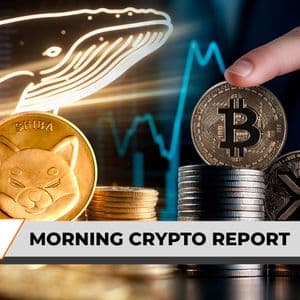
This morning in crypto: Whale buys 120 billion SHIB as "smart money" pounces! Plus, DonAlt's "all or nothing" Bitcoin outlook and Jim Cramer's controversial crypto crisis take.
25 Mar 2026, 13:01
Cardano Price Prediction: ADA Eyeing Further Gains After Climbing Above Key EMA

Cardano climbed above a key moving average as buying strength improved. Can ADA surge further? Visit Website
25 Mar 2026, 13:00
Bitcoin’s bottom in sight? Why Bernstein still expects $150K BTC rally

Short-term momentum builds, but long-term resistance holds firm, so is Bitcoin gearing up for a breakout or another pullback?


