


 Invest ideas
News
24 Mar 2026, 15:31
Bitcoin ETFs Have Recorded $2.5B Inflows in March, on Track to Recover 2026 Losses

Bitcoin ETFs have witnessed nearly $2.5 billion worth of capital inflows in March alone, as they embark on a campaign to recover the losses of 2026. The ongoing market-wide turbulence has impacted both the Bitcoin (BTC) price and ETF performance. Visit Website
24 Mar 2026, 15:25
XRP Takes a Breather: Why the $1.40 Zone Could Decide the Next Big Move

XRP Holds the Line at $1.40 as Pullback Signals Healthy Consolidation, Not Breakdown According to market analyst Vlad Anderson, XRP’s current pullback appears to be a healthy cooling phase rather than a structural breakdown. After breaking out decisively above the $1.40–$1.45 range, price briefly peaked around $1.465 before easing into a controlled correction. Despite slipping below some short-term Fibonacci levels, XRP continues to hold above the $1.40 mark and remains supported by the 100-hour moving average. This positioning is significant, staying above both a key psychological level and a major moving average suggests the broader trend is still intact. Rather than signaling weakness, the price action points to consolidation following a strong expansion phase, with the market seemingly pausing before its next decisive move. Well, on-chain signals continue to support the bullish case for XRP. Despite ongoing short-term volatility, longer-term accumulation trends remain steady, suggesting underlying strength in market positioning. Some analysts argue that valuations once considered out of reach are gradually becoming more realistic as liquidity conditions and adoption evolve. In that broader context, a move toward $27 is not seen as a short-term projection, but rather a reflection of XRP’s potential across multiple market cycles, assuming sustained growth in usage and favorable macro liquidity dynamics. XRP Coils at $1.40: Breakout Above $1.425 or Breakdown Ahead? Stablecoin developments and shifting liquidity flows are also influencing sentiment. For instance, Evernorth CEO Asheesh Birla believes that the RLUSD stablecoin could improve capital efficiency across the Ripple network, boosting XRP’s utility instead of competing with it. From a technical perspective, the near-term outlook remains level-driven. A reclaim of $1.425 would likely trigger a retest of $1.465. A clean break above that range could open momentum toward $1.50, followed by $1.525 and $1.55, with $1.60 emerging as the next key resistance zone. On the other hand, a break below $1.40 would likely shift momentum and open the door to a deeper correction. In that scenario, immediate support levels are seen at $1.378, $1.355, and $1.32, with $1.30 coming into play if selling pressure accelerates. With XRP hovering around $1.40, data from CoinCodex highlights how tightly the price is currently balanced at a key inflection point. The broader structure still leans neutral-to-bullish, but the next move will hinge on whether buyers can reclaim strength above $1.425 or if bears gain control and drive the price lower. Conclusion XRP’s current structure points to a pause rather than a loss of momentum. As noted by Vlad Anderson, the pullback appears to be a healthy correction after a strong breakout, with price still holding above the $1.40 level and the 100-hour moving average. Therefore, this keeps the broader outlook neutral-to-bullish, as long as buyers continue to defend key support and regain traction above $1.425 in the near term.
24 Mar 2026, 15:23
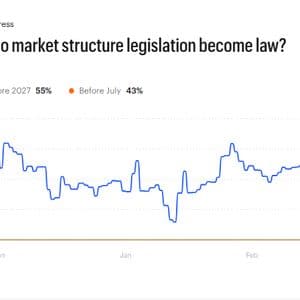
Stablecoin yield deal verdict nears: Will Clarity Act 68% odds pay off?
More on Bitcoin USD Bitcoin Says The War Ends Soon Bitcoin: What's Really Happening Despite The Bear Market Crazy Swings All Across Markets As U.S.-Iran Talks Pick Up: Gold Grazes $4,000, WTI To $90 Bitcoin leads weekly crypto ETF inflows rally; Ethereum shows caution Bitcoin rises as Trump postpones strikes on Iranian power plants
24 Mar 2026, 15:20
BlackRock’s Bold Vision: Chairman Larry Fink Targets $500M Crypto Revenue Surge in Five Years

BitcoinWorld BlackRock’s Bold Vision: Chairman Larry Fink Targets $500M Crypto Revenue Surge in Five Years In a significant declaration that underscores the deepening institutional embrace of digital assets, BlackRock Chairman and CEO Larry Fink has projected the financial giant’s cryptocurrency division will generate approximately $500 million in annual revenue within the next five years. This ambitious forecast, detailed in Fink’s 2026 shareholder letter and reported by Forbes, arrives as BlackRock already manages a staggering $55 billion in Bitcoin for its clients. The firm’s current activity through its iShares Bitcoin Trust (IBIT) ETF yields about $250 million in annual management fees, positioning this goal as a strategic doubling of its crypto-derived income. This projection from the world’s largest asset manager sends a powerful signal about the maturation and financial potential of the cryptocurrency market within traditional finance. BlackRock’s Crypto Revenue Target and Current Footprint Larry Fink’s $500 million annual revenue target represents a clear, quantified ambition for BlackRock’s digital asset operations. Currently, the firm’s crypto revenue stream is substantial, deriving primarily from its pioneering spot Bitcoin ETF. BlackRock’s iShares Bitcoin Trust (IBIT) holds roughly 800,000 BTC on behalf of its clients. This massive position, valued at approximately $55 billion, generates an estimated $250 million in management fee revenue each year. Consequently, Fink’s five-year vision essentially aims to double the firm’s existing crypto earnings. This goal is not merely aspirational but is rooted in the explosive growth trajectory IBIT has demonstrated since its launch. The ETF quickly became one of the most successful fund launches in history, amassing billions in assets under management within months. This established foundation provides a realistic springboard for the projected revenue surge. Furthermore, the target implies confidence in both the continued inflow of institutional capital into Bitcoin and the potential expansion of BlackRock’s crypto product suite beyond a single ETF. The Institutional Context and Market Impact Fink’s statement carries immense weight due to BlackRock’s authoritative position in global finance. As the steward of over $10 trillion in client assets, the firm’s strategic moves are closely analyzed by the entire investment community. His revenue projection is therefore more than a corporate goal; it is a bellwether for institutional sentiment. This announcement validates cryptocurrency as a legitimate, revenue-generating asset class for the world’s most sophisticated financial institutions. The market impact of such validation is multifaceted. Firstly, it encourages other traditional asset managers to accelerate their own crypto offerings, increasing competition and product innovation. Secondly, it provides regulatory comfort, as BlackRock’s involvement is often seen as a stamp of compliance and due diligence. Thirdly, it attracts a broader pool of conservative capital from pensions, endowments, and insurance companies that follow BlackRock’s lead. This institutional influx contributes to market liquidity and stability, potentially reducing the extreme volatility historically associated with crypto markets. Analyzing the Path to $500 Million Reaching the $500 million revenue mark will likely require a multi-pronged strategy beyond simply gathering more Bitcoin ETF assets. Analysts point to several plausible avenues for growth. The most direct path is the continued expansion of IBIT’s market share. However, BlackRock may also develop and launch additional cryptocurrency investment vehicles. Potential products could include a spot Ethereum ETF, following potential regulatory approval, or thematic crypto index funds that offer diversified exposure. Another significant revenue stream could emerge from blockchain technology services for tokenization of traditional assets like stocks, bonds, or real estate. BlackRock has previously expressed strong interest in tokenization, viewing it as the next evolution for capital markets. Revenue could also come from private market offerings, structured products for accredited investors, or integrated crypto services within its Aladdin technology platform. The firm’s vast client network and distribution power provide a unique advantage in scaling any new product rapidly. Historical Shift: Larry Fink’s Evolving Stance on Bitcoin Larry Fink’s current bullish projection marks a dramatic evolution in his public stance on cryptocurrency. For years, Fink and BlackRock were notably cautious, with Fink once expressing skepticism about Bitcoin’s role as an asset class. The transformation began around 2022, as institutional client interest became undeniable. BlackRock’s decisive move to file for a spot Bitcoin ETF in 2023, despite a initially skeptical SEC, signaled a complete strategic pivot. This journey from skeptic to leading advocate mirrors the broader narrative of institutional adoption. Fink now frequently cites Bitcoin’s potential as “digital gold”—a hedge against currency devaluation and inflation. His shareholder letters have progressively highlighted the technological innovation underlying crypto assets, particularly their potential to increase transparency and efficiency in payments and asset management. This historical context makes his $500 million revenue target particularly noteworthy; it is the culmination of a calculated, evidence-based shift in strategy rather than a speculative gamble. Competitive Landscape and Fee Structures BlackRock’s dominance in the spot Bitcoin ETF market is significant but not unchallenged. Competitors like Fidelity, Ark Invest, and Bitwise also manage billions in assets, creating a competitive environment that benefits investors through lower fees. IBIT’s management fee is a critical lever for achieving its revenue target. Currently, the fee is competitively low to attract assets, a classic BlackRock strategy. As the market matures and products become more differentiated, fee structures may evolve. The projected $500 million revenue suggests BlackRock is confident it can maintain or grow its asset base even if fee competition intensifies. The firm’s scale allows it to operate on thinner margins while still generating substantial absolute revenue. A comparison of major ETF providers reveals BlackRock’s commanding lead in net asset inflows since launch, a trend that must continue for the revenue goal to be met. This competition also drives innovation, pushing firms to develop better custody solutions, more educational resources, and tighter integration with traditional portfolio models. Regulatory Considerations and Future Risks The path to $500 million in annual crypto revenue is inextricably linked to the regulatory environment. BlackRock’s strategy operates under the assumption of a stable or increasingly clear regulatory framework in the United States and other key jurisdictions. Positive regulatory developments, such as the approval of spot Ethereum ETFs or clearer rules for crypto custodianship, would accelerate growth. Conversely, regulatory crackdowns or restrictive legislation pose a material risk to the revenue target. BlackRock mitigates this risk through its rigorous compliance approach and active engagement with policymakers. Another consideration is market risk. Cryptocurrency prices are inherently volatile. A prolonged bear market could reduce assets under management and, consequently, fee-based revenue. However, BlackRock’s long-term horizon and focus on annual revenue smoothing out short-term price fluctuations suggest the target is based on structural adoption trends rather than cyclical price peaks. Conclusion Larry Fink’s projection of $500 million in annual crypto revenue for BlackRock within five years is a landmark statement in the convergence of traditional and digital finance. It reflects a profound confidence in the enduring institutional demand for cryptocurrency exposure and BlackRock’s ability to capitalize on it. Building on the formidable foundation of its $55 billion iShares Bitcoin Trust, the firm is poised to expand its digital asset suite and services. This target, set by the world’s preeminent asset manager, validates the crypto asset class as a significant and sustainable revenue center for global finance. Achieving this goal will require continued product innovation, navigating a complex regulatory landscape, and maintaining a competitive edge. Ultimately, BlackRock’s bold crypto revenue vision signals not just corporate ambition, but a broader, irreversible shift in how institutional capital engages with the future of money and assets. FAQs Q1: How much Bitcoin does BlackRock currently manage for its clients? BlackRock currently manages approximately 800,000 Bitcoin on behalf of its clients through the iShares Bitcoin Trust (IBIT) ETF. This holding is valued at about $55 billion based on prevailing market prices. Q2: What is BlackRock’s current annual revenue from its cryptocurrency activities? According to reports, BlackRock’s current cryptocurrency operations, primarily via the IBIT ETF, generate around $250 million in annual management fee revenue. Q3: What is the time frame for Larry Fink’s $500 million crypto revenue target? Larry Fink expects BlackRock’s cryptocurrency division to reach about $500 million in annual revenue within the next five years, as stated in his 2026 shareholder letter. Q4: How does BlackRock generate revenue from its Bitcoin ETF? BlackRock generates revenue from the iShares Bitcoin Trust (IBIT) by charging a management fee, which is a small percentage of the total assets under management in the fund. This fee is collected annually for providing the investment vehicle, custody, and administration services. Q5: Why is Larry Fink’s revenue projection significant for the broader crypto market? As the Chairman and CEO of the world’s largest asset manager, Larry Fink’s projection signals deep institutional validation of cryptocurrency as a serious, revenue-generating asset class. It encourages further institutional adoption, provides regulatory comfort, and highlights the long-term financial potential major firms see in digital assets. This post BlackRock’s Bold Vision: Chairman Larry Fink Targets $500M Crypto Revenue Surge in Five Years first appeared on BitcoinWorld .
24 Mar 2026, 15:16
Dogecoin Price Prediction: Can DOGE Rally 2,500% to $2 or Will It Drop to $0.06?
Dogecoin is drawing sharp attention from the crypto analyst community. The foremost meme coin currently trades at approximately $0.09311, holding below the key psychological level of $0.10. DOGE faces competing forecasts ranging from a historic rally to a potential deeper decline. Crypto analyst Hailey has issued a bold projection . She believes Dogecoin could surge 2,500% to reach $2, based on a repeating historical pattern. Her analysis, shared on X, outlines a staggered target structure: $0.28, $0.50, $1, and ultimately $2. According to her chart, this move could materialize by 2029, coinciding with what many expect to be the peak of the next major bull cycle. Supporting this outlook, analyst CW pointed to a green candle forming at the bottom of a rising channel, a formation he identifies as a historical bottom signal. Analyst TraderSZ echoed that view, arguing DOGE has already bottomed at current levels. His projections place the meme coin at $0.80 by next year, which he describes as a new structural low within a broader recovery. Near-Term Targets Emerge Amid Technical Signals Not all analysts are thinking years ahead. Crypto analyst Javon Marks has identified a shorter-term opportunity. He points to a Hidden Bull Divergence forming on DOGE's momentum oscillator. The pattern shows the oscillator making lower lows while price holds higher lows, a classic divergence signal that often precedes a sharp move upward. Marks forecasts a 350% rally from current levels, with $0.44 as the near-term target. If realized, this would push Dogecoin decisively above the $0.10 barrier and restore confidence among retail investors who have held through the recent drawdown. However, caution remains warranted. Analyst Trader Tardigrade has flagged two concerning indicators on the daily chart. The Relative Strength Index is breaking down from support, and the MACD is approaching a bearish crossover. Both signals suggest short-term selling pressure has not yet been exhausted. That said, Tardigrade maintains a bullish stance on the monthly timeframe, citing conditions he believes are primed for a rally toward $1. Bearish Risks Persist Below the $0.10 Level The optimistic forecasts face a direct challenge. Analyst Chiefra warns that Dogecoin remains inside what he calls the last bear market accumulation range. In his view, sustained consolidation below $0.10 could trigger a further 35% drop, potentially sending DOGE to $0.06. That outcome would mark a new local low and invalidate the bullish bottom arguments put forward by other analysts. External factors add to the uncertainty. The ongoing U.S.-Iran conflict continues to weigh on broader risk assets, including crypto. Geopolitical tension historically drives capital toward safe havens and away from speculative assets like meme coins. As long as that conflict remains unresolved, DOGE and the wider market face persistent headwinds that technical patterns alone cannot override.
24 Mar 2026, 15:15
Ledger Secures $50M in Strategic Secondary Share Sale, Bolstering Crypto Security Leadership
BitcoinWorld Ledger Secures $50M in Strategic Secondary Share Sale, Bolstering Crypto Security Leadership In a significant move within the cryptocurrency security sector, hardware wallet manufacturer Ledger has successfully raised $50 million through a secondary share sale, Bloomberg reported. This strategic financial transaction, finalized in the fourth quarter of last year, involved a substantial transfer of equity from the company’s early investors to new stakeholders. Consequently, the Paris-based firm has clarified it maintains no immediate plans for an Initial Public Offering (IPO), while also choosing not to disclose the specific valuation attached to this latest capital infusion. This development arrives at a pivotal moment for digital asset security, highlighting sustained investor confidence in foundational blockchain infrastructure. Ledger Secondary Share Sale: A Deep Dive into the Transaction Bloomberg’s report confirms Ledger completed this $50 million secondary share sale in Q4 of the previous year. Importantly, a secondary sale differs fundamentally from a primary funding round. Instead of issuing new company shares to raise capital directly for corporate operations, a secondary sale facilitates the exchange of existing shares between investors. In this case, early backers of Ledger opted to liquidate a portion of their holdings, thereby providing them with an exit opportunity while introducing new institutional capital to the company’s cap table. Ledger’s decision to withhold the specific valuation from this transaction is not uncommon in private markets, yet it sparks analysis regarding the company’s perceived market position relative to its last primary funding round. Secondary transactions serve as critical liquidity events in the lifecycle of high-growth private companies like Ledger. They allow early employees and investors to realize gains without forcing the company toward an immediate public listing. For the new investors acquiring these shares, the deal represents a chance to gain exposure to a market leader at a potentially attractive entry point, bypassing the traditional venture capital sequence. This mechanism is increasingly prevalent in the technology and cryptocurrency sectors, where companies often remain private for extended periods. The Broader Context of Crypto Security Funding Ledger’s funding event occurs against a dynamic backdrop in the digital asset industry. Following several high-profile exchange collapses and security breaches, the narrative around self-custody and hardware-based security has gained immense traction. Industry analysts frequently cite this “security premium” as a driving force behind sustained investment in non-custodial solutions. Furthermore, regulatory developments worldwide, particularly the European Union’s Markets in Crypto-Assets (MiCA) regulation, are creating clearer frameworks that often emphasize secure asset storage, potentially benefiting established players like Ledger. The hardware wallet market itself is characterized by intense competition and rapid innovation. Key competitors include Trezor, KeepKey, and newer entrants offering various security models. Market differentiation often hinges on: Security Architecture: Isolated secure elements, open-source firmware, and penetration testing. User Experience: Mobile app integration, staking capabilities, and NFT management. Supported Assets: The breadth of cryptocurrencies and blockchain networks. Enterprise Solutions: Services for institutional clients and fund managers. Ledger’s ability to attract $50 million in a secondary sale suggests that sophisticated investors view the company as a resilient and defensible player within this competitive landscape, even amid broader market volatility. Analyzing the Strategic Delay of an IPO Ledger’s explicit statement that it has “no current plans for an IPO” offers a clear signal of its strategic timeline. An Initial Public Offering represents a major milestone, providing liquidity, a public currency for acquisitions, and enhanced brand prestige. However, it also introduces significant costs, regulatory scrutiny, and quarterly earnings pressure. For a company in the still-evolving crypto sector, delaying an IPO can be a prudent choice. It allows management to focus on long-term product development and market expansion without the short-term demands of public market investors. Several factors likely influence this decision. First, the public market sentiment toward cryptocurrency-related stocks has experienced considerable fluctuation. Second, private capital remains abundant for category-leading companies with strong fundamentals, reducing the immediate necessity for public funds. Third, Ledger may be prioritizing further growth, market share consolidation, or strategic acquisitions before undertaking the rigors of a public listing. This secondary sale effectively provides shareholder liquidity while keeping the company’s strategic options fully open for the future. The table below outlines key differences between secondary sales and traditional funding rounds: Aspect Secondary Share Sale Primary Funding Round (Series A, B, C) Capital Destination Proceeds go to selling shareholders (early investors/employees). Proceeds go directly into the company’s treasury. Share Creation No new shares are created; existing shares change hands. New shares are created and issued, diluting existing ownership. Company Valuation Implies a valuation based on the sale price, but not always formalized. Establishes a formal, public pre-money and post-money valuation. Primary Purpose Provide liquidity for early stakeholders. Raise capital for company operations, growth, and R&D. Expert Perspectives on Market Implications Financial analysts specializing in blockchain infrastructure view transactions like Ledger’s as vital health indicators for the sector. “A successful secondary sale at this scale demonstrates that mature, later-stage investors see long-term value in crypto security fundamentals, beyond just speculative asset prices,” notes a fintech analyst from a major investment bank. This sentiment echoes a broader trend where venture capital is increasingly flowing into “picks and shovels” companies—those providing essential tools and services—rather than purely speculative applications. Moreover, the transaction reinforces the bifurcation in the crypto market between trusted, audited service providers and less-established entities. Following events like the FTX collapse, institutional and retail investors alike have shown a marked preference for transparent companies with proven security track records. Ledger, with its significant market share and focus on physical security hardware, is positioned as a direct beneficiary of this shift in sentiment. The $50 million infusion, even indirectly, validates its business model and its role as a cornerstone of secure digital asset ownership. Conclusion Ledger’s $50 million secondary share sale represents a multifaceted development in the cryptocurrency ecosystem. It provides crucial liquidity for the company’s early supporters, introduces new institutional capital, and affirms strong market confidence in the hardware wallet leader’s trajectory—all without the immediate pressure of an IPO. This strategic move underscores the maturation of the crypto security sector, where foundational infrastructure providers continue to attract investment based on utility and resilience. As regulatory landscapes solidify and self-custody adoption grows, Ledger’s fortified position following this secondary sale will likely be a significant factor in shaping the future of personal digital asset security. FAQs Q1: What is a secondary share sale, and how is it different from a funding round? A secondary share sale involves existing shareholders (like early investors or employees) selling their shares to new investors. The money goes to the sellers, not the company. In contrast, a primary funding round involves the company creating and selling new shares to raise capital directly for its operations. Q2: Why would Ledger choose a secondary sale instead of going public with an IPO? A secondary sale provides liquidity for early stakeholders without the complexity, cost, and regulatory scrutiny of an Initial Public Offering. It allows Ledger to remain private, maintain strategic flexibility, and avoid the short-term performance pressures of public markets while still facilitating investor transitions. Q3: What does this transaction indicate about investor sentiment toward the crypto hardware wallet market? The successful $50 million sale suggests sustained, confident investor interest in the foundational infrastructure of cryptocurrency, particularly security solutions. It indicates that investors value business models based on tangible products and recurring revenue, especially in the self-custody segment, which has gained importance after major exchange failures. Q4: Did Ledger’s company valuation increase with this sale? Ledger declined to disclose the valuation from this transaction. The sale price of the shares implies a market valuation, but without official confirmation, it’s not possible to determine if it represents an increase or decrease from previous valuations. Secondary sales can sometimes occur at a discount to the last primary round valuation. Q5: How might this capital affect Ledger’s competitors and the broader market? The influx of new investors and the validation of Ledger’s model could intensify competition, pushing rivals to innovate further in security, user experience, and supported features. It also signals to the broader market that established players in crypto security remain attractive to institutional capital, potentially encouraging further investment across the sector. This post Ledger Secures $50M in Strategic Secondary Share Sale, Bolstering Crypto Security Leadership first appeared on BitcoinWorld .


