


 Invest ideas
News
19 Apr 2026, 18:53
‘Facing Deception’: Bitcoin Dumps Below $75K as US-Iran Tensions Threaten to Escalate

Bitcoin’s price was halted at its multi-month peak at over $78,000 on Friday, and the subsequent conflicting actions and statements from Iran and the US have led to another retracement to under $75,000 as of press time. The latest set of blame-throwing came minutes ago, as reports emerged that Iran believes they are “facing deception” from US President Donald Trump due to “inconsistency with what is actually happening.” Moreover, Iranian officials said they believe the two sides are “on the verge of a new round of escalation,” as reported by The Kobeissi Letter. It’s worth noting that there’s merit to this claim . There have been numerous statements from the POTUS in the past 72 hours alone, starting from the more positive gratefulness for Iran’s decision to reopen the Strait of Hormuz on Friday. However, the US blockade remained in place, and Iran decided to close the Strait just a day later. Trump started to threaten once again, while also saying that both nations’ delegations will meet again in Pakistan for another round of peace talks. In contrast, Iran’s Tasnim news agency said there were no such plans. Trump then alleged that there’s a “divide” in the Iranian government and threatened to “blow up” the entire country if the two nations fail to reach an agreement. This rather escalating uncertainty, with just a few days left until the ceasefire deal ends, led to a weekend correction for BTC, as the asset just slipped below $75,000. It’s now down by almost $4,000 since the Friday peak. However, more volatility is to be expected later this evening when the futures legacy markets open and tomorrow morning, as it has happened in previous instances following major weekend developments. BTCUSD April 19. Source: TradingView The post ‘Facing Deception’: Bitcoin Dumps Below $75K as US-Iran Tensions Threaten to Escalate appeared first on CryptoPotato .
19 Apr 2026, 18:49
XRP Price Prediction: Ripple Leads This Week – Can XRP Do It Again Next Week

XRP has blasted through the $1.40 range for its strongest weekly gain among major crypto, and it’s still bullish for next week’s price prediction. The token climbed to $1.45 during the week, and resistance capped the move. The rally developed without sharp spikes in a controlled grind higher that points to accumulation. Volume ran at approximately 70% of its weekly average, which limits the conviction behind the move. XRP outperformed bitcoin and ether over the same seven-day window, and while that relative strength is meaningful, the volume support is real. Crypto Rank by Market Cap, CoinGecko Macro headwinds remain this week. The FOMC meeting on April 28–29 looms, and $14.16 billion in quarterly options expiry on Deribit recently pressured XRP below $1.30 before the recovery. Now, can XRP maintain its leadership position heading into next week, or is this week’s outperformance the ceiling? Discover: The best crypto to diversify your portfolio with XRP Price Prediction: $1.60 Next Week? XRP is trading above its 50-day EMA at $1.40 with the RSI still sitting at a neutral position. As for now, the price is approaching the lower Bollinger Band. That combination signals compression before a directional move, though direction remains the open question for the next week. The key resistance cluster runs from $1.40 to $1.50. A clean break above $1.50 would open the path toward analyst targets in the $1.60 range. Near-term support holds way lower at $1.28–$1.32, with the critical floor at $1.25. XRP USD, TradingView The best-case scenario would happen if XRP clears $1.44 on rising volume, FOMC outcome relieves macro pressure, and price advances toward $1.60 under favorable conditions. The CLARITY Act markup in late April and any Iran ceasefire progress could act as binary catalysts. Watch the $1.50 level as the immediate tell, because reclaiming that level with volume changes the technical picture meaningfully. Discover: The best pre-launch token sales Bitcoin Hyper to Follow XRP? XRP’s measured climb is exactly the kind of price action that reminds traders why large-cap positioning has limits, but at a market cap this size, the asymmetric upside that defined XRP’s earlier moves requires a different kind of entry. That dynamic is pushing risk-tolerant capital toward early-stage infrastructure plays with harder catalysts. Bitcoin Hyper is one project absorbing that rotation. It positions itself as the first Bitcoin Layer 2 with Solana Virtual Machine (SVM) integration. Its smart contract execute at sub-Solana speeds while relying on Bitcoin’s security layer. The presale has raised $32 million, and beyond, at a current price of just $0.0136 , with staking live and high APY available to early participants. The core proposition is direct: Bitcoin provides liquidity and trust, while SVM delivers the programmability and throughput that Bitcoin’s base layer was never built to support. The presale’s fundraising trajectory has drawn attention as BTC infrastructure narratives gain traction. Review Bitcoin Hyper’s presale details here. The post XRP Price Prediction: Ripple Leads This Week – Can XRP Do It Again Next Week appeared first on Cryptonews .
19 Apr 2026, 18:40
Ethereum Price Prediction: Has ETH’s Rally Run Out of Steam After Another Rejection?
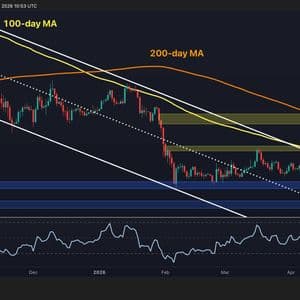
Ethereum is trading around $2.3k, holding near its highest levels since the February crash. Yet, there are signs of short-term fatigue after failing to sustain a breakout above the $2.4k resistance zone. The broader recovery remains intact, but the repeated failure at this ceiling is becoming a pattern that buyers will need to decisively break to shift the narrative. Ethereum Price Analysis: The Daily Chart The price is pressing against a genuinely significant confluence on the daily chart, comprised of the 100-day moving average and the $2.4k supply zone. ETH has now closed above the long-term descending channel after months, but it is failing to follow through convincingly. That inability to sustain the breakout is the dominant story right now. What keeps the setup from being outright bearish is the RSI, which has been grinding higher since February and is now holding above 50 on the daily timeframe. It is a reflection of steady bullish momentum building beneath the surface. The 200-day MA (~$2.9k) and the $2.8k supply zone sit well above, representing the next meaningful targets if the breakout does eventually confirm. Below, $1.8k remains the line in the sand, with $1.6k and $1.4k as deeper support levels. ETH/USDT 4-Hour Chart The 4-hour chart is flashing a warning sign that deserves attention. After briefly breaking above $2.4k earlier this week, the price quickly reversed, and the RSI has printed a clear bearish divergence on this timeframe. The signal is marked visibly on the chart: the price made a higher high just below $2.5k while the RSI made a lower high. This is a classic signal of fading momentum at resistance. Since that rejection, the price has pulled back to around $2.32k and is now sitting just above the bullish trendline from the early-April lows near $2k, with the RSI dropping toward the 40s. The trendline is being tested right now, alongside the recent short-term low. Holding above these levels would keep the short-term structure of higher lows intact and leave the door open for another attempt at $2.4k. Conversely, a breakdown shifts the immediate focus lower toward the $2k psychological level, with the $1.8k support band as the deeper backstop. Sentiment Analysis Ethereum’s funding rates present an interesting picture heading into the week. The chart shows negative readings that have dominated April. While the price has been gradually rising over the past couple of weeks, the funding rates have yet to show convincing, consistent positive readings. Futures market participants are seemingly expecting the price to fail at $2.4k. However, a breakout could lead to a short liquidation cascade that could push the price rapidly toward the next significant resistance located at $2.8k. But for this scenario to materialize, sufficient demand from the spot market should be available to push the price over the line, or another wave of correction would be imminent. Screenshot The post Ethereum Price Prediction: Has ETH’s Rally Run Out of Steam After Another Rejection? appeared first on CryptoPotato .
19 Apr 2026, 18:34
XRP ETF inflows hit $55M as price stalls at $1.445

🚨 XRP ETFs attracted $55M in weekly inflows, their best showing of 2026. XRP price failed to break $1.445, showing persistent resistance. Continue Reading: XRP ETF inflows hit $55M as price stalls at $1.445 The post XRP ETF inflows hit $55M as price stalls at $1.445 appeared first on COINTURK NEWS .
19 Apr 2026, 18:22
Bitcoin Holds Steady Above $74,000 as U.S. Inflation Climbs to 3.3%

Bitcoin traded firmly last week, extending its seven-day rally to nearly 9%. The move came amid fresh macroeconomic data from the U.S. Bureau of Labor Statistics last Friday, which showed March Consumer Price Index (CPI) inflation at 3.3%, slightly below the 3.4% forecast, offering limited but notable relief to markets. Even so, inflation remained elevated,
19 Apr 2026, 18:10
Bitcoin Price Plummets: BTC Falls Below Crucial $75,000 Support Level

BitcoinWorld Bitcoin Price Plummets: BTC Falls Below Crucial $75,000 Support Level Global cryptocurrency markets witnessed a significant shift on April 10, 2025, as the Bitcoin price fell decisively below the $75,000 psychological support level, triggering analysis among traders and institutions worldwide. According to real-time data from Bitcoin World market monitoring, BTC is currently trading at $74,988.72 on the Binance USDT perpetual futures market, marking a notable retreat from recent highs. This movement represents a critical juncture for the dominant digital asset, consequently prompting examination of underlying market mechanics and broader financial conditions. Bitcoin Price Action and Immediate Market Context The descent of the Bitcoin price below $75,000 follows a period of consolidation after the asset’s historic climb earlier in the year. Market data reveals increased selling pressure during the Asian and European trading sessions. Several concurrent factors typically influence such movements. For instance, derivatives market metrics showed elevated funding rates prior to the drop, often a precursor to a long squeeze. Furthermore, on-chain analytics firms reported a spike in coin movement from older wallets to exchanges, a signal frequently associated with profit-taking behavior. Simultaneously, traditional finance correlations resurfaced. The U.S. Dollar Index (DXY) showed strength, and bond yields edged higher, creating headwinds for risk assets globally. This Bitcoin price action underscores its evolving, yet persistent, connection to macro liquidity conditions. Trading volume across major spot and derivatives venues surged by approximately 35% compared to the 24-hour average, indicating heightened participant engagement. Notably, the move breached several short-term technical support levels identified by analysts. Analyzing the Drivers Behind Cryptocurrency Market Volatility Cryptocurrency market movements rarely stem from a single catalyst. Instead, they result from a confluence of technical, fundamental, and sentiment-driven factors. The current Bitcoin price correction aligns with a predictable pattern observed after major bullish impulses. Historically, drawdowns of 10-20% are common within ongoing uptrends. This volatility is intrinsic to an asset class characterized by 24/7 trading and high leverage availability. Institutional Flows and Macroeconomic Pressures Recent weeks saw mixed signals from institutional investment vehicles. While net inflows into U.S. spot Bitcoin ETFs persisted, their pace decelerated. Concurrently, macroeconomic uncertainty increased following the latest Federal Reserve meeting minutes, which adopted a more hawkish tone than some market participants anticipated. Central bank policies directly impact liquidity, a primary driver for all risk-on assets including Bitcoin. Analysts from firms like Glassnode and CoinMetrics often highlight the importance of the Macroeconomic Uncertainty Index when contextualizing such Bitcoin price swings. The table below summarizes key pressure points: Factor Current Status Likely Impact on BTC ETF Net Flows Positive but Slowing Reduced Buy-Side Pressure DXY Strength Increasing Negative for Risk Assets Network Hash Rate All-Time High Long-Term Fundamental Support Miner Revenue Elevated Post-Halving Neutral to Positive Moreover, regulatory developments continue to create a complex backdrop. Clearer frameworks in jurisdictions like the EU provide stability, while ongoing legal cases in the U.S. introduce short-term uncertainty. This regulatory mosaic influences institutional adoption timelines and, by extension, market sentiment. Technical Perspective and Key Levels to Watch From a chart analysis viewpoint, the $75,000 level had transitioned from resistance to support during the prior uptrend. Its breach is therefore technically significant. Market technicians now monitor several key zones for potential stabilization or further movement. The immediate support band lies between $72,500 and $74,000, an area that previously acted as consolidation resistance. A sustained break below this could see the Bitcoin price test the 50-day moving average, a level that has contained corrections during this cycle. On the other hand, resistance is now established at the $75,000 to $76,000 range. A reclaim of this zone would invalidate the bearish breakdown signal. Key on-chain metrics provide additional context: Realized Price: The average price at which all circulating BTC last moved. It acts as a broad support benchmark. UTXO Age Bands: Show the spending behavior of long-term holders versus short-term speculators. Exchange Net Position Change: Measures whether coins are moving to or from trading platforms, indicating selling or holding intent. Current data suggests long-term holders remain largely steadfast, while short-term volatility is driven by leveraged traders and newer entrants. This dichotomy is a classic feature of Bitcoin’s market structure. Historical Precedent and Market Cycle Analysis Bitcoin’s history is defined by parabolic advances followed by steep corrections. Comparing present conditions to past cycles offers perspective, not prediction. The 2024-2025 cycle shares characteristics with prior epochs, particularly the 2016-2017 and 2020-2021 periods. For example, post-halening rallies have consistently experienced multiple corrections exceeding 20% before reaching a cycle top. The current pullback from the recent high remains within this historical volatility envelope. Furthermore, the introduction of spot ETFs has created a new, steady demand vector absent in previous cycles. This structural change may alter the depth and duration of corrections. Analysts debate whether ETF buying can provide a durable floor during sell-offs. The flow data following this Bitcoin price drop below $75,000 will be a critical test of that hypothesis. Past performance never guarantees future results, but it provides a framework for understanding probable market participant behavior and sentiment extremes. Conclusion The Bitcoin price falling below $75,000 represents a meaningful technical event within the broader context of the 2024-2025 market cycle. This movement highlights the asset’s inherent volatility and its ongoing sensitivity to macroeconomic conditions and internal market leverage. While the short-term trend has turned negative, key fundamental pillars—such as hash rate security, institutional adoption, and the fixed issuance schedule—remain intact. Market participants will now watch for consolidation around new support levels and shifts in on-chain behavior to gauge the next major directional bias. The evolution of the Bitcoin price continues to be a complex interplay of technology, finance, and human psychology. FAQs Q1: Why did the Bitcoin price fall below $75,000? The drop likely resulted from a combination of profit-taking after a strong rally, a strengthening U.S. dollar, a slowdown in ETF inflow momentum, and the liquidation of over-leveraged long positions in the derivatives market. Q2: Is this a normal correction for Bitcoin? Yes. Historically, Bitcoin experiences multiple corrections of 10-30% during major bull markets. This level of volatility is consistent with its past performance. Q3: What is the most important support level to watch now? Analysts are watching the zone between $72,500 and $74,000, which was previous resistance. The 50-day moving average, currently around $71,000, is also a key technical level. Q4: How do Bitcoin ETFs affect this price movement? Spot ETFs create consistent institutional buying pressure, which can dampen severe downturns. However, if their net flows turn negative, they can also accelerate selling pressure. Q5: Should long-term investors be concerned about this drop? Long-term investment strategies typically focus on Bitcoin’s fundamental properties (decentralization, scarcity, security) rather than short-term price fluctuations. Volatility is an expected characteristic of the asset class. This post Bitcoin Price Plummets: BTC Falls Below Crucial $75,000 Support Level first appeared on BitcoinWorld .

