


 Invest ideas
News
27 May 2026, 05:01
XRP steadies near $1.32 as failed breakout keeps focus on narrowing trading range
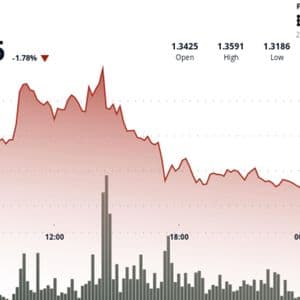
XRP stayed trapped inside the same consolidation structure after another rejection near $1.36, with traders watching whether months of compression finally resolve into a larger move.
27 May 2026, 05:00
Bitcoin Could Fall To $40,000 If Saylor’s Bid Stalls, Ran Neuner Warns

Ran Neuner says Bitcoin’s chart structure is starting to resemble the breakdown pattern that preceded the 2022 capitulation, with one key difference: this time, he argues, Michael Saylor’s Strategy may be the market’s most important marginal buyer. Speaking with Scott Melker in a May 24 interview, Neuner said Bitcoin is sitting inside a “very scary structure,” pointing to what he described as a bear flag that has failed to resolve higher. His concern is not only technical. It is also tied to whether Strategy can keep raising capital through STRC, a preferred-stock instrument that Neuner believes has become central to Saylor’s ability to buy more Bitcoin. “If history repeats, right, then we should break down or could break down below this,” Neuner said, referring to Bitcoin’s current chart pattern. “I hate saying it because look, I don’t even want to admit it to myself, but I mean definitely it’s going down to the $40ks or $50ks if it happens.” The argument rests on a comparison with 2022. Neuner said Bitcoin previously dropped, formed a bear flag, retested the 200-day moving average, and then suffered a deeper leg lower after failing to reclaim the structure. He said the present setup looks like a “mirror image,” with Bitcoin again testing the bear-flag region and the 200-day moving average before rolling back into the range. Related Reading: Bitcoin Sell Pressure Rising? Binance Inflows Hit 10-Day Streak But the sharper part of Neuner’s thesis concerns Strategy’s funding engine. He argued that Saylor’s recent Bitcoin purchases have depended heavily on STRC trading back toward $100 ahead of its ex-dividend date, allowing Strategy to issue shares, raise capital and deploy the proceeds into Bitcoin. The problem, in Neuner’s view, is that the window for that trade has been narrowing. “Last month in May, it only pegged at 100 on the 11th of May when the XD date was the 15th of May,” Neuner said. “Whereas in the previous months, it pegged on the 25th of the previous month. So it should have pegged, if it was going to keep the trend, on the 25th of April. It only pegged on the 11th of May, right? Which meant that he only had four days to raise money.” Neuner said that matters because Bitcoin’s recent rallies appeared to line up with periods when Strategy had more time to raise capital and buy. If STRC spends fewer days near $100, he argued, the market may begin to discount the absence of its largest recurring buyer. Related Reading: Bitcoin Rally Faces Fresh Test As Demand Metric Hits 2026 Low “If we carry on like last month and we have another month where he can’t raise money, eventually the market’s going to start discounting the fact that Saylor is not in the market anymore on STRC,” Neuner said. “Your biggest buyer at the moment is not in the market anymore.” Melker pushed back on the idea that STRC would collapse without a major credit event, noting that the product is linked to Strategy and indirectly backed by its Bitcoin position. Neuner did not describe STRC as a Ponzi or suggest wrongdoing. His concern was more mechanical: he said he does not understand why the instrument must trade at $100 when holders still receive the dividend below that level. The discussion also widened into macro risks. Neuner cited rising Treasury yields, sticky inflation, oil prices, and the possibility that large SpaceX and OpenAI IPOs could drain liquidity from risk assets. He said Treasury yields and equities cannot both keep rising indefinitely, arguing that “one of them has to give.” At press time, Bitcoin traded at $77,033. Featured image created with DALL.E, chart from TradingView.com
27 May 2026, 04:50
Dollar Steadies as US-Iran Talks Dominate; Aussie Drops on Soft CPI Print

BitcoinWorld Dollar Steadies as US-Iran Talks Dominate; Aussie Drops on Soft CPI Print The US dollar traded in a narrow range on Wednesday as currency markets remained fixated on diplomatic developments between the United States and Iran, while the Australian dollar slid following a weaker-than-expected inflation reading that bolstered expectations for a near-term interest rate cut by the Reserve Bank of Australia. Geopolitical Calm Caps Dollar Moves The greenback struggled to find a clear direction as traders weighed the potential outcome of ongoing US-Iran nuclear talks. Reports from diplomatic channels suggested that negotiations, while progressing, remain fragile. Market participants are pricing in a range of scenarios, from a de-escalation that could ease oil supply concerns to a breakdown that might reignite geopolitical risk premiums. The dollar index, which measures the currency against a basket of six major peers, hovered near the 104.00 mark, reflecting a market in wait-and-see mode. The lack of a decisive breakout indicates that traders are reluctant to place large directional bets ahead of clearer signals from the talks and upcoming US economic data. Aussie Dollar Hit by Soft CPI Data The Australian dollar was the biggest mover among major currencies, falling roughly 0.6% against the US dollar after the Australian Bureau of Statistics reported that the monthly consumer price index (CPI) rose just 2.7% year-on-year in February, below the 3.0% consensus forecast. Core inflation, which strips out volatile items, also came in softer than anticipated. The data has reinforced the view that the RBA may have room to cut its cash rate sooner than previously thought. Markets are now pricing in a roughly 60% probability of a 25-basis-point cut at the central bank’s next meeting in May, up from around 40% before the CPI release. Impact on Rate Expectations and Bond Yields Australian government bond yields declined across the curve following the inflation miss, with the three-year yield falling 8 basis points to 3.65%. The softer CPI print is seen as a validation of the RBA’s recent cautious tone, which has emphasized that while inflation is moderating, the pace of disinflation remains uncertain. For Australian households and businesses, the prospect of lower borrowing costs could provide some relief, but the currency’s weakness may also feed into import prices, potentially complicating the RBA’s inflation outlook. Broader Market Context The euro and Japanese yen were little changed against the dollar, as traders digested mixed eurozone economic data and awaited further guidance from the Bank of Japan. The pound remained steady as UK retail sales figures came in slightly above expectations, offering some support. Oil prices, which have been sensitive to developments in the Middle East, edged lower on Wednesday amid reports of potential progress in the US-Iran talks, easing some supply disruption fears. This, in turn, has provided a modest tailwind for currencies of oil-importing nations. Conclusion The currency market’s focus remains split between geopolitical developments and diverging monetary policy expectations. The US dollar’s near-term trajectory will likely hinge on the outcome of US-Iran negotiations and the next round of US economic data, particularly the personal consumption expenditures (PCE) price index due later this week. For the Australian dollar, the soft CPI print has shifted the narrative firmly toward rate cut expectations, and further downside may be limited only if the RBA pushes back against market pricing. FAQs Q1: Why did the Australian dollar fall after the CPI data? The softer-than-expected CPI reading increased market expectations that the Reserve Bank of Australia may cut interest rates sooner, which reduces the currency’s yield appeal and led to selling pressure. Q2: How do US-Iran talks affect the US dollar? Progress in talks can reduce geopolitical risk premiums, potentially weakening safe-haven demand for the dollar. Conversely, a breakdown could boost the dollar as investors seek safety. Q3: What is the next key data point for the US dollar? The upcoming US PCE price index, the Federal Reserve’s preferred inflation gauge, is the next major catalyst. A higher-than-expected reading could strengthen the dollar by reducing rate cut expectations. This post Dollar Steadies as US-Iran Talks Dominate; Aussie Drops on Soft CPI Print first appeared on BitcoinWorld .
27 May 2026, 04:48
Ethereum Price Struggles Near Key Levels As Market Sentiment Weakens

Ethereum price started a fresh decline and traded below $2,080. ETH is now consolidating above $2,050 and might struggle to recover. Ethereum remained in a bearish zone after a fresh decline. The price is trading below $2,100 and the 100-hourly Simple Moving Average. There was a break below a bullish trend line with support at $2,095 on the hourly chart of ETH/USD (data feed via Kraken). The pair could continue to move down if it stays below the $2,100 zone. Ethereum Price Consolidates Losses Ethereum price failed to remain stable above $2,120 and started a downside correction, like Bitcoin . ETH price dipped below the $2,110 and $2,100 levels. The price even traded below $2,080. Besides, there was a break below a bullish trend line with support at $2,095 on the hourly chart of ETH/USD. A low was formed at $2,052, and the price is now attempting to recover. There was a recovery wave above the 23.6% Fib retracement level of the downward move from the $2,138 swing high to the $2,052 low. Ethereum price is now trading below $2,100 and the 100-hourly Simple Moving Average . If the bulls remain in action above $2,050, the price could attempt another increase. Immediate resistance is seen near the $2,085 level or the 38.2% Fib retracement level of the downward move from the $2,138 swing high to the $2,052 low. The first key resistance is near the $2,100 level. The next major resistance is near the $2,120 level. A clear move above the $2,120 resistance might send the price toward the $2,150 resistance. An upside break above the $2,150 region might call for more gains in the coming days. In the stated case, Ether could rise toward the $2,220 resistance zone or even $2,250 in the near term. Another Drop In ETH? If Ethereum fails to clear the $2,100 resistance, it could start a fresh decline. Initial support on the downside is near the $2,065 level. The first major support sits near the $2,050 zone. A clear move below the $2,050 support might push the price toward the $2,020 support. Any more losses might send the price toward the $1,940 region. The main support could be $1,920. Technical Indicators Hourly MACD – The MACD for ETH/USD is losing momentum in the bearish zone. Hourly RSI – The RSI for ETH/USD is now below the 50 zone. Major Support Level – $2,050 Major Resistance Level – $2,150
27 May 2026, 04:42
XRP stuck at $1.33 as $1.65 resistance holds strong

🚨 $XRP is stuck around $1.33 as the $1.65 resistance blocks recovery. Buyers remain cautious and technical signals favor sellers. 📉 Key point: Losing the $1.10 or $0.87 support could trigger further declines. Continue Reading: XRP stuck at $1.33 as $1.65 resistance holds strong The post XRP stuck at $1.33 as $1.65 resistance holds strong appeared first on COINTURK NEWS .
27 May 2026, 04:40
US Spot Ethereum ETFs Extend Losing Streak to 11 Days With $35.1M in Outflows
BitcoinWorld US Spot Ethereum ETFs Extend Losing Streak to 11 Days With $35.1M in Outflows U.S. spot Ethereum exchange-traded funds (ETFs) recorded net outflows of approximately $35.1 million on May 26, extending the current withdrawal streak to 11 consecutive trading days, according to data from Farside Investors. The persistent selling pressure underscores ongoing caution among institutional investors toward the second-largest cryptocurrency by market capitalization. Breakdown of Daily Outflows by Fund Data from Farside Investors reveals that the outflows were distributed across several major ETF issuers. Fidelity’s FETH led the withdrawals with $17 million in net outflows, followed by Grayscale’s Mini Ethereum Trust at $8.3 million and the Grayscale Ethereum Trust (ETHE) at $7.9 million. BlackRock’s ETHA, despite being the largest spot Ethereum ETF by assets under management, saw comparatively modest outflows of $1.9 million on the day. The 11-day outflow streak now represents the longest sustained period of capital withdrawals since the launch of spot Ethereum ETFs in July 2024. Total cumulative outflows during this period have surpassed $320 million, according to fund flow aggregators. Market Context and Investor Sentiment The continued outflows come amid a broader period of consolidation for Ethereum, which has traded in a relatively narrow range between $3,000 and $3,400 over the past two weeks. The broader cryptocurrency market has also faced headwinds from macroeconomic uncertainty, including shifting expectations around Federal Reserve interest rate policy and persistent regulatory ambiguity in the United States. Analysts note that the outflows may reflect profit-taking by institutional investors who entered positions earlier in the year, as well as a rotation toward bitcoin-focused products, which have seen comparatively stable inflows during the same period. Bitcoin spot ETFs recorded net inflows of $112 million on May 26, suggesting a preference shift among allocators. What This Means for Ethereum’s Market Position The persistent outflows from spot Ethereum ETFs do not necessarily indicate a loss of confidence in Ethereum’s long-term fundamentals, but they do signal near-term caution. The Ethereum network continues to process significant transaction volume, and the upcoming Pectra upgrade remains a catalyst for developer activity. However, ETF flows are often viewed as a proxy for institutional sentiment, and the current trend suggests that large investors are adopting a wait-and-see approach. Farside Investors data also shows that trading volumes across all spot Ethereum ETFs have declined by roughly 30% over the past two weeks, indicating reduced participation rather than aggressive selling alone. Conclusion The 11-day outflow streak for U.S. spot Ethereum ETFs reflects a cautious institutional stance amid broader market consolidation and macroeconomic uncertainty. While the outflows are notable in duration and magnitude, they remain modest relative to the total assets under management in these funds. Investors will be watching for a reversal in flows as a potential signal of renewed institutional appetite for Ethereum exposure. FAQs Q1: What caused the 11-day outflow streak for spot Ethereum ETFs? A: The outflows are attributed to a combination of profit-taking, macroeconomic uncertainty, and a rotation toward bitcoin-focused products. Institutional investors appear to be reducing exposure amid a period of price consolidation for Ethereum. Q2: Which Ethereum ETFs saw the largest outflows on May 26? A: Fidelity’s FETH recorded the largest outflow at $17 million, followed by Grayscale’s Mini Ethereum Trust at $8.3 million and Grayscale’s ETHE at $7.9 million. BlackRock’s ETHA saw relatively minor outflows of $1.9 million. Q3: How do these outflows compare to previous trends? A: The 11-day streak is the longest since spot Ethereum ETFs launched in July 2024. Cumulative outflows during this period exceed $320 million, though total assets under management remain substantial at over $10 billion across all funds. This post US Spot Ethereum ETFs Extend Losing Streak to 11 Days With $35.1M in Outflows first appeared on BitcoinWorld .
