


 Invest ideas
News
23 May 2026, 16:00
Bitcoin Bottom May Be 2 Months Away, On-Chain Data Suggests

Over the past week, Bitcoin has traded sideways in the high $70,000 region, unable to reclaim the psychological $82,000 level that has eluded market bulls since mid-May. Notably, the $76,000 price level has now been tested three weeks in a row and held each time, emerging as a real support zone. However, an obscure on-chain metric may be flashing the clearest bottom signal in Bitcoin’s history. Key Bearish Signal Arises From Investor Cost Basis Data In an X post on May 22, CryptoChan shares data from an historically reliable bottom indicator built from two realized price bands: the 6m–10y Realized Price, representing the average acquisition cost of long-term holders, currently at $60,316; and the 0–10y Realized Price, a broader market average cost basis, sitting at $64,412. The ratio between these two bands indicates how stressed long-term holders are relative to the broader market. When it drops below 0.936 and then recovers back toward 1.0, it has marked the precise bottom moment in every prior Bitcoin cycle. 历史经验表明,当黑线逼近绿线,往往也正是熊市尾声与历史级大底的标志性信号──────────────────────── 【 #BTC 四年周期系列更新】当前图中指标已升至 0.936 2015年熊底该指标从 0.936 升到 1,花费 59天18-19年熊底该指标从 0.936 升到 1,花费 66天… https://t.co/pOwvk1rsDu pic.twitter.com/kr6P4m7bBy — CryptoChan (@0xCryptoChan) May 22, 2026 This is because when the ratio touches 1.0, the green line (long-term holder cost) overtakes the black line (full market cost), meaning even the most conviction-driven holders are underwater. That is the moment when selling pressure is fully exhausted, and market sentiment is in extreme panic. In the 2015 bear market bottom, the ratio took 59 days to climb from 0.936 back to 1.0. In the 2018–2019 bear bottom, the recovery took 66 days. In the November 2022 FTX collapse-driven bottom, the journey took 50 days. The ratio is presently at 0.936 again. If the current reading holds and historical data repeats itself, Bitcoin’s definitive bottom window may open sometime around mid-to-late July 2026. Bitcoin Price Overview At the time of writing, Bitcoin is valued at $75,269, following a 2.84% loss in the last week. In tandem, the asset’s performance on larger timeframes is also negative, with declines of 4.65% and 3.55% on the weekly and monthly charts, respectively. According to data from Coincodex , the Fear & Greed Index stands at 28, indicating that fear is significantly affecting the market. Nevertheless, CoinCodex analysts are backing a short squeeze toward $83,354 over the next five days. In a month, they predict a return to $77,741. However, their three-month projection points to a $90,529 price target, suggesting a potential 16% gain over current market prices.
23 May 2026, 15:59
Ethereum Price Prediction: Will ETH Crash Below $2K This Week After Key Breakdown?
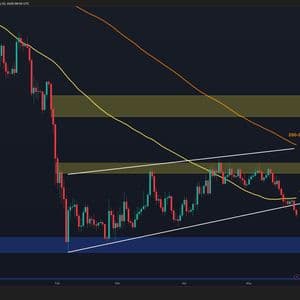
Ethereum has come under renewed selling pressure after failing to reclaim a key dynamic resistance cluster around the 100-day moving average and the lower boundary of the previous consolidation range. While the broader market remains under pressure, ETH is now approaching a critical support region where short-term reactions may emerge. However, unless buyers quickly reclaim lost levels, the path of least resistance appears tilted toward further downside continuation. Ethereum Price Analysis: The Daily Chart On the daily timeframe, ETH faced a strong rejection from the confluence of the 100-day moving average near the $2.1K-$2.15K region and the broken wedge support structure, which had previously acted as dynamic support for several months. Following this rejection, the asset decisively broke below the wedge formation, confirming a notable bearish structural shift in the market. This breakdown signals weakening bullish momentum and increasing dominance from sellers. Currently, ETH is trading around the $2K psychological support zone after losing the important $2.1K level. The overall structure suggests that the recent move could evolve into a classic breakdown-and-pullback scenario, where price may temporarily retest the broken wedge boundary and the $2.1K-$2.15K resistance area before continuing lower. If bearish momentum persists, the next major downside target lies near the substantial $1.8K support region, which previously acted as a strong demand zone during the February capitulation event. A break below that area could expose Ethereum to deeper corrections toward the lower macro support levels around $1.55K-$1.6K. On the bullish side, reclaiming the 100-day MA around $2.15K would be the first sign that buyers are attempting to invalidate the recent bearish breakdown. ETH/USDT 4-Hour Chart On the 4-hour timeframe, Ethereum’s market structure remains clearly bearish, reflecting growing fear and uncertainty among market participants after the sharp impulsive decline from the $2.4K region. The price has consistently formed lower highs and lower lows, while recent selling pressure accelerated after ETH lost the important ascending support trendline near $2.2K-$2.25K. This breakdown triggered another wave of liquidation-driven selling, pushing the asset directly into a key 4-hour order block located around the $1.95K-$2K support zone. This region is highly important because it has served as a major reaction area for an extended period of time and likely contains significant resting liquidity. As a result, Ethereum could experience a short-term corrective bullish retracement from this zone before any continuation toward lower prices. In the event of a rebound, the primary pullback target sits around the $2.1K-$2.15K area, which now acts as the nearest supply zone and potential pullback resistance. This region also coincides with the previously broken market structure, increasing the probability of renewed selling pressure if the price revisits it. However, unless ETH manages to reclaim and stabilize above the $2.2K region, the broader short-term trend remains bearish, and any recovery rally may simply be considered a corrective move within a larger downtrend. Sentiment Analysis The latest Ethereum liquidation heatmap reveals a substantial liquidity concentration below the current market price, with the most significant cluster positioned around the $1.8K region. This zone has emerged as a major liquidity magnet, containing a dense accumulation of leveraged positions that could attract price action in the coming phase. Historically, Ethereum tends to gravitate toward high-liquidity regions before establishing a meaningful reversal. The recent decline and weak recovery structure suggest that the market may still require a final liquidity sweep to fully reset positioning and flush out remaining leveraged participants. As a result, the $1.8K area becomes a critical level to monitor, as it holds the potential to absorb incoming selling pressure while clearing a large portion of resting liquidity. From a market mechanics perspective, such liquidity grabs often occur before the beginning of a stronger impulsive trend. If Ethereum eventually taps into this zone, it could trigger panic-driven selling and forced liquidations, creating favorable conditions for large players to accumulate at discounted prices. Consequently, while short-term rebounds remain possible, the broader liquidity structure indicates that Ethereum may still be vulnerable to a deeper corrective move toward the $1.8K cluster before a sustainable bullish expansion can begin. The post Ethereum Price Prediction: Will ETH Crash Below $2K This Week After Key Breakdown? appeared first on CryptoPotato .
23 May 2026, 15:02
Long-Term Bitcoin Investor: This Will Be the Final Leg Down for XRP Before a New Dawn

Crypto analyst Crypto Michael (@MichaelXBT) recently followed up on his earlier XRP analysis. His message carries more urgency than before. XRP is currently trading at $1.32, down over 3% from yesterday, putting the price within striking distance of the critical $1.30 support level many analysts have been tracking. According to Crypto Michael, “the shakeout has begun.” He sees this decline as the final leg down before a significant reversal . Investors who hold through the pressure will be the ones positioned to benefit once the move comes. A Pattern Taking Shape Crypto Michael has been tracking a large falling wedge on the weekly timeframe. This structure began forming after XRP peaked in 2025. Since then, its price has produced lower highs while continuing to defend a long-term support trendline. The wedge is now approaching its apex, leaving XRP with limited room before a decisive move occurs. Weekly candles have become tighter as price trades deeper into the pattern. Swings have narrowed considerably compared to earlier stages of the correction. This compression reflects a market coiling before a significant directional move. The shakeout has begun This will be the final leg down for XRP Then a new dawn begins https://t.co/dFI2hfDLTM — Crypto Michael (@MichaelXBT) May 22, 2026 Support Holds, Resistance Remains The lower trendline sits around $1.30. Buyers have defended that level multiple times, including a breakdown attempt in early February . Each rejection from the upper resistance line has produced smaller pullbacks, suggesting sellers have not regained full control. The current price of $1.32 sits just above the critical $1.30 support level. A sustained drop below that level would test the falling wedge structure Crypto Michael is counting on. So far, it has held through months of selling pressure. The descending resistance trendline remains the primary barrier. It now intersects near $1.45 and $1.50. XRP recently tested that zone before pulling back. That rejection aligns with Crypto Michael’s earlier prediction . His follow-up post confirms he sees this week’s decline as that shakeout playing out in real time. What a Breakout Could Mean Crypto Michael sees one more move lower before momentum shifts upward. Investors who hold through the pressure stand to benefit if his outlook proves correct. Those who exit now become part of the shakeout he predicted. If XRP breaks above the descending resistance with strong volume, previous resistance zones between $1.80 and $2.20 become the focus. A confirmed breakout could also reopen the path toward higher levels from the 2025 rally. Disclaimer : This content is meant to inform and should not be considered financial advice. The views expressed in this article may include the author’s personal opinions and do not represent Times Tabloid’s opinion. Readers are advised to conduct thorough research before making any investment decisions. Any action taken by the reader is strictly at their own risk. Times Tabloid is not responsible for any financial losses. Follow us on X , Facebook , Telegram , and Google News The post Long-Term Bitcoin Investor: This Will Be the Final Leg Down for XRP Before a New Dawn appeared first on Times Tabloid .
23 May 2026, 15:00
Bitcoin Bull Thesis Goes Big: 39 Trillion Reasons To Buy, Says Gemini Founder

The Winklevoss twins donated $21 million worth of Bitcoin to a political action committee supporting US President Donald Trump’s re-election campaign, underscoring just how deeply committed the Gemini co-founders are to the cryptocurrency’s future. Related Reading: Bitcoin Treasury Company Nakamoto Takes Action To Prevent Stock Slide A Debt Clock That Never Stops That political move now sits alongside a fresh statement from Cameron Winklevoss, who took to X on May 22 to declare there are “39 trillion reasons to buy Bitcoin.” He was pointing directly at the US national debt, which has climbed to over $39 trillion. The remark was brief. The implication was not. 39 trillion reasons to buy bitcoin https://t.co/0E2OvKkNKu — Cameron Winklevoss (@cameron) May 22, 2026 A Fixed Supply Against A Growing Debt Cameron and his brother Tyler have long argued that Bitcoin’s hard cap of 21 million coins makes it a natural hedge against governments that keep spending beyond their means. They call it “gold 2.0,” and they believe that if Bitcoin ever displaces gold as the world’s go-to store of value, the price could eventually hit $1 million. Cameron has a history of flagging what he sees as prime buying moments. When Bitcoin fell below $90,000 late last year, he told his more than 700,000 followers on X that it was a final chance to buy before a rebound. The rebound did not come as expected — Bitcoin slid further and now trades around $74,000. The Debt Argument Gains Ground Across The Industry Cameron is not the only prominent voice tying the national debt to the case for Bitcoin. Jim Cramer urged Americans last year to consider cryptocurrencies as the debt climbed to $37.63 trillion, a point when the National Debt Clock in New York showed each American family carrying a burden of nearly $955,708. Michael Saylor and Anthony Pompliano have made similar arguments, repeatedly framing Bitcoin as a shield against economic uncertainty and ballooning government obligations. The idea is straightforward: as government debt grows and the purchasing power of fiat currencies shrinks, an asset with a fixed supply becomes harder to ignore. Related Reading: New Bitcoin Lows? Analysts Say Chances Are ‘Extremely Slim’ Loud Voices, Clear Interests Gemini is a cryptocurrency exchange, and the Winklevoss brothers have built their business around Bitcoin adoption. Their advocacy and their financial interests run in the same direction. Cameron’s latest post adds one more data point to a narrative the crypto industry has been building for years — that the national debt is not just an economic problem but an argument for holding Bitcoin. Featured image from Pexels, chart from TradingView
23 May 2026, 14:55
Analyst Predicts HYPE and AI Tokens Could Lead Next Altcoin Season as Risk Appetite Returns

BitcoinWorld Analyst Predicts HYPE and AI Tokens Could Lead Next Altcoin Season as Risk Appetite Returns A prominent crypto analyst has identified Hyperliquid’s native token, HYPE, and artificial intelligence-related cryptocurrencies as potential leaders of the next altcoin season, citing a revival in market risk appetite. Analyst Points to HYPE and AI Tokens as Market Sentiment Shifts Michaël van de Poppe, a well-known figure in cryptocurrency analysis, noted in a recent assessment that the bullish price action in HYPE, combined with growing interest in AI-focused digital assets, signals a broader return of risk-on sentiment among traders. He highlighted that Hyperliquid is not merely a trading platform but is expanding into the tokenization of real-world assets, including stocks, commodities, and pre-IPO offerings. This move, according to van de Poppe, strengthens the on-chain asset tokenization trend and adds fundamental value to the HYPE token. HYPE Could Surpass $100, Says Van de Poppe Van de Poppe expressed confidence that HYPE could break above the $100 mark if the current improvement in market sentiment continues. He also pointed to two AI-focused projects—NEAR Protocol and Bittensor (TAO)—as being significantly undervalued relative to their potential. Both projects are building infrastructure for decentralized AI applications, a sector that has seen increased attention following advancements in generative AI and machine learning models. What This Means for Altcoin Investors The analyst’s comments come at a time when the broader cryptocurrency market is showing signs of recovery after a prolonged period of consolidation. If van de Poppe’s assessment proves accurate, the next altcoin season may be led not by meme coins or speculative tokens, but by projects with tangible utility in emerging sectors like AI and real-world asset tokenization. For investors, this suggests a potential shift toward fundamentals-driven trading rather than pure speculation. Conclusion While the crypto market remains volatile and predictions should be approached with caution, the convergence of on-chain asset tokenization and AI development presents a compelling narrative. Van de Poppe’s analysis adds to a growing chorus of voices suggesting that the next major market cycle could be defined by technological utility rather than hype alone. Readers are advised to conduct their own research and consider the inherent risks before making investment decisions. FAQs Q1: What is HYPE token? HYPE is the native token of Hyperliquid, a decentralized exchange and trading platform that is expanding into tokenized real-world assets such as stocks, commodities, and pre-IPO investments. Q2: Why are AI tokens like NEAR and TAO considered undervalued? Analyst Michaël van de Poppe believes NEAR Protocol and Bittensor (TAO) are undervalued because they are building critical infrastructure for decentralized AI applications, a sector with high growth potential that is still in its early stages. Q3: What is an altcoin season? An altcoin season refers to a period in the cryptocurrency market when alternative coins (altcoins) outperform Bitcoin in terms of price appreciation, often driven by increased risk appetite and speculative interest. This post Analyst Predicts HYPE and AI Tokens Could Lead Next Altcoin Season as Risk Appetite Returns first appeared on BitcoinWorld .
23 May 2026, 14:37
Bitcoin jumps above $82,000 as ETF demand weakens

🚨 Bitcoin soared past $82,000 before facing strong resistance. The rally was driven largely by futures trading, not spot demand. Continue Reading: Bitcoin jumps above $82,000 as ETF demand weakens The post Bitcoin jumps above $82,000 as ETF demand weakens appeared first on COINTURK NEWS .


