


 Invest ideas
News
23 May 2026, 11:25
Pump.fun USDC Pairs: How Stablecoin Liquidity Could Change Solana Memecoins

Memecoin launches on Solana have mostly been priced against SOL, which makes every trade a bet on two assets at once: the coin and SOL itself. As USDC-quoted pairs gain traction on Solana DEXs and launchpads, many are asking how stablecoin liquidity—potentially including support on or alongside Pump.fun —might change the game. This guide breaks down what USDC pairs mean in practice: how price discovery could shift, what it implies for creators and early LPs, and how traders can adapt. It’s designed to help you evaluate trade-offs, reduce avoidable mistakes, and navigate new liquidity options without the hype. None of this is financial advice. Crypto assets are volatile and speculative. Always do your own research and only risk what you can afford to lose. AspectWhat to Know Price QuoteUSDC pairs express price in dollars, removing SOL price fluctuations from the quote and simplifying valuation. Slippage DynamicsSlippage depends on pool depth; USDC can reduce "hidden" volatility from SOL moves but doesn’t eliminate thin liquidity risk. LP RiskImpermanent loss still exists; it’s referenced to USDC rather than SOL, which may clarify P&L for some LPs. Arbitrage & MEVUSDC quotes can tighten cross-venue arbitrage versus centralized exchanges, but MEV bots still compete for flow on Solana. On-Ramp SimplicityUSDC is widely used as a base asset; new users may find it easier to understand and size positions. Launch MechanicsBonding curves and migrations to DEXs can work with USDC or SOL; details depend on the launchpad’s implementation. Regulatory NuanceUSDC is issued by a centralized entity; compliance and blacklisting policies apply to stablecoins. Core Concepts: How USDC Pairs Fit Solana Memecoin Launches On Solana, new tokens often debut via a bonding curve or fair-launch mechanism on a platform like Pump.fun, then migrate to an AMM pool on a DEX such as Raydium. Historically, most of these markets quoted against SOL, meaning each token’s price was implicitly tied to SOL’s performance. When SOL rallies or dumps, it distorts memecoin charts even if the token’s own order flow is unchanged. USDC-quoted pairs decouple that effect by denominating price in a dollar-pegged stablecoin. For traders, that can make price action more intuitive and risk sizing more precise. For creators and LPs, it can simplify accounting and may attract participants who prefer stable-denominated exposure. That doesn’t mean risks disappear. Liquidity depth, fee tiers, sniping bots, and smart-contract risk still dominate outcomes—regardless of whether the base asset is SOL or USDC. Impermanent loss remains a factor for LPs whenever the token’s price moves relative to the quoting asset. As USDC pairs appear across Solana venues—and as launchpads experiment with or expand support—the mechanics of bonding curves, migrations, and pool incentives matter. Always verify the official pool and read the launchpad’s documentation to understand how USDC is integrated compared with SOL. Glossary you’ll actually use Bonding curve: A mechanism that mints and prices tokens along a predefined curve as liquidity enters, common in early launches. Quote asset: The currency in which a token’s price is expressed (SOL or USDC). It anchors P&L and arbitrage. LP (liquidity provider): A participant supplying assets to a pool in exchange for fees; exposed to impermanent loss. Slippage: The difference between the expected and executed price due to order size versus pool depth and volatility. Impermanent loss: The value difference between holding assets in a pool versus holding them separately when prices move. Migration: The step where a launched token is listed or moved from a curve to a DEX pool (e.g., on Raydium) for open trading. Step-by-Step Playbook: Trading or Launching with USDC Pairs Decide your base exposure: Choose whether you want P&L in SOL terms or in dollars. USDC pairs suit dollar-based sizing; SOL pairs add directional SOL risk. Verify the pool and token mint: Check the token’s mint address and official pool on the launchpad and DEX explorer. Beware lookalike pools and fake USDC mints. Assess depth and fees before trading: Review pool reserves, fee tier, and recent volume on a DEX or aggregator like Jupiter . Thin USDC pools can still slip hard. Use limit orders where available: If supported, set limits to control entry on volatile launches. Otherwise, break buys into smaller clips to reduce slippage. Plan your exits in USDC terms: With USDC quotes, set profit targets and stop levels as dollar amounts. Pre-define partial take-profit rules to avoid emotional decisions. For creators, match liquidity to demand: If launching with USDC, seed enough depth to tolerate early volatility. Consider phased adds rather than one big deposit. Monitor migration timing: Understand how and when the token transitions from a curve to a DEX pool (e.g., Raydium ). Liquidity can fragment around the switch. Track peg and stablecoin specifics: Confirm you’re using native USDC on Solana and watch for any depegs or issuer events via Circle’s docs . USDC Quotes and Price Discovery: What Actually Changes With SOL-quoted pools, token prices move both when the token is bought or sold and when SOL itself moves. If SOL rallies 10% while a memecoin is flat in USD terms, the SOL-quoted chart can still look strong—masking stagnation. USDC pairs strip out that second variable so order flow tells a cleaner story. That clarity can tighten arbitrage. Many centralized venues, OTC desks, and portfolio trackers reference USD. When a Solana token trades in USDC on-chain, its dollar price aligns more directly to off-chain references, potentially reducing cross-venue mispricings. Tighter spreads may help serious traders but also reduce the “free” volatility some memecoins rode during SOL’s big swings. For creators, USDC quotes can make fair-launch narratives more transparent: supporters see exactly how much USDC is entering the curve and what market cap that implies. That could encourage steadier participation—but it can also remove the tailwind from SOL bull moves, so hype may translate less efficiently into price. SOL Quote vs USDC Quote: Choosing What Fits Your Strategy Whether you’re trading or launching, the base asset affects slippage, risk perception, and audience. Here’s a practical comparison to help you choose: DimensionSOL-Quoted PairUSDC-Quoted Pair Price IntuitionHarder: price is in SOL; USD value changes with SOL moves.Easier: price is in dollars; no SOL conversion needed. ExposureToken + SOL directionality (double beta in bull runs and drawdowns).Token-only directionality in USD terms. ArbitrageWider spreads to USD venues during volatile SOL moves.Typically tighter to USD references; cleaner cross-venue pricing. LP AccountingP&L in SOL; USD value swings even if token is flat.P&L in USDC; simpler to track fees vs. IL in dollars. Marketing StoryCan benefit from SOL pumps inflating optics.Transparent growth unmasked by SOL volatility. User OnboardingRequires SOL for quotes and gas; mental math for USD value.USDC balances are intuitive; gas still paid in SOL. Risk PerceptionFeels “risk-on,” amplifying narratives.Feels more neutral; may attract cautious capital. Pro tip: If you’re a creator, consider offering both a SOL and a USDC pool post-migration, but designate one as “official.” This can widen your audience while reducing fragmentation and phishing risk. Scenarios: Bull, Sideways, and Drawdown Markets Market regime matters. The same token can behave very differently depending on whether liquidity is quoted in SOL or USDC. Bull market: SOL-quoted pools can turbocharge optics—prices ride positive SOL drift plus token demand. USDC pairs bring discipline: if buyers aren’t stepping in, the chart won’t moon on SOL alone. Traders who want pure token exposure may prefer USDC; hype traders may favor SOL quotes for momentum. Sideways market: USDC pairs often feel calmer. With SOL range-bound, the difference shrinks, but USDC pools can still tighten spreads and make fee farming steadier for LPs. Creators might benefit from clearer fundraising signals in this regime. Drawdown: SOL-quoted tokens can suffer double pain: token sells and SOL declines. USDC quotes shield the price from SOL’s fall, though liquidity can still vanish quickly. For risk management, dollar-denominated targets and stops are easier to maintain with USDC pairs. Pitfalls & Red Flags Fake USDC or wrong token standard: Only use native USDC on Solana and verify mint addresses. Avoid lookalikes labeled “USDC.e” or unofficial wrappers unless you accept bridging risk. Counterfeit pools: Scammers spin up pools with similar tickers. Always match the token mint and official links from the launchpad or the project’s verified channels. Thin early liquidity: USDC quotes won’t save you from slippage if depth is weak. Check reserves and recent volume before sending a market order. Migration traps: Be careful around bonding-curve closures and DEX go-live events. Bots and spoofed announcements try to front-run or redirect users. Stablecoin policy risk: USDC is centralized. While rare, issuer actions and blacklisting policies exist—understand the trade-offs versus SOL as base liquidity. Tax treatment: Dollar-quoted P&L can change how you calculate gains or losses. Consult a qualified professional in your jurisdiction. For ongoing coverage, market explainers, and practical crypto education, visit Crypto Daily . Frequently Asked Questions Are USDC pairs “safer” than SOL pairs? No quote asset makes a memecoin safe. USDC pairs remove SOL’s price swings from the quote, which can simplify risk management, but you still face volatility, liquidity shocks, smart-contract risk, and project-specific hazards. How do bonding curves work when the quote is USDC? The principle is the same: tokens are minted and priced along a curve as USDC flows in, with parameters defined by the launchpad. Instead of SOL entering the curve, USDC does. Always read the platform’s documentation to confirm fees, caps, and migration steps. Does USDC reduce impermanent loss for LPs? It doesn’t eliminate IL. It makes IL easier to measure in dollars because the reference is USDC. If the token rallies or falls versus USDC, IL still occurs; the difference is you’re not simultaneously exposed to SOL’s separate moves. Will USDC pairs make prices more stable? Not necessarily. They remove SOL’s influence on the quote, but the token can remain highly volatile based on order flow, liquidity depth, and narrative. Stability depends more on market participation than on the base asset alone. How can I verify I’m trading the correct USDC and token pool? Match the token mint address from the project’s official channel and confirm the pool via the launchpad’s page or a trusted DEX UI. On Solana, use explorers and aggregator warnings. Be cautious of links in social posts or replies. Do USDC pairs help with cross-exchange arbitrage? They can. Dollar-quoted on-chain prices align more directly with centralized exchange USD markets, which may tighten spreads. That said, MEV and bot competition on Solana can still capture a large share of the edge. What fees should I expect when trading USDC-quoted memecoins? Typical fees include AMM swap fees, potential launchpad or bonding-curve fees, and Solana network costs. Check the pool’s fee tier and the launchpad’s disclosures before trading or providing liquidity. Disclaimer: This article is provided for informational purposes only. It is not offered or intended to be used as legal, tax, investment, financial, or other advice.
23 May 2026, 11:16
Bitcoin Drops to $74,300 as Spot ETFs Bleed $2.26B, SEC Greenlights Nasdaq Options
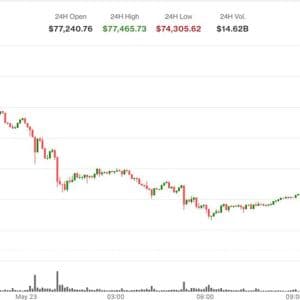
Bitcoin News Bitcoin sank to $74,305 in early Saturday trading, marking its lowest print since April 20 and capping a brutal stretch that has shaved roughly 10% off the cryptocurrency from a recent...
23 May 2026, 11:15
Ronin’s Comeback: Coinbase Listing, Ethereum L2 Migration, and RON Supply Shock

Ronin, the gaming-focused EVM chain behind Axie Infinity, has been staging a quiet revival. Fresh exchange attention, talk of an Ethereum Layer-2 (L2) trajectory, and tightening liquid supply of RON have put the network back on watchlists. If you’re weighing whether to engage with RON—by trading it, staking, or building on Ronin—this guide breaks down how a Coinbase listing could alter liquidity, what an L2 migration would practically change, and how supply dynamics can create bullish or bearish pressure. AspectWhat to Know Coinbase Listing ImpactListings on major U.S. exchanges often expand fiat on-ramps and liquidity, but can trigger short-term volatility and listing-day whipsaws. Ethereum L2 NarrativeA shift toward L2 mechanics would affect fees, security trade-offs, and how assets bridge—good for UX, but introduces new risks to study. RON Supply DriversValidator staking, exchange custody, dApp sinks, and vesting unlocks influence the liquid float and price discovery. For BuildersEVM compatibility and gaming tooling are strengths; an L2 stack could add easier liquidity access and shared security at the cost of new constraints. Key RisksSmart-contract risk, bridge exploits, regulatory shifts, token unlocks, and rumor-driven narratives can all move markets abruptly. Due DiligenceVerify listings, check circulating supply on aggregators, and watch official announcements before acting on headlines. Core Concepts: Ronin, RON, and the Narratives Ronin launched as an EVM-compatible appchain built by Sky Mavis to support blockchain games, most notably Axie Infinity. It prioritizes low fees and fast confirmations for game loops and on-chain assets such as NFTs and in-game currencies. The ecosystem includes the Katana DEX, Ronin Wallet, and an expanding lineup of game studios. RON is the network’s native token used for gas, staking/delegation, and governance. Its market dynamics depend on how much RON is locked by validators and delegators, held in exchange custody, used in dApps, or freed by unlock schedules. Liquidity conditions shift when new exchanges add spot/derivatives markets or when on-chain incentives change. Three storylines shape the current debate: the impact of a Coinbase listing on liquidity and user access; the strategic question of whether Ronin embraces an Ethereum L2 architecture (or integrates more deeply with it); and the possibility of a “supply shock,” where reduced liquid float meets rising demand. Key terms, in plain English RON: Ronin’s native token used for gas, staking, and network governance. Validator/Delegator: Validators produce blocks and secure the chain; delegators stake RON with validators for a share of rewards. Appchain: A dedicated blockchain tailored to a specific use case, like gaming, often with custom economics and tooling. Ethereum L2: A scaling layer that batches transactions and posts data to Ethereum, inheriting aspects of its security while offering lower fees. Bridging: Moving assets between chains or layers via smart contracts or custodial methods; a prime area for security diligence. Step-by-Step Playbook Confirm the listing status: Check official Coinbase channels and Ronin announcements to verify if/when RON is listed, supported regions, and trading pairs. Map your custody plan: Decide whether you’ll hold RON on a centralized exchange, self-custody via Ronin Wallet, or a hardware wallet that supports EVM assets. Evaluate liquidity venues: Compare spreads and depth on major exchanges with on-chain liquidity on Katana and other DEXs; slippage matters during volatile windows. Understand staking mechanics: If delegating RON to validators, learn lock-ups, reward variability, and validator reliability before committing. Assess the L2 path: If Ronin signals an L2 transition or deeper L2 integration, review how bridging, fees, and contract deployment will change for your use case. Track the supply map: Use reputable trackers (e.g., CoinGecko/CoinMarketCap for circulating supply; token unlock dashboards) to anticipate emissions and cliffs. Risk-budget your exposure: Size positions for volatility, set stop-loss or alert levels, and avoid leverage until liquidity stabilizes after any listing news. Document taxes and fees: Record cost basis for RON purchases, staking rewards, and gas to avoid end-of-year headaches (rules vary by jurisdiction). How a Coinbase Listing Rewires Liquidity Listings on large U.S.-facing exchanges tend to broaden access, add fiat on-ramps, and improve price discovery. If RON is listed on Coinbase, expect a larger retail funnel, institutional-grade custody pathways, and potentially new market pairs. Liquidity often improves, but the path is rarely smooth on day one. Short-term, order books can gap on headlines, creating wicks that punish market orders. Over the medium term, more venues and market-makers typically compress spreads and reduce slippage. For builders, a listing can make in-game token economies easier to onboard, as players can fund wallets more simply. For holders, enhanced off-ramps can reduce custody risk concentration on smaller exchanges. Always confirm the precise listing details: supported jurisdictions, whether deposits/withdrawals are open at the same time as trading, and any transfer memos. Mismatches between trading go-live and deposit readiness can cause unexpected delays or premiums. What an Ethereum L2 Shift Would Actually Change The L2 thesis is straightforward: inherit more of Ethereum’s security and liquidity gravity while keeping fees low via rollup compression. For a gaming chain, that could mean cheaper asset portability to the broader Ethereum ecosystem and smoother integrations with DeFi liquidity hubs. In practice, moving from an appchain model to an L2 (or adding an L2 component) comes with trade-offs. Data availability fees, sequencer design, and bridging UX must be re-architected. Contracts may need redeployment, indexers adjusted, and dev tooling updated. Users would likely interact with new bridges or canonical rollup gateways; on the plus side, asset composability could improve markedly. As of writing, any L2 migration talk around Ronin should be validated via official channels before you act on it. The broader takeaway: if Ronin moves toward L2 rails, expect a transition phase where liquidity, fees, and tooling evolve—opportunities for agile builders, but also a window for misconfigurations and impostor bridges to appear. DimensionRonin Appchain (Today)Potential Ethereum L2 Path Security ModelValidator set and chain-specific consensusRollup security anchored to Ethereum, sequencer design matters FeesLow, predictable for gaming loopsLow at user level; costs depend on data availability and batching Liquidity AccessPrimarily native DEXs and bridgesCloser to Ethereum liquidity, easier routing to DeFi hubs Dev ExperienceEVM-compatible, custom gaming stackEVM-compatible; must align with rollup infra and canonical bridges User OnboardingRonin Wallet + exchange listingsL2 wallet flows; potentially simpler interop with ETH mainnet Risk ProfileChain-level and bridge-specific risksRollup-specific risks (sequencer, bridges, DA), plus Ethereum dependencies Pro tip: If an L2 transition is announced, treat the bridge like a new product launch—start with small transfers, verify contract addresses from official sources, and wait for post-launch audits where possible. Decoding the RON “Supply Shock” Narrative “Supply shock” describes a scenario where available tokens for trading shrink while demand rises. For RON, four levers influence the liquid float: Staking & validator lock-ups: Delegation removes RON from active circulation. If staking yields look competitive relative to perceived risk, more holders may lock up tokens. Exchange custody: New listings can temporarily concentrate coins on centralized exchanges (CEXs). Depending on incentives, coins might flow off-exchange into staking or remain parked as dry powder for trading. dApp sinks and utility: If more games and marketplaces require RON for fees or features, day-to-day usage can absorb circulating supply. Vesting and unlocks: Team, investor, or ecosystem allocations unlocking add supply. Cliff events can overwhelm buy pressure if they coincide with risk-off markets. No single factor guarantees a supply squeeze. Instead, watch how these forces overlap. A listing that broadens access while staking and dApp demand grow, timed during a lull in unlocks, can create upward pressure. Conversely, a large unlock during broad crypto weakness can negate other tailwinds. For monitoring, compare circulating supply on reputable aggregators and cross-check token unlock trackers for schedules and any changes announced by the project. Be cautious with dashboards that estimate emissions; validate against official documentation and communications. Who Benefits: Players, Builders, or Token Holders? In gaming ecosystems, value often accrues to fun, sticky experiences first. Players benefit when gas is low and assets move easily. Builders benefit from reliable tooling, liquidity access for their in-game economies, and clear platform support. Token holders benefit when utility expands faster than supply. A Coinbase listing can help all three groups by simplifying on-ramps and improving liquidity. An L2 tilt could reduce frictions to interact with Ethereum-native tooling, creating more opportunities for game assets to find markets. But each benefit line has a trade-off: compliance and listing rules may restrict access in some regions, L2 fees can fluctuate with Ethereum data costs, and token velocity may increase if assets are easier to move across venues. Pitfalls & Red Flags Announcement vs. rumor: Verify listings and migration plans from official Ronin and exchange channels. Impostor accounts routinely front-run hype cycles. Impersonation and fake tokens: New ticker attention invites scam contracts and phishing sites. Always confirm contract addresses from official documentation. Bridge risk: Whether appchain or L2, bridges are high-value targets. Use canonical bridges, start small, and avoid unverified third-party relays. Liquidity traps: Listing-day spreads and thin books can trigger slippage and liquidations. Prefer limit orders and avoid excessive leverage. Unlock overhang: Token cliffs can overwhelm buy pressure. Map out schedules and avoid overexposure near major unlock events. Validator concentration: Staking with a small set of validators can amplify slashing or downtime risk. Diversify delegates where possible. For ongoing coverage and level-headed analysis on crypto markets, you can always visit Crypto Daily . Frequently Asked Questions Has Coinbase listed RON and what should I check before trading? Always confirm on Coinbase’s official channels and Ronin’s announcements for the current status, supported regions, trading pairs, and whether deposits/withdrawals are live. Listing timelines can differ by jurisdiction and product (e.g., retail vs. institutional). How would an Ethereum L2 approach affect fees and speed for games? Users would likely see low fees and fast confirmations, similar to today, but the fee composition changes due to rollup mechanics and data availability costs. Net impact depends on sequencer design, batching efficiency, and Ethereum base-layer congestion. What does a RON “supply shock” look like in data? Rising staking ratios, increasing on-chain activity that consumes RON, and declining exchange balances alongside steady or rising demand. Cross-check circulating supply, staking dashboards, and exchange reserves for a complete picture. Is staking RON risk-free? No. Smart-contract risk, validator performance, potential slashing, and lock-up terms all matter. Review validator history, fees, and any independent audits before delegating. How should builders prepare for a possible L2 transition? Audit contract dependencies, plan for redeployments if needed, test bridges on testnets, and coordinate with indexers, wallets, and marketplaces. Communicate migration steps early to users to minimize disruption. What’s the safest way to bridge assets if architecture changes? Use official, well-documented bridges only. Verify URLs and contract addresses from primary docs, start with small test transfers, and avoid interacting with contracts without verified source code and audits. Where can I track RON’s circulating supply and unlock schedules? Use reputable market aggregators for circulating supply and recognized token unlock trackers for schedules. Validate any figures against official Ronin communications for the most accurate view. Disclaimer: This article is provided for informational purposes only. It is not offered or intended to be used as legal, tax, investment, financial, or other advice.
23 May 2026, 11:10
Dogecoin Price Prediction: DOGE Targets Higher Move Above Resistance

Dogecoin is pressing against a key resistance zone after forming another rounded base on the weekly chart. Traders are watching whether DOGE can break its descending trendline and hold above the $0.10 to $0.11 area Dogecoin Price Setup Points to Meme Coin Breakout Dogecoin is holding near a long term horizontal support area after months of sideways price action. The chart shared by TraderSZ on X compares the current DOGE structure with an earlier breakout pattern that led to a sharp rally. The main level is the yellow support line near the lower range. DOGE has returned to that zone several times, but sellers have not pushed price far below it. That shows the market is still defending the base. DOGE Similar Pattern Chart. Source: TraderSZ on X The chart also shows a descending resistance line above the current structure. DOGE needs to break that line before the setup can confirm a stronger move. Until then, the chart remains in consolidation. TraderSZ’s point is that DOGE may be repeating a similar pattern from the previous cycle. The earlier setup showed a long base, a breakout, and then a larger move higher. The current chart now shows another base with price sitting under trendline resistance. If DOGE breaks above the descending line, the first major area to watch would be the previous local high zone. A stronger breakout could then open the way toward the blue target area shown on the chart. However, the support line still matters first. If Dogecoin loses that base, the bullish meme coin setup weakens. For now, DOGE needs a clean breakout before the larger meme coin run case becomes stronger. Dogecoin Price Tests 3 Month Resistance as DOGE Setup Points Higher Dogecoin is testing a key 3 month resistance zone after forming another rounded bottom on the weekly chart. The chart shared by Moe on X shows DOGE holding above its recent base while price pushes back into the same resistance area that mattered before the late 2024 rally. The setup compares the current DOGE structure with the earlier bottom formed in 2024. Back then, Dogecoin built a base, reclaimed resistance, and moved sharply higher afterward. Moe suggests the current structure could follow a similar path if DOGE keeps holding above the breakout area. DOGE 3 Month Resistance Chart. Source: Moe on X The green resistance band sits around the $0.10 to $0.11 area. DOGE has already moved into that zone, but the chart shows price still needs stronger follow through to confirm a clean breakout. The “no upper wick” note points to a weekly candle structure where sellers did not strongly reject the move from the top. That can show stronger buyer control, especially if the next candles continue to hold above the same zone. The lower support area now matters because DOGE recently broke above it and retested it. If price holds that level, the chart keeps the bullish structure active. A loss of that support would weaken the setup and put the recent bottom back in focus. For now, DOGE sits at an important decision point. A clean weekly hold above the 3 month resistance could strengthen the case for a larger move higher, while rejection from the same zone would keep Dogecoin inside its broader range.
23 May 2026, 11:05
Solana Price Prediction: SOL Faces $125 Test After Breakout
Solana is trading between two clear chart signals, with one setup showing weak corrective rallies and another pointing to a possible breakout retest. SOL needs to hold the $84 to $85 area and clear nearby resistance before the $125 target becomes stronger. Solana Price Struggles as SOL Rejects Corrective Rallies Solana traded near $84.68 on the 4 hour chart after another rejection from a short term recovery move. The chart shared by More Crypto Online on X shows SOL failing to hold above the nearby resistance zone around $87. The main issue is clear. SOL keeps bouncing, but each rally loses strength before price reaches the larger resistance near $95 to $96. That area acted as a major rejection zone earlier in May. As long as SOL stays below it, the recovery structure remains weak. SOL Corrective Rally Rejection Chart. Source: More Crypto Online on X The nearest support sits around $82, marked by the red horizontal line. If Solana loses that level, the chart points back toward the main range support area between $77.96, $75.41, and $71.92. These levels match the 50%, 61.8%, and 78.6% Fibonacci retracement marks shown on the chart. The orange support zone matters because it has held previous downside moves. A deeper move into that area would not fully break the larger range, but it would show that buyers still lack control. For the upside case, SOL needs a clean move above $87 first. Then, the more important level remains $95 to $96. A break above that zone would weaken the bearish setup and open room for a stronger move toward the higher Fibonacci extension area near $110, $120, and $128. For now, the chart supports More Crypto Online’s point. SOL has not shown enough strength after corrective rallies. The price remains stuck between short term resistance and the main support range, with $82 as the first level to watch. Solana Price Breakout Keeps $125 Target in View Solana traded near $87.60 on the 4 hour chart after breaking out from a large triangle structure. The chart shared by ray on X shows SOL moving above the long descending resistance line that capped price action since February. The breakout is the main point here. SOL spent months moving inside the triangle, with lower highs and higher lows tightening the range. After the breakout in May, price rallied toward $98, then pulled back into the former breakout area. SOL Triangle Breakout Chart. Source: ray on X That pullback looks like a retest. SOL held near the $84 to $85 zone and started moving higher again. This keeps the bullish structure alive as long as price does not lose that support. The first resistance now sits around $90 to $92. If SOL clears that area, the next major level is the previous local high near $98. A clean move above $98 would strengthen the case for a larger rally. The chart’s upside target is $125. That level sits above the previous breakdown zone and marks the main target shown on the chart. However, SOL still needs confirmation. If price falls below $84, the breakout retest weakens. A deeper drop could send SOL back toward $80 or even the lower range near $76. For now, the chart shows a stronger setup than the previous one. SOL has broken the triangle, retested support, and started to recover. The $125 target stays active while price holds above the breakout zone.
23 May 2026, 11:02
We Asked Elon Musk’s AI Where XRP Will Trade On June 1, 2026, Here’s What It Says
Artificial intelligence continues to influence discussions across the cryptocurrency sector, with investors increasingly turning to AI-driven models for market insights and price forecasts. One of the latest predictions attracting attention comes from Grok, the artificial intelligence chatbot developed by xAI under the leadership of Elon Musk. The AI model recently offered its outlook for XRP’s price heading into June 1, 2026, presenting a detailed explanation grounded in technical indicators, trading activity, and broader market dynamics. The prediction arrives at a time when XRP remains one of the most closely monitored digital assets in the market. Traders continue to assess whether the token can regain stronger momentum after a period of consolidation. While optimism surrounding institutional adoption and futures-related developments remains, market participants are also weighing macroeconomic uncertainty and broader Bitcoin dominance over the altcoin market. Grok Predicts XRP Could Reach $1.42 According to Grok, “Pinpointing an exact price for a highly volatile cryptocurrency just over a week from now is mathematically impossible, but looking at current market data, standard moving averages, and order book consolidation, a realistic target for June 1, 2026, is $1.42.” The AI model emphasized that its estimate is based on current technical conditions rather than speculation about sudden market events or unexpected news catalysts. Grok explained that one of the biggest factors influencing its forecast is what it described as “moving average gravity.” The chatbot noted that XRP has been trading around $1.38 while remaining slightly below its short-term exponential moving averages, specifically the 20-day and 50-day EMAs. At the same time, the 200-day moving average reportedly sits near $1.45. Grok argued that assets consolidating beneath major long-term moving averages often move up to retest those levels. Based on that structure, the AI concluded that a move toward $1.42 represents a likely midpoint before XRP potentially challenges the broader resistance zone. Trading Volume and Market Rotation Support the Outlook The chatbot also pointed to changing capital rotation trends within the crypto market. According to Grok, Bitcoin’s recent dominance has weakened momentum across many altcoins, including XRP. However, the AI stressed that XRP’s rising trading volume suggests investors are still actively participating in the market rather than abandoning their positions. Grok stated that XRP trading volume recently increased by more than 60%, which it interpreted as evidence of accumulation in the $1.34 to $1.36 support range. We are on X, follow us to connect with us :- @TimesTabloid1 — TimesTabloid (@TimesTabloid1) June 15, 2025 In Grok’s assessment, the current environment reflects repositioning rather than panic selling. The AI suggested that once Bitcoin’s local rally relaxes, part of the market’s liquidity could rotate back into major altcoins at the start of June. That shift, according to the prediction, could help XRP gradually climb back toward the projected $1.42 level. The AI also mentioned the continued growth of tokenization activity tied to blockchain-based financial assets. Still, Grok cautioned against expecting immediate explosive price action from those developments. The chatbot argued that institutional infrastructure and adoption trends generally influence markets over extended periods rather than triggering rapid price surges within a single week. As a result, the AI maintained that XRP is more likely to remain within its established trading range instead of experiencing an aggressive breakout before June begins. Disclaimer : This content is meant to inform and should not be considered financial advice. The views expressed in this article may include the author’s personal opinions and do not represent Times Tabloid’s opinion. Readers are advised to conduct thorough research before making any investment decisions. Any action taken by the reader is strictly at their own risk. Times Tabloid is not responsible for any financial losses. Follow us on X , Facebook , Telegram , and Google News The post We Asked Elon Musk’s AI Where XRP Will Trade On June 1, 2026, Here’s What It Says appeared first on Times Tabloid .


