


 Invest ideas
News
21 May 2026, 14:02
This Mainstream Media Posted Bullish Trump Crypto Report With Ripple (XRP) Logo

NewsMax published a report on Tuesday about the Trump administration’s plans for digital securities trading. The outlet chose to illustrate it with the Ripple (XRP) logo. That choice did not go unnoticed. Software engineer Vincent Van Code (@vincent_vancode) responded directly to the post. He noted that NewsMax either has inside knowledge or is deliberately targeting XRP community traffic. He added, “I would take it with a grain of salt.” This news site posted a Ripple logo, they either know something or just want XRP army traffic to their site. I would take it with a grain of salt. https://t.co/qsbxSQVAs7 pic.twitter.com/Tc9jLlPSFB — Vincent Van Code (@vincent_vancode) May 19, 2026 What the Report Says The substance of the NewsMax report is significant on its own. The Trump administration plans to unveil a framework for trading tokenized or digital versions of securities, according to Bloomberg News, which cited people familiar with the matter. Tokenized securities represent a major area of interest in the current regulatory environment. The move would create pathways for crypto assets to operate within traditional financial markets. XRP has long been associated with institutional financial infrastructure, which makes the logo choice notable to many in the community. Why the Logo Choice Matters to XRP Holders NewsMax did not name XRP or Ripple in the report. The logo appeared as the article’s featured image. NewsMax either knows something or wants the traffic. XRP has one of the most engaged communities in crypto . The XRP Army follows developments closely and searches aggressively for news. A Ripple logo on a high-profile policy story pulls that audience in. It costs nothing editorially and drives significant clicks. XRP also carries a unique history with securities law. The SEC wrongly classified XRP as an unregistered security for years before Ripple won key court rulings . That battle kept XRP at the center of every conversation about crypto regulation and securities law. A story about tokenized securities trading is exactly the kind of headline the XRP community gravitates toward. NewsMax knows that. We are on X, follow us to connect with us :- @TimesTabloid1 — TimesTabloid (@TimesTabloid1) June 15, 2025 Do They Know Something? The other possibility is more straightforward. The Trump administration is building a framework for digital securities trading. Ripple’s core technology targets institutional finance and cross-border settlements. If XRP plays a role in whatever the administration announces, using the logo now would make editorial sense. No confirmation exists, and no source named Ripple. The logo choice remains unexplained. But it appeared in a story about digital securities policy at a moment when the administration is actively shaping crypto regulation. That timing is worth paying attention to. Disclaimer : This content is meant to inform and should not be considered financial advice. The views expressed in this article may include the author’s personal opinions and do not represent Times Tabloid’s opinion. Readers are advised to conduct thorough research before making any investment decisions. Any action taken by the reader is strictly at their own risk. Times Tabloid is not responsible for any financial losses. Follow us on X , Facebook , Telegram , and Google News The post This Mainstream Media Posted Bullish Trump Crypto Report With Ripple (XRP) Logo appeared first on Times Tabloid .
21 May 2026, 14:00
SpaceX Reveals $1.45B Bitcoin Stash In S-1 Filing, Surpassing Market Estimates

Blockchain analysts had it wrong — by a wide margin. When SpaceX filed its S-1 registration statement with US securities regulators ahead of its planned June 12 stock market debut, the company disclosed Bitcoin holdings that were more than double what tracking firms had estimated. A Closer Look At The Numbers SpaceX reported owning 18,712 Bitcoin valued at roughly $1.45 billion as of March 31. That figure caught much of the crypto world off guard. Companies like BitcoinTreasuries.NET and Arkham had pegged the company’s holdings at around 8,285 Bitcoin — less than half the actual amount. The coins were purchased at an average price of $35,320 each, according to the SEC filing. At current prices, the position represents a substantial gain. The disclosure places SpaceX seventh among publicly listed companies by Bitcoin holdings. That ranking is set to become official once the company completes its IPO, which would push it past several well-known names in the corporate Bitcoin space. Bigger Than Tesla SpaceX’s stash also puts it ahead of Tesla, the electric vehicle company also led by Elon Musk. Tesla holds 11,509 Bitcoin — roughly 7,000 fewer coins. Both companies began buying Bitcoin around the same time. Reports indicate SpaceX started accumulating the cryptocurrency in early 2021, right around when Tesla made its own move into digital assets. The parallel timing suggests Bitcoin adoption across Musk’s companies was no coincidence. The IPO itself carries numbers that are hard to ignore. SpaceX is aiming to raise around $75 billion, with an estimated company valuation ranging from $1.75 trillion to $2 trillion. If achieved, it would rank as the largest public offering in capital markets history. The company says it is targeting what it described in its filing as the largest addressable market in human history — a $28.5 trillion opportunity spanning artificial intelligence, space exploration, and global connectivity. A New Layer For Investors Once SpaceX begins trading, its stock will offer investors something beyond aerospace exposure. Owning shares would also mean indirect access to one of the largest corporate Bitcoin positions among public companies. That combination — rockets, satellites, AI ambitions, and a billion-dollar crypto holding — gives the offering a profile unlike most traditional IPOs. SpaceX joins a short list of major corporations that have moved Bitcoin onto their balance sheets in a meaningful way. The company’s filing makes clear the position was not a small experiment. Nearly 19,000 coins held over several years points to a deliberate, long-term strategy — one that was largely hidden from public view until now. Featured image from Unsplash, chart from TradingView
21 May 2026, 13:53
Crypto platform Blockchain moves ahead with confidential IPO filing

Blockchain.com has confidentially filed for an initial public offering in the United States, the cryptocurrency exchange said on Thursday, marking another potential public market debut from the digital asset sector. Confidential filings with the US securities regulator allow companies to prepare for initial public offerings away from public market scrutiny. The process enables firms to move forward with listing preparations before publicly disclosing detailed financial information and offering plans. The company said the number of shares to be offered and the proposed price range for the IPO have not yet been determined. IPO details yet to be disclosed The cryptocurrency platform did not provide additional details regarding the timeline of the proposed offering or the expected valuation linked to the listing. The confidential filing comes as digital asset firms continue to explore opportunities in the public markets. However, Blockchain.com stated that the size of the offering and pricing structure remain under discussion. The company repeated that the number of shares to be offered and the price range for the proposed offering have not yet been finalised. One of the crypto industry's oldest infrastructure providers Founded in 2011, Blockchain.com is considered one of the oldest infrastructure providers in the cryptocurrency industry. The platform provides several services across the digital asset ecosystem, including cryptocurrency wallets, a trading exchange, institutional trading solutions, and blockchain data tools. Among its core products is the Blockchain Explorer, a search tool widely used to verify transaction data across public blockchain networks. The company also operates digital wallet services that include both custodial and non-custodial offerings. Users can access a DeFi Wallet, where they control their own private keys, alongside custodial trading accounts managed by the platform. Trading and institutional services remain central In addition to wallet services, Blockchain.com operates a cryptocurrency exchange that allows users to buy, sell, and swap dozens of digital assets. The company also provides institutional services aimed at corporate and high-net-worth clients. These services include over-the-counter trading, credit products, and digital asset management solutions. The Blockchain Explorer remains one of the company’s most recognised tools. It allows users to track and view transactions across networks, including Bitcoin, Ethereum, and Bitcoin Cash. The platform processed over $1.2 trillion in transactions According to the company, the platform has historically hosted tens of millions of cryptocurrency wallets and facilitated more than $1.2 trillion in transactions. Blockchain.com said users can access a broad range of services through its trading and wallet infrastructure, while institutional clients continue to use its OTC and digital asset management operations. The company has not yet disclosed when it expects the IPO filing to become public or when shares could begin trading in the United States. The post Crypto platform Blockchain moves ahead with confidential IPO filing appeared first on Invezz
21 May 2026, 13:45
Japanese Yen Consolidates Below 160 Against US Dollar: DBS Analysis

BitcoinWorld Japanese Yen Consolidates Below 160 Against US Dollar: DBS Analysis The Japanese yen is trading in a consolidation phase below the 160 level against the US dollar, according to a recent analysis from DBS. The currency pair has been range-bound, reflecting a balance of market forces as traders assess the outlook for monetary policy in both Japan and the United States. Key Levels and Market Dynamics DBS analysts note that the USD/JPY pair has been hovering near the 160 mark, a level that has historically acted as both support and resistance. The consolidation suggests a period of indecision, with the yen finding some support from expectations of a potential shift in the Bank of Japan’s ultra-loose monetary policy. However, the dollar remains supported by the Federal Reserve’s higher-for-longer interest rate stance. Implications for Traders and the Broader Economy The yen’s position below 160 is significant for Japanese exporters, who benefit from a weaker currency, but it also raises import costs, particularly for energy and raw materials. For global forex markets, the USD/JPY pair remains a key barometer of risk sentiment and interest rate differentials. A sustained break above 160 could signal further yen weakness, while a move lower might indicate renewed confidence in the Japanese economy. What to Watch Next Traders are closely watching upcoming data releases, including US inflation figures and Japanese GDP numbers, as well as any verbal intervention from Japanese officials. The Bank of Japan’s next policy meeting will be a critical event, with any hint of a rate hike potentially strengthening the yen. Conversely, if the Fed maintains its hawkish tone, the dollar could resume its upward trend. Conclusion The yen’s consolidation below 160 reflects a market in wait-and-see mode. With key economic data and central bank decisions on the horizon, the next major move in USD/JPY could define trends for the coming months. DBS’s analysis provides a useful framework for understanding the current technical and fundamental landscape. FAQs Q1: What does it mean when a currency consolidates? Consolidation refers to a period when a currency pair trades within a narrow range, indicating a balance between buyers and sellers. It often precedes a significant breakout or breakdown. Q2: Why is the 160 level important for USD/JPY? The 160 level is a key psychological and technical threshold. Historically, it has acted as a point of resistance or support, and a sustained move above or below it can signal a new trend. Q3: How does the yen’s value affect the Japanese economy? A weaker yen benefits exporters by making their goods cheaper abroad, but it increases the cost of imports, especially energy and food, which can fuel inflation. The Bank of Japan monitors this balance closely. This post Japanese Yen Consolidates Below 160 Against US Dollar: DBS Analysis first appeared on BitcoinWorld .
21 May 2026, 13:40
Ripple Price Analysis: Where’s XRP Going Next After Latest Rejection at the 100-Day MA?
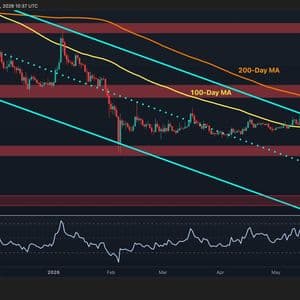
XRP is trading at $1.37 as May draws toward its final week, having erased every gain from what briefly looked like the most promising technical setup of the corrective cycle. The breakout above the 100-day MA on the USDT chart has failed to hold, and a lower high has formed on the BTC pair. The levels that looked like support last week are now the targets that bulls need to reclaim just to get back to where they started. Ripple Price Analysis: The USDT Pair The USDT pair’s daily timeframe setup looked compelling last week. The asset was pressing the upper boundary of the long-term descending channel and holding above the 100-day moving average at around $1.45, with an RSI climbing toward 65. Yet, this move has played out as a textbook rejection. XRP failed to post a single candle close above the channel, and the subsequent sell-off has brought the price back to $1.37. The 100-day MA, which was seen as dynamic support just days ago, is now the nearby overhead resistance at $1.40, sitting just below the descending channel ceiling. The RSI has faded from 65 back to the 40s, wiping out the momentum that made the setup optimistic. The $1.20 demand zone below should now be watched as the potential floor, while a recovery back above $1.45 and the 100-day MA remains the minimum requirement to rebuild any constructive case. Yet, with the broader altcoin market breaking down, the path of least resistance points toward another test of support rather than another attempt at resistance. The BTC Pair The brief breakout above 1,800 sats that appeared on the BTC pair last week has proven to be a fakeout. XRP/BTC has slipped back to around 1,770 sats, creating a lower high at around 1,800-1,900 sats. The RSI, which had recovered from the extreme low of ~25 all the way to above 50 while demonstrating a bullish divergence, has also faded back toward 40. The relief bounce is losing energy before it accomplishes anything structurally meaningful. The failed reclaim of 1,800 sats is the defining development on this pair. It confirms that the oversold bounce was corrective rather than structural, and that the broader downtrend in the ratio remains intact. The 100-day moving average at ~1,900 sats and the 200-day moving average at ~2,100 sats continue to decline well above, offering no nearby reference for a recovery. Below, the lower channel boundary near 1,550 sats and the 1,500 sat horizontal support band remain the next downside targets if the current level gives way. With altcoin sentiment deteriorating across the board, there is little in the near-term macro picture to suggest that pressure is about to ease. The post Ripple Price Analysis: Where’s XRP Going Next After Latest Rejection at the 100-Day MA? appeared first on CryptoPotato .
21 May 2026, 13:31
Cardano Leios Testnet Goes Live as ADA Hovers Near Key Support

Cardano price faces a major breakdown amid the formation of an inverted pennant pattern in the daily time-frame chart. Cardano advances the Leios protocol update to live testing for protocol readiness checks. New features such as Endorser Blocks and committee-based validation aim to improve throughput by 10x to 65x. ADA, the native cryptocurrency of the Cardano ecosystem is down 1% during Thursday’s U.S. market hours to trade at $0.246. The price drop aligns with broader crypto market pullback as Bitcoin price rejects from the $78,000 floor. Despite the intact bearish sentiment in the market, the Cardano network continues to progress in its major scalability update— Ouroboros Leios— expected to boost network throughput by 10x to 65x and drive demand pressure to native cryptocurrency ADA. Cardano Advances Leios Protocol Upgrade to Meet Long-Term Scaling Targets Cardano’s blockchain currently processes approximately 800,000 transactions per month. The company’s internal plans call for a goal of more than 27 million monthly transactions by 2030 and maintaining a stable network even as treasury reserves decrease due to transaction fees. The Leios initiative is the main technical initiative to provide the needed capacity growth within the consensus layer. Leios is not replacing Ouroboros Praos, as it builds on the already existing consensus mechanism. The design preserves the security properties of the network, such as safety and liveness guarantees. It adds features like Endorser Blocks and committee-based validation processes that are expected to provide the throughput improvements of anywhere from 10x to 65x of current throughput. The approach is tuned to ensure decentralization requirements and economic viability of the stake pool operators. Development Status and Timeline Leios is considered the biggest technical development project in Input Output’s current development portfolio. The project continues ongoing from a budget cycle that ends in June 2026. The phase provided the combination of CIP-164, initial performance testing on an alpha implementation, and the release of a special public testnet for Leios. The 2026/27 development cycle focuses on further development of the protocol from the prototype phase to mainnet. The teams will develop software that will go through the Software Readiness Levels (SRL) 5 to 8. The effort is divided into 3 main work streams: Release Candidate Development- The Release Candidate track is the primary development stream. It will involve significant engineering changes as part of the major rewrite of consensus components and the incorporation of new Leios block structures designed for the Dijkstra ledger era. Other work to be done includes a full conformance test suite, based on the formal Agda specification, and integrating the new code into the main implementation of the Cardano node. Validation and Security Testing: A parallel validation track emphasizes systematic testing and risk assessment. These activities involve providing a parameter sweep of timing values and size limits, continuous load testing, and adversarial simulations on the public testnet. This includes the development of a new threat model with documented mitigations, stake-based attacks, network-based attacks, and red-teaming. Hard-Form Preparation: The third track focuses on elements of hard-fork readiness for which Input Output has direct control. This includes the stabilization of client interfaces, technical documentation creation with no dependency on specific implementations, and organising workshops for participants of the stake pool and developers, along with coordination with related projects like DB-Sync, Mithril, and Blockfrost. Additional items are testnet hard-fork executions, a plan for graduating parameters on mainnet, contingency plans, and preparation of new guardrails scripts and supporting rationale documents for governance review. These activities are completed and do not need to be linked to a real mainnet release plan. Leadership and Execution Carlos Lopez De Lara and Sebastian Nagel lead the initiative at Input Output. Delivery includes teams of engineers from various disciplines such as consensus protocols, ledger systems, networking, cryptography, node development, API development, performance optimization, tracing, testing, research and formal methods. “We have been researching and prototyping Leios for years. The science is done. Now we deliver it. When this ships, Cardano’s throughput story changes permanently.” said Carlos Lopez De Lara. Expected Technical Outcomes Upon completion, the project will deliver a Leios release candidate, ready for mainnet deployment across subsequent readiness stages. Validation work will produce detailed insights from load testing and adversarial analysis, supported by an updated threat model. Hard-fork preparation tasks will provide the required interfaces, documentation and support for ecosystem participants. The capacity boosts are designed to accommodate increased transaction volumes for additional activity in decentralized finance, real-world asset tokenization, and enterprise solutions. This infrastructure development targets core network metrics, including monthly transaction throughput and sustained operational scalability, while preserving the protocol’s original design principles. The final selections of parameters and their activation will be made after testing phases and community governance processes have been completed. It reflects the ongoing efforts of the Cardano engineering team to get the consensus layer’s performance to match the long-term anticipated needs of the network. Cardano Price May Extend Correction Trend with this Breakdown Over the past three months, the Cardano price has fluctuated in a narrow range between two converging trendlines of the daily chart. Following the January 2026 correction, this current consolidation indicates the formation of a classic bearish continuation pattern called inverted pennant. With today’s price drop, the Cardano ADA -0.40% price is just 1.3% away from challenging the pattern’s support trendline at $0.244. A potential bearish breakdown below the bottom trendline will complete the chart pattern and drive a prolonged correction towards $0.22 support. ADA/USDT -1d chart Alternatively, if the buyers continue to defend the support trendline, the Cardano price will prolong its consolidation within pennant structure till late-May.


