


 Invest ideas
News
20 May 2026, 09:58
Algorand Officially Debuts on Robinhood US: A Boost for Retail Accessibility

Algorand (ALGO) token is now fully tradable on Robinhood for U.S. retail users, ending a multi-year freeze that traced directly to the SEC’s 2023 enforcement wave. The listing restores a domestic retail gateway for one of the tokens most visibly caught in the crossfire of the agency’s campaign to classify crypto assets as unregistered securities. The regulatory overhang was explicit. In June 2023, the SEC’s complaint against Coinbase named ALGO specifically as an unregistered security, citing Algorand’s early token sales and promotional activity as evidence of an investment contract. $ALGO is now available to trade on Robinhood Crypto, including NY. pic.twitter.com/HBqM2MZ9zA — Robinhood (@RobinhoodApp) May 19, 2026 That single filing triggered a wave of U.S. platform restrictions. Robinhood’s U.S. app quietly shifted ALGO to view-only status, displaying price data while blocking trades. Robinhood Europe, operating under EU frameworks where ALGO is treated as a standard crypto asset, had already offered full ALGO spot trading throughout that period. The divergence between the same company’s U.S. and European product lines was the clearest possible illustration of how much regulatory jurisdiction shapes retail access. Discover: The best pre-launch token sales What the Robinhood Listing Actually Changes for Algorand (ALGO) The directional signal here is unambiguous. When a major U.S. retail brokerage, one that previously restricted a token citing compliance risk, restores full trading access, it reflects a recalibrated internal legal assessment. Robinhood’s platform reaches millions of retail users across all 50 states, and the decision to support ALGO under its existing New York State Department of Financial Services license is a statement about where the platform now places the token on the regulatory risk spectrum. $ALGO is a top 10 coin and I'm tired of pretending it's not. https://t.co/9XzhIeRu35 — geek.algo (@AlgorandAddict) May 20, 2026 The broader regulatory environment has shifted materially since 2023. The post-Gensler SEC has retreated from the enforcement-first posture that produced the ALGO security classification, and the CLARITY Act reaching the Senate floor signals that legislative frameworks are advancing to replace the old guidance-by-lawsuit approach. Robinhood’s move fits that arc; it is listing an asset that remains in legal gray territory technically, but where the practical enforcement risk has diminished enough to clear internal compliance thresholds. Robinhood’s Bitstamp acquisition adds another layer. Bitstamp, now branded “Bitstamp by Robinhood”, has operated active ALGO/USD markets for years, meaning the infrastructure and liquidity rails for ALGO already existed within Robinhood’s corporate footprint before the U.S. retail launch. Source: ALGOUSD / Tradingview This was an alignment exercise as much as a new listing. Community threads on r/Algorand have framed the development as a “validation” step, with the consensus being that rebuilding presence on major U.S. retail brokerages is a prerequisite for ALGO recovering meaningful domestic retail volume. Discover: The best crypto to diversify your portfolio with The post Algorand Officially Debuts on Robinhood US: A Boost for Retail Accessibility appeared first on Cryptonews .
20 May 2026, 09:52
Can XRP rebound from $1.32 support as ETF demand grows?
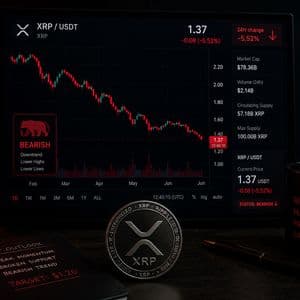
The cryptocurrency market is having a poor start to the week, with Bitcoin and Ethereum trading below key levels. XRP, Ripple’s native coin, also lost the $1.41 support level over the weekend and is now trading around $1.370 per coin. The bulls are holding XRP above the $1.32 support zone. The price could surge higher in the near future, as institutional demand continues to grow. However, the momentum indicators still show a bearish market condition, with the sellers firmly in control. Institutional demand for XRP funds continues to grow Similar to Solana, institutional demand for XRP funds continues to increase. Last week, XRP spot ETFs recorded $60.5 million in net inflows, partially offsetting broader outflows. The trend has continued this week, with the ETFs recording an inflow of $10.7 million on Monday and another $1.45 million on Tuesday . However, retail demand for XRP is cooling as shown by the declining crypto Fear & Greed Index. This index measures market sentiment, and it has now dropped to 25 in the Extreme Fear territory on Wednesday, down from 28 the previous day and 49 last week. The derivatives data is showing signs of activity in the market. According to CoinGlass , XRP’s futures Open Interest (OI) stands at $3 billion on Wednesday, higher than the $2.8 billion recorded the previous day. The rising OI suggests growing retail activity in the market. Meanwhile, the OI-Weighted Funding Rate flipped positive on Monday and now reads 0.0063%. The positive OI-weighted funding rate suggests that traders are starting to open buy positions in the market. If this metric remains positive, the market could see increased retail participation over the next few days. XRP price outlook: Is XRP getting ready for a bounce back? The XRP/USD 4-hour chart remains bearish and efficient despite the broader crypto market stabilizing in the last few hours. Currently, XRP is trading at $1.370, which is still below the EMA-20 ($1.4150), EMA-50 ($1.3939), and EMA-200 ($1.7149) levels. The momentum indicators are still within the negative territories, suggesting that the selloff might still be in play. The MACD lines are within the negative territory but holding above the oversold area. The RSI of 39 suggests that the bearish trend is slowly fading. If the market conditions improve, the bulls could push XRP’s price higher towards the first resistance level at $1.415. A daily candle close above this level would allow XRP to extend its rally towards the $1.4477 resistance area. However, if the bears remain in control, they will encounter the first major support at $1.32. Failure to defend this support level would indicate a bearish extension, exposing lower demand zones. The broader crypto market conditions remain bearish, and unless buyers step in, Bitcoin, XRP, and other major cryptocurrencies could continue to underperform. The post Can XRP rebound from $1.32 support as ETF demand grows? appeared first on Invezz
20 May 2026, 09:45
Australian Dollar Edges Higher but Gains Remain Fragile as Markets Await FOMC Minutes

BitcoinWorld Australian Dollar Edges Higher but Gains Remain Fragile as Markets Await FOMC Minutes The Australian dollar (AUD) managed a modest recovery against the US dollar (USD) during Tuesday’s trading session, clawing back some of the previous week’s losses. However, the upside remains constrained as a broadly firm US dollar continues to weigh on risk-sensitive currencies, with traders now squarely focused on the release of the Federal Reserve’s Federal Open Market Committee (FOMC) meeting minutes, scheduled for Wednesday. AUD/USD Finds Temporary Support, but Resistance Looms The AUD/USD pair edged higher, trading near the 0.6570 level after dipping to multi-week lows earlier in the week. The move appears to be a technical correction following an oversold reading on the daily Relative Strength Index (RSI), rather than a shift in fundamental sentiment. The pair remains under pressure from a combination of factors, including a resilient US economy, sticky inflation data that keeps the Fed cautious on rate cuts, and ongoing concerns about China’s economic slowdown—a key driver for Australian export demand. The immediate resistance zone sits around 0.6600, a level that has acted as both support and resistance in recent weeks. A sustained break above this threshold would be needed to signal a more meaningful recovery, but the prevailing market dynamics suggest that such a move may be short-lived without a catalyst from the Fed. FOMC Minutes in Focus: What Markets Are Watching The primary event risk for the AUD/USD pair this week is the release of the minutes from the Federal Reserve’s January policy meeting. Investors will scrutinize the document for any nuance in the central bank’s stance on inflation, labor market conditions, and the timing of potential interest rate adjustments. Recent US economic data, including stronger-than-expected non-farm payrolls and elevated consumer price index (CPI) readings, have reinforced the narrative that the Fed may need to keep rates higher for longer than previously anticipated. This has pushed US Treasury yields higher and provided a solid floor under the US dollar. If the minutes reveal a more hawkish tone—suggesting that policymakers are in no rush to ease policy—the US dollar could extend its gains, putting renewed downside pressure on the Australian dollar. Conversely, any hints of dovish concerns about economic weakness could trigger a dollar pullback, offering the AUD a temporary reprieve. Why This Matters for Forex Traders and Importers The direction of the AUD/USD pair has real-world implications beyond the trading floor. A weaker Australian dollar makes imports—such as electronics, machinery, and fuel—more expensive for Australian businesses and consumers, potentially feeding into domestic inflation. For exporters, however, a lower AUD can boost competitiveness abroad, particularly in the mining and agricultural sectors. For traders, the pair’s sensitivity to both US monetary policy and Chinese economic data makes it a barometer for global risk appetite. The current environment, characterized by a strong USD and cautious central bank guidance, suggests that AUD/USD may remain range-bound in the near term, with a downside bias. Technical Outlook: Key Levels to Watch From a technical perspective, the AUD/USD pair is testing a critical support zone near the 0.6550 level, which corresponds to the 61.8% Fibonacci retracement of the October-to-December rally. A break below this level could open the door for a move toward the 0.6500 psychological handle, or even the 2023 lows around 0.6450. On the upside, resistance is layered at 0.6600, followed by the 50-day moving average near 0.6650. A close above the latter would suggest that selling pressure is easing, but such a scenario would likely require a significant shift in the macro backdrop. Conclusion The Australian dollar’s modest recovery is a technical bounce within a broader downtrend, and the path of least resistance remains lower as long as the US dollar stays supported by hawkish Fed expectations. The FOMC minutes will be the next major test, and their tone will likely determine whether the AUD can extend its gains or resume its decline. Traders and businesses with exposure to the currency pair should prepare for potential volatility in the aftermath of the release. FAQs Q1: Why is the Australian dollar sensitive to the FOMC minutes? The AUD/USD pair is heavily influenced by the interest rate differential between the Reserve Bank of Australia (RBA) and the Federal Reserve. Hawkish Fed minutes that signal higher-for-longer US rates make the USD more attractive, pressuring the AUD. Conversely, dovish signals can weaken the USD and support the AUD. Q2: What is the key support level for AUD/USD right now? The immediate support is around 0.6550, which aligns with a major Fibonacci retracement level. A break below this could lead to a test of 0.6500, a psychologically important level. Further downside could target 0.6450. Q3: How does China’s economy affect the Australian dollar? Australia is a major exporter of commodities like iron ore, coal, and natural gas to China. When China’s economy slows, demand for these exports falls, reducing Australia’s trade surplus and weakening the AUD. Any negative news from China tends to weigh on the currency. This post Australian Dollar Edges Higher but Gains Remain Fragile as Markets Await FOMC Minutes first appeared on BitcoinWorld .
20 May 2026, 09:35
Why SOL price is struggling even as Solana ETF inflows rise

The market selloff has subsided over the past 48 hours, with Bitcoin, Ethereum, and XRP all stabilizing around key levels. SOL, Solana’s native coin, has also stabilized around the $85 level after losing 11% of its value in the last seven days. The recent bearish performance has not affected the institutional appetite, with the ETFs' inflow still rising. Furthermore, retail interest in Solana is slowly recovering, which could push SOL’s price higher in the near term. Institutional appetite for Solana rises SOL is down by less than 1% in the last 24 hours and is now trading below $85. The bearish performance comes despite rising institutional demand for Solana funds. Data obtained from CoinGlass’s Solana ETF page revealed that spot Solana ETFs recorded inflows of $3.8 million on Tuesday, following inflows of $2.1 million on Monday. Institutional demand has been increasing since the start of the month, with buying pressure rising despite the bearish conditions. Retail traders are not left behind as Solana’s derivatives data paints a bullish picture. Solana’s funding rate turned positive on Tuesday and now reads 0.0063%. The positive funding rate means that the bulls are in control, suggesting that SOL could rally higher in the near term. Furthermore, SOL’s long-to-short ratio has climbed above on Wednesday, nearing the positive territory after reaching the lowest level in over a month on Sunday. The ratio climbing above 1 would reignite the bullish sentiment, with traders now opening long positions in the market. Solana technical outlook: Bears eye the $81 support level The SOL/USD 4-hour chart remains bearish as Solana is down 11% in the last seven days. Despite the rising retail and institutional demand, SOL continues to underperform. The momentum indicators show that Solana is approaching oversold conditions. The RSI of 39 means that Solana is bearish and could enter the oversold territory if the sell-off continues. The MACD lines are still within the negative territory after flipping last week, adding further selling pressure to the pair. If the bullish trend resumes, the buyers would encounter immediate resistance at the $92.96 area. A candle close above this level would allow the bulls to extend their rally towards the $97.89 resistance, with the $100 psychological level also a target. However, if the sellers continue to dominate, initial support would arrive at the $77.71 level, which coincides with the daily Inducement Liquidity (ILQ) zone. Failure to defend this support level could see Solana revisit the $67.50 level, where buyers can step in. The bulls would need to defend the April 29 swing low of $81 in the near term to enable them to push SOL’s price higher. This swing low is crucial as breaking below it could expose lower support levels. The ongoing inflation concerns in the United States continue to affect the broader crypto market. However, with retail and institutional demand still growing, SOL could bounce back in the near term. The post Why SOL price is struggling even as Solana ETF inflows rise appeared first on Invezz
20 May 2026, 09:30
Bithumb to Temporarily Halt Filecoin (FIL) Deposits and Withdrawals for Network Upgrade
BitcoinWorld Bithumb to Temporarily Halt Filecoin (FIL) Deposits and Withdrawals for Network Upgrade South Korean cryptocurrency exchange Bithumb has announced a temporary suspension of deposits and withdrawals for Filecoin (FIL), effective from 9:00 a.m. UTC today. The exchange cited an upcoming network upgrade as the reason for the halt, a routine but critical process to ensure the blockchain’s stability and functionality. Details of the Suspension The suspension applies to all FIL transactions on Bithumb, one of the largest crypto exchanges in South Korea by trading volume. According to the exchange’s official notice, the halt will remain in effect until the network upgrade is completed and the stability of the new protocol is verified. Bithumb has not specified an exact end time but stated that services will resume automatically once the upgrade is fully implemented and the network is deemed secure. Why Network Upgrades Matter for FIL Holders Filecoin, a decentralized storage network, periodically undergoes network upgrades to improve scalability, security, and efficiency. These upgrades often introduce new features or optimize existing protocols. For users, this means that during the upgrade window, transactions may be temporarily unavailable on exchanges that require network synchronization. Bithumb’s proactive suspension is a standard precaution to prevent transaction errors or asset loss during the transition. What This Means for Traders For FIL holders and traders on Bithumb, the suspension means that they cannot move their tokens in or out of the exchange during this period. However, trading pairs involving FIL on the platform may still be active, depending on the exchange’s internal policies. Users are advised to monitor Bithumb’s official announcements for the exact resumption time. Such suspensions are typically short-lived, often lasting a few hours to a day, but delays can occur if unexpected issues arise during the upgrade. Broader Context: Exchange Suspensions and Market Impact While temporary suspensions are routine in the crypto space, they can sometimes lead to short-term price volatility as traders react to perceived liquidity constraints. However, for a scheduled upgrade, the impact is usually minimal. Filecoin’s price has remained relatively stable in recent trading sessions, reflecting the market’s understanding of the event as a standard technical procedure rather than a cause for concern. Conclusion Bithumb’s decision to suspend FIL deposits and withdrawals is a standard operational measure tied to Filecoin’s network upgrade. Users should expect normal service to resume shortly after the upgrade completes. For now, the best course of action is to stay informed through official Bithumb channels and avoid making time-sensitive transactions involving FIL until the suspension is lifted. FAQs Q1: How long will the FIL suspension on Bithumb last? A1: The exact duration has not been specified, but it will last until the Filecoin network upgrade is complete and verified as stable. Typically, such suspensions last a few hours to a day. Q2: Can I still trade FIL on Bithumb during the suspension? A2: The suspension applies only to deposits and withdrawals. Internal trading on the exchange may still be available, but it is best to check Bithumb’s official announcements for any trading-related restrictions. Q3: What should I do if my FIL transaction is pending during the suspension? A3: Pending transactions may be delayed or cancelled. It is recommended to contact Bithumb customer support for specific guidance on your transaction status. This post Bithumb to Temporarily Halt Filecoin (FIL) Deposits and Withdrawals for Network Upgrade first appeared on BitcoinWorld .
20 May 2026, 09:25
Altcoin Season in 2026: What Needs to Happen First?

Altcoin season is one of the most watched ideas in crypto because it describes a period when many non-Bitcoin assets outperform Bitcoin. For traders, it can mean faster-moving markets. For long-term investors, it can mean renewed attention on ecosystems, infrastructure tokens, DeFi, Web3 apps, and emerging narratives. For beginners, it can also be one of the easiest times to make emotional mistakes. In 2026, the useful question is not simply whether altcoins can rise. Individual tokens can outperform at almost any point in the cycle. The more important question is whether the market is ready for a broad and sustained rotation where altcoin strength becomes widespread rather than isolated. That distinction matters. A few strong tokens in Solana, XRP, AI, DeFi, RWA, or gaming categories do not automatically mean “altcoin season.” A real altcoin season usually needs several conditions to line up: Bitcoin dominance softening, liquidity expanding, risk appetite improving, stablecoin supply supporting market activity, and stronger narratives backed by real usage. Key Takeaways PointDetailsAltcoin season needs breadthA few tokens outperforming Bitcoin is not enough. A larger share of major altcoins needs to beat BTC over a sustained period.Bitcoin dominance is a core signalWhen Bitcoin keeps absorbing market share, altcoin rallies often remain narrow and short-lived.Liquidity matters more than slogansStablecoin supply, exchange depth, fund flows, and trading volume can show whether capital is actually rotating.2026 may reward selectivityInstitutional access, regulation, tokenization, and stablecoins may favor stronger projects over speculative “everything rallies.”Tokenomics can block upsideUnlocks, insider allocations, weak liquidity, low float, and poor demand design can pressure tokens even in bullish conditions.Risk control is essentialAltcoins can move quickly in both directions, so position sizing, custody, scam checks, and exit planning matter. The 2026 Setup: Rotation Is More Selective Than Before Altcoin season used to be described as a fairly simple cycle. Bitcoin rallied first, Ethereum followed, large-cap altcoins moved next, and then smaller speculative tokens surged as retail appetite returned. That pattern can still appear, but the 2026 market structure is more complex. Crypto is now more institutionalized. Spot ETFs, regulated custody, stablecoin settlement, tokenized assets, and clearer policy frameworks have changed how capital enters the market. Coinbase Institutional’s 2026 crypto market outlook highlights regulatory progress, institutional participation, tokenization, stablecoins, and macro conditions as major themes for the year. ( Coinbase Institutional ) This matters for altcoins because broad market rallies may be less automatic than in earlier cycles. Capital may rotate into specific sectors where investors see liquidity, usage, credible infrastructure, and clearer regulatory positioning. In other words, a 2026 altcoin season may not lift every token equally. The first rule for 2026 is simple: do not assume all altcoins will move together. A broad rotation could happen, but it may be uneven, narrative-driven, and highly sensitive to liquidity conditions. Signal 1: Bitcoin Dominance Needs to Stop Leading Everything Bitcoin dominance measures Bitcoin’s share of the total crypto market capitalization. CoinMarketCap tracks this metric by comparing Bitcoin’s market cap with the wider crypto market. ( CoinMarketCap Bitcoin Dominance ) This matters because altcoin season is fundamentally about capital rotation. If Bitcoin dominance is rising, more value is concentrating in BTC relative to the rest of the market. That does not mean altcoins cannot rally, but it often means the average altcoin is still struggling to outperform Bitcoin. A healthier altcoin setup usually begins when Bitcoin dominance stops rising and starts moving sideways or lower. This can happen after Bitcoin has already had a strong move, when traders begin looking for higher-beta opportunities, or when specific ecosystems start attracting new users and capital. What to Watch Bitcoin dominance loses momentum after a sustained rise. Ethereum or other major altcoins begin outperforming BTC. Altcoin market capitalization rises without relying only on meme-token speculation. More sectors participate, rather than one temporary narrative leading alone. Strong altcoins show shallower pullbacks than Bitcoin during market dips. The key mistake is treating one short dip in Bitcoin dominance as confirmation. Altcoin season needs follow-through. A temporary dominance decline can be noise; a persistent trend change can indicate a more meaningful rotation. Signal 2: Liquidity Has to Move Beyond Bitcoin and Ethereum A broad altcoin season requires liquidity. Without it, price spikes can be fragile, spreads can widen, and late buyers can get trapped when volume disappears. This is especially important for mid-cap and small-cap altcoins, where order books can be much thinner than they appear during a fast rally. Altcoin season indexes can help measure whether participation is broad. CoinMarketCap’s altcoin season index, for example, looks at whether a large share of top crypto assets has outperformed Bitcoin over a defined period, excluding certain assets such as stablecoins. ( CoinMarketCap Altcoin Season Index ) The exact index level is less important than the concept. A real altcoin season is not only about one popular token. It is about breadth. More assets need to participate, and that participation should be supported by real trading volume rather than thin, short-lived speculation. Practical Liquidity Checks Liquidity SignalWhy It MattersSpot volumeShows whether demand is broad or limited to thin markets.Order-book depthHelps estimate slippage risk when entering or exiting a position.Exchange coverageMore reputable venues can improve access, although they do not remove risk.Derivatives fundingOverheated funding can signal crowded leverage and higher liquidation risk.Stablecoin pairsDeep stablecoin liquidity can support smoother trading.On-chain liquidityImportant for DeFi tokens, DEX trading, and long-tail assets. A token can rise quickly on low liquidity, but that also makes exits harder. During altcoin season, managing liquidity risk is as important as identifying the right narrative. Signal 3: Stablecoin Growth Must Support Risk Appetite Stablecoins are one of the clearest liquidity indicators in crypto. They are used for trading collateral, DeFi liquidity, payments, market-making, and capital parking. When stablecoin supply grows and moves onto exchanges or active on-chain ecosystems, it can support risk-taking. When stablecoin supply stagnates or exits active markets, altcoin rallies may struggle to broaden. Dashboards such as DeFiLlama’s stablecoin tracker can help investors monitor total stablecoin supply, chain-level distribution, and market share across major stablecoins. ( DeFiLlama Stablecoins ) For altcoin season, the direction of liquidity matters more than the headline number. Investors should ask whether stablecoins are moving into exchanges, DeFi protocols, new ecosystems, lending markets, or cross-chain activity. Idle liquidity does not automatically create an altcoin rally. Deployed liquidity is more meaningful. Questions to Ask Before Calling a Rotation Is stablecoin supply expanding or flat? Are stablecoins moving into exchanges, DeFi, or newer ecosystems? Are DEX volumes, lending activity, and bridge flows improving? Is liquidity concentrated in a few chains, or spreading across multiple ecosystems? Are stablecoins being used for real settlement and DeFi activity, or only short-term speculation? Stablecoin growth does not guarantee altcoin upside. It simply creates better conditions for capital to rotate when risk appetite improves. Signal 4: Altcoin Narratives Need Real Evidence Every altcoin season has narratives. Previous cycles have featured smart contract platforms, DeFi, NFTs, metaverse tokens, gaming, meme coins, Layer-2 networks, AI tokens, and real-world asset projects. The danger is that narratives can move faster than fundamentals. In 2026, the strongest narratives may need more evidence than a viral chart or influencer thread. That does not mean every project must already be profitable or fully mature. It means investors should look for signs that a token’s story is backed by actual activity. Evidence Worth Checking Growing active addresses or users. Sustainable protocol fees or revenue. Meaningful developer activity. Useful integrations with wallets, exchanges, apps, or protocols. Deepening liquidity across reputable venues. A clear use case beyond speculation. Transparent governance and upgrade processes. Security audits and a visible incident history. Real demand for the token inside the ecosystem. For example, a DeFi token with actual fee generation deserves different analysis from a token that only promises future rewards. A Layer-2 with real transaction activity and developer adoption is different from one relying mostly on incentives. An AI crypto project with working infrastructure is different from one using AI branding without a clear product. Pro tip: In a real altcoin season, weak tokens can still pump. That does not make them strong long-term investments. Separate “can move fast” from “has durable value drivers.” Signal 5: Tokenomics Must Stop Fighting the Trend Tokenomics can quietly ruin an altcoin thesis. Even when the market is bullish, a token with heavy unlocks, low float, weak demand, or aggressive insider allocations may face constant sell pressure. Before buying into any altcoin season narrative, check the supply structure. A token can look cheap by market capitalization but expensive by fully diluted valuation. It can also appear strong on the chart while early investors, team allocations, or ecosystem incentives are preparing to unlock. QuestionWhy It MattersWhat percentage of supply is circulating?Low float can make price action misleading.Are major unlocks coming soon?Unlocks can create sell pressure or increase volatility.Who holds the supply?Concentrated ownership increases market risk.Does the token capture value?Protocol usage does not always translate into token demand.Are rewards inflationary?High emissions can dilute holders.Is liquidity deep enough?Thin liquidity can exaggerate both rallies and crashes. One common mistake is buying a project because the ecosystem is growing without checking whether the token benefits from that growth. A blockchain, app, or protocol can gain users while its token underperforms if emissions, unlocks, or weak value capture dominate demand. Which Altcoin Sectors Could Lead a 2026 Rotation? No one can know in advance which sectors will lead a future rotation. Still, some areas are worth watching because they connect to broader market themes such as scaling, tokenization, stablecoin settlement, AI infrastructure, and consumer crypto adoption. Layer-1 and Layer-2 Ecosystems Smart contract networks remain central to altcoin speculation because they host DeFi, NFTs, gaming, wallets, stablecoins, and applications. In 2026, investors may focus less on abstract “ETH killer” narratives and more on throughput, developer activity, fees, users, application quality, and ecosystem liquidity. The caution is that many Layer-1 and Layer-2 tokens compete for similar users. Incentive-driven growth can fade quickly if rewards dry up or if applications fail to retain users. DeFi and Revenue-Generating Protocols DeFi may attract renewed attention if users seek on-chain trading, lending, derivatives, yield, or stablecoin infrastructure. Projects with real fees, visible risk controls, and transparent reserves may stand out more than protocols offering unsustainably high APYs. The caution is that smart contract risk, oracle risk, liquidation risk, bridge risk, and governance attacks remain real. High yield is not the same as healthy yield. Real-World Assets and Tokenization Tokenized treasuries, credit products, fund shares, and settlement rails remain one of crypto’s more institution-friendly narratives. However, RWA projects can involve legal structures, counterparties, jurisdictional limits, and compliance assumptions that ordinary token buyers may not fully understand. AI and Decentralized Infrastructure AI-related crypto projects may remain popular because they connect two high-interest markets. Infrastructure tokens linked to compute, data, identity, agents, or decentralized networks could attract attention if they show real usage. The caution is that AI branding is easy to copy. Investors should verify whether the project has working technology, demand, credible economics, and a clear reason for using a token. Gaming, Social, and Consumer Crypto Consumer crypto can move quickly when retail interest returns. Games, social apps, creator economies, and mobile-first crypto products may benefit from cheaper transactions and simpler onboarding. The caution is that many consumer tokens depend on attention cycles. User retention matters more than launch hype. How to Prepare Without Chasing Every Green Candle Altcoin season preparation should happen before the market becomes euphoric. Once every chart is moving, decision quality usually falls. A better approach is to build a watchlist, define criteria, and decide what would invalidate each idea. Build a Watchlist by Category Large-cap infrastructure tokens. Ethereum Layer-2 assets. Solana ecosystem assets. DeFi protocols. RWA and tokenization projects. AI and decentralized compute tokens. Gaming and consumer crypto projects. Meme coins and high-risk speculative assets. This helps compare similar assets instead of treating every altcoin as the same type of opportunity. A DeFi token, a Layer-1 token, a gaming token, and a meme coin should not be evaluated with the same checklist. Define Your Entry Logic Market condition: Bitcoin dominance is weakening and altcoin breadth is improving. Sector condition: The project’s category is gaining volume and attention. Project condition: Usage, liquidity, tokenomics, and roadmap credibility are acceptable. Risk condition: Position size is small enough to survive volatility. Exit condition: Profit-taking and invalidation levels are defined before entry. This does not guarantee success. It simply reduces impulsive decision-making. Avoid Common Altcoin Season Mistakes Buying after a token has already gone vertical. Ignoring token unlock schedules. Using leverage on highly volatile assets. Holding illiquid tokens with no exit plan. Confusing social media attention with adoption. Keeping funds on risky platforms without considering custody. Bridging assets through unknown protocols. Chasing APYs without understanding smart contract or liquidation risk. Treating “altcoin season” as a guarantee rather than a market condition. Regulation is another risk. In the European Union, MiCA creates a harmonized framework for crypto-assets, including rules for transparency, disclosure, authorization, and supervision of crypto-asset service providers and issuers. ( ESMA ) Macro conditions also matter. Altcoins are risk assets, so they can respond sharply to interest-rate expectations, equity-market sentiment, liquidity conditions, and geopolitical uncertainty. When risk appetite fades, altcoin rallies can reverse faster than Bitcoin because many tokens have thinner liquidity and higher volatility. Crypto Daily: Follow the Market Without the Noise Altcoin season can create opportunity, but it can also create confusion. Crypto Daily helps readers follow crypto market structure, Bitcoin dominance, altcoin narratives, regulation, DeFi, Web3, stablecoins, and blockchain infrastructure with an editorial focus on context rather than hype. For readers tracking a possible 2026 altcoin rotation, the goal is not to predict every move. It is to understand which signals matter, which risks are being ignored, and which projects have evidence behind the story. Frequently Asked Questions What is altcoin season? Altcoin season is a period when a broad range of altcoins outperform Bitcoin over a sustained timeframe. It is not just one or two tokens rallying. Most market definitions look for widespread outperformance across major altcoins, often over a multi-week or multi-month window. Is altcoin season guaranteed in 2026? No. Altcoin season is not guaranteed. Market conditions, Bitcoin dominance, liquidity, regulation, macro policy, investor sentiment, and token-specific risks can all affect whether a broad rotation develops. What needs to happen before altcoin season starts? The most important signals are weakening Bitcoin dominance, improving altcoin breadth, rising liquidity, stronger stablecoin flows, broader trading volume, and narratives supported by real adoption or usage. Does Bitcoin have to crash for altcoins to rise? No. Some altcoin rotations happen after Bitcoin consolidates rather than crashes. A stable Bitcoin can give traders confidence to rotate into higher-risk assets. A sharp Bitcoin sell-off, however, can also hurt altcoins because they are often more volatile. Which altcoins usually move first? Historically, large-cap altcoins and strong ecosystem tokens often move before smaller speculative assets. In 2026, sectors such as Layer-1s, Layer-2s, DeFi, RWA, AI infrastructure, and consumer crypto may be watched closely, but leadership can change quickly. How can beginners reduce risk during altcoin season? Beginners can reduce risk by avoiding leverage, checking liquidity, understanding token unlocks, using secure wallets, avoiding unknown links and fake airdrops, and sizing positions conservatively. Research is usually more useful before a rally than during a market-wide surge. Is altcoin season good for long-term investors? It can create opportunities, but it can also inflate weak projects. Long-term investors should focus on fundamentals such as adoption, developer activity, tokenomics, security, liquidity, and real utility rather than assuming every altcoin rally will last. Disclaimer: This article is provided for informational purposes only. It is not offered or intended to be used as legal, tax, investment, financial, or other advice.


