


 Invest ideas
News
20 May 2026, 04:25
Gold Holds Near Lows as Dollar Strength, Fed Rate Bets Weigh on Appeal

BitcoinWorld Gold Holds Near Lows as Dollar Strength, Fed Rate Bets Weigh on Appeal Gold prices remained under pressure on Wednesday, hovering near recent lows as a robust US dollar and expectations of further Federal Reserve interest rate hikes continued to dampen the precious metal’s appeal. The persistent strength of the greenback, supported by hawkish Fed rhetoric and resilient US economic data, has been a primary headwind for gold, which is priced in dollars and becomes more expensive for holders of other currencies when the dollar rises. Dollar Strength and Fed Expectations Drive Sentiment The US dollar index held firm near multi-month highs, reflecting market expectations that the Federal Reserve will maintain higher interest rates for longer than previously anticipated. Recent comments from Fed officials have reinforced a cautious stance on inflation, with several policymakers signaling that additional rate hikes may be necessary to bring price pressures fully under control. This outlook has boosted US Treasury yields, increasing the opportunity cost of holding non-yielding assets like gold. Market pricing now reflects a significant probability of at least one more quarter-point rate increase before the end of the year, with rate cuts not expected until well into 2025. This repricing of monetary policy expectations has been a key factor behind gold’s inability to stage a meaningful recovery from its recent lows. Geopolitical Risks Offer Limited Support While ongoing geopolitical tensions—including the protracted conflict in Ukraine and heightened instability in the Middle East—typically provide a floor for gold as a safe-haven asset, their supportive effect has been limited in the current environment. The overriding influence of dollar strength and rising yields has largely offset safe-haven demand. Analysts note that geopolitical risk premiums are often temporary and can dissipate quickly without a direct escalation. In the current context, investors appear more focused on the macroeconomic outlook and central bank policy trajectories than on geopolitical uncertainties, limiting gold’s upside potential. What This Means for Investors For investors holding gold or considering an entry point, the near-term outlook remains challenging. A sustained break above key resistance levels would likely require a clear shift in Fed policy expectations or a significant deterioration in the global economic outlook. Until then, gold is expected to trade in a range, with support levels tied to the dollar’s strength and the pace of Fed tightening. Diversification remains a key strategy, as gold’s role as a portfolio hedge may still prove valuable if economic conditions deteriorate faster than anticipated. However, the current environment suggests patience is warranted for those looking for a clear catalyst to drive a sustained rally. Conclusion Gold prices remain trapped in a bearish trend, weighed down by a strong US dollar and persistent expectations of further Federal Reserve interest rate hikes. While geopolitical risks provide some underlying support, they are insufficient to overcome the headwinds from monetary policy. The metal’s near-term trajectory will depend heavily on upcoming US economic data and Fed communications for clues on the future path of interest rates. FAQs Q1: Why is the US dollar putting pressure on gold prices? A: Gold is priced in US dollars. When the dollar strengthens, it takes fewer dollars to buy the same amount of gold, pushing prices down. Additionally, a stronger dollar often reflects expectations of higher US interest rates, which makes non-yielding assets like gold less attractive compared to yield-bearing investments. Q2: How do Federal Reserve rate hikes affect gold? A: The Fed raises interest rates to combat inflation. Higher rates increase the opportunity cost of holding gold, which pays no interest or dividends. They also tend to strengthen the dollar, further pressuring gold prices. Expectations of future rate hikes can weigh on gold even before the hikes are implemented. Q3: Can geopolitical risks still push gold higher? A: Yes, geopolitical risks can boost gold’s safe-haven appeal, but their impact is often temporary and can be overwhelmed by stronger macroeconomic forces like dollar strength and interest rate expectations. For gold to rally significantly on geopolitical news, the event would likely need to be severe and directly threaten global economic stability. This post Gold Holds Near Lows as Dollar Strength, Fed Rate Bets Weigh on Appeal first appeared on BitcoinWorld .
20 May 2026, 03:48
XRP Price Under Pressure Again, Traders Brace For More Weakness
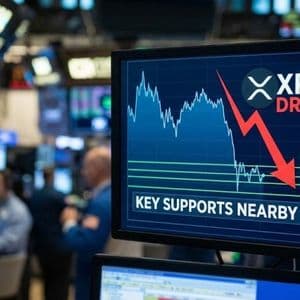
XRP price extended losses and traded below $1.40. The price is now consolidating losses and faces hurdles near $1.3650 and $1.3940. XRP price started another decline and traded below the $1.40 zone. The price is now trading below $1.3880 and the 100-hourly Simple Moving Average. There is a bearish trend line forming with resistance at $1.3720 on the hourly chart of the XRP/USD pair (data source from Kraken). The pair could continue to move down if it stays below $1.40. XRP Price Dips Below $1.40 XRP price failed to stay above $1.4150 and extended its decline, like Bitcoin and Ethereum. The price declined below $1.4050 and $1.40 to enter a short-term bearish zone. The price even extended losses below $1.380. A low was formed at $1.3464, and the price is now consolidating losses well below the 23.6% Fib retracement level of the downward move from the $1.5495 swing high to the $1.3464 low. The price is now trading below $1.3880 and the 100-hourly Simple Moving Average. If there is a fresh recovery move, the price might face resistance near the $1.3650 level. There is also a bearish trend line forming with resistance at $1.3720 on the hourly chart of the XRP/USD pair. The first major resistance is near the $1.380 level. The main resistance could be $1.3940. A close above $1.3940 could send the price to $1.40. The next hurdle sits at $1.4250 or the 50% Fib retracement level of the downward move from the $1.5495 swing high to the $1.3464 low. A clear move above the $1.4250 resistance might send the price toward the $1.440 resistance. Any more gains might send the price toward the $1.450 resistance. More Losses? If XRP fails to clear the $1.40 resistance zone, it could start a fresh decline. Initial support on the downside is near the $1.3465 level. The next major support is near the $1.3350 level. If there is a downside break and a close below the $1.3350 level, the price might continue to decline toward $1.3220. The next major support sits near the $1.320 zone, below which the price could continue lower toward $1.3120. Technical Indicators Hourly MACD – The MACD for XRP/USD is now gaining pace in the bearish zone. Hourly RSI (Relative Strength Index) – The RSI for XRP/USD is now below the 50 level. Major Support Levels – $1.3465 and $1.3350. Major Resistance Levels – $1.3720 and $1.3940.
20 May 2026, 03:45
US Dollar Index Holds Near Six-Week Highs as Trump Tariff Threats Boost Safe-Haven Appeal
BitcoinWorld US Dollar Index Holds Near Six-Week Highs as Trump Tariff Threats Boost Safe-Haven Appeal The US Dollar Index (DXY) remained elevated near six-week highs around 99.50 during Asian trading on Wednesday, extending its recent rally as fresh trade threats from former President Donald Trump revived safe-haven demand for the greenback. The index, which measures the dollar against a basket of six major currencies, has climbed steadily since mid-March, supported by a combination of geopolitical uncertainty and diverging monetary policy expectations. Fresh Tariff Rhetoric Fuels Risk-Off Sentiment Trump’s latest comments, in which he threatened to impose new tariffs on imports from key trading partners if re-elected, injected a fresh wave of uncertainty into global markets. Investors interpreted the remarks as a signal that trade tensions could escalate again, prompting a rotation out of risk-sensitive assets like equities and emerging market currencies into the relative safety of the US dollar. The DXY touched 99.52 in early trade, its highest level since mid-February, before consolidating near that mark. The move reflects a broader risk-off tone, with the Japanese yen and Swiss franc also gaining ground against the euro and British pound. Fed Policy Divergence Supports Dollar Strength Beyond geopolitical headlines, the dollar has been underpinned by the Federal Reserve’s cautious stance on rate cuts. While markets have priced in a first rate reduction by September, Fed officials have repeatedly stressed the need for more evidence that inflation is sustainably moving toward the 2% target. This contrasts with the European Central Bank and the Bank of England, which have signaled greater willingness to ease policy sooner. Strong US economic data, including better-than-expected retail sales and durable goods orders, has further reduced the urgency for Fed action, keeping US Treasury yields elevated relative to those in Europe and Japan. The yield differential continues to attract foreign capital into dollar-denominated assets. Market Implications and Key Levels to Watch For traders, the 99.50 level represents a key resistance zone. A sustained break above this threshold could open the door to a test of the 100.00 psychological barrier, a level not seen since early November. On the downside, support is seen near 99.00, with a break below that exposing the 98.70 area. The immediate catalyst for further dollar movement will be the upcoming US inflation data and any additional comments from Trump or other policymakers. The dollar’s trajectory also hinges on whether risk appetite recovers or deteriorates further. Why This Matters for Investors A stronger dollar has broad implications for global markets. It pressures multinational companies with overseas earnings, weighs on commodity prices priced in dollars, and can tighten financial conditions in emerging economies that have borrowed in dollars. For US consumers, a strong dollar helps keep import prices low, which could help moderate inflation, but it also makes American exports less competitive. Currency markets are now pricing in a higher probability of sustained dollar strength through mid-2025, unless the Fed pivots more dovishly or geopolitical tensions ease significantly. Conclusion The US Dollar Index’s hold near six-week highs reflects a market caught between renewed trade policy uncertainty and a patient Federal Reserve. While the dollar’s safe-haven appeal is currently driving gains, the sustainability of this move will depend on upcoming economic data and the evolution of tariff threats. Investors should monitor the 99.50–100.00 range closely for directional cues. FAQs Q1: What is the US Dollar Index (DXY)? The US Dollar Index measures the value of the US dollar relative to a basket of six major currencies: the euro, Japanese yen, British pound, Canadian dollar, Swedish krona, and Swiss franc. It is a widely used benchmark for the dollar’s overall strength. Q2: Why do Trump tariff threats boost the dollar? Tariff threats increase economic uncertainty, prompting investors to sell riskier assets and buy safe-haven currencies like the US dollar. The dollar also benefits from the perception that the US economy is more resilient to trade disruptions than many of its trading partners. Q3: What does a strong dollar mean for the stock market? A strong dollar can negatively impact US multinational companies by reducing the value of their overseas revenues when converted back to dollars. It can also pressure commodity prices and emerging market stocks, contributing to broader market volatility. This post US Dollar Index Holds Near Six-Week Highs as Trump Tariff Threats Boost Safe-Haven Appeal first appeared on BitcoinWorld .
20 May 2026, 03:40
Crypto Liquidations Top $66M in 24 Hours as Long Positions Take Heavy Hit
BitcoinWorld Crypto Liquidations Top $66M in 24 Hours as Long Positions Take Heavy Hit The cryptocurrency futures market experienced a significant shakeout over the past 24 hours, with total liquidation volumes exceeding $66 million across major digital assets. Data from leading analytics platforms shows that long traders bore the brunt of the losses, particularly in Ethereum and Bitcoin perpetual contracts. Breakdown of Liquidation Volumes Ethereum led the liquidation wave with approximately $29.87 million in positions forcibly closed, of which a striking 77.58% were long positions. Bitcoin followed closely, with $29.09 million liquidated and 69.02% representing bets on price increases. A smaller but notable outlier was BSB, which saw $7.17 million in liquidations, with 76.08% of those being short positions — a reversal of the dominant trend seen in the larger assets. This data, compiled from major exchanges offering perpetual futures, indicates a sudden and sharp price movement that caught a majority of leveraged long traders off guard. The high concentration of long liquidations suggests the market was heavily positioned for continued upward momentum, making the correction particularly painful for over-leveraged participants. Market Context and Implications Liquidation events of this magnitude often serve as a reset mechanism for overheated markets. When a large number of long positions are flushed out, it can sometimes clear the path for a more sustainable recovery, as weaker hands are removed from the market. However, it also signals that bullish sentiment may have been overextended relative to actual buying pressure. The fact that BSB shorts were liquidated simultaneously points to a more complex market dynamic, where not all assets moved in the same direction. This divergence suggests that capital rotation or specific news events may have influenced individual tokens differently, rather than a uniform market-wide selloff. What This Means for Traders For active futures traders, these liquidation cascades highlight the persistent risks of high leverage in volatile markets. The data serves as a reminder that even when market sentiment appears overwhelmingly bullish, sudden reversals can trigger forced selling that amplifies losses. Risk management strategies, including appropriate position sizing and stop-loss orders, remain critical in navigating such environments. For longer-term investors, the liquidation of over-leveraged positions can sometimes present buying opportunities, as the market may have temporarily overshot to the downside. However, caution is warranted until clearer directional signals emerge. Conclusion The $66 million in crypto futures liquidations over the past 24 hours underscores the inherent volatility and risk in leveraged trading. With Ethereum and Bitcoin longs taking the heaviest losses, the event reflects a market caught off guard by a sudden shift in momentum. While such resets can be painful, they are a recurring feature of crypto markets and often precede more balanced price action. Traders and investors alike should monitor for further volatility and adjust their strategies accordingly. FAQs Q1: What are crypto futures liquidations? Liquidations occur when a trader’s leveraged position is forcibly closed by the exchange because the margin balance has fallen below the required maintenance level, typically due to adverse price movements. Q2: Why were long positions hit harder than shorts? The data shows that a majority of open positions were long (betting on price increases), and a sudden price drop triggered a cascade of forced selling, disproportionately affecting those with bullish bets. Q3: How can traders protect themselves from liquidations? Traders can reduce liquidation risk by using lower leverage, setting stop-loss orders, diversifying positions, and maintaining sufficient margin buffers to withstand short-term volatility. This post Crypto Liquidations Top $66M in 24 Hours as Long Positions Take Heavy Hit first appeared on BitcoinWorld .
20 May 2026, 03:36
Coinbase Warns of Possible Weekend Disruptions: What You Need to Know

The leading US-based cryptocurrency exchange warned its users that they may experience certain disruptions this weekend. The company has recently drawn significant attention after cutting staff and introducing a series of platform adjustments and other developments. Attention This Saturday Coinbase has scheduled a system upgrade for Saturday (May 23), which is estimated to last approximately half an hour. The team explained that during this time, trading will not be impacted, while order status updates across all markets may be delayed. The company promised to provide updates as the maintenance progresses. These types of upgrades are fairly standard and typically not a cause for alarm. In October last year, for instance, Coinbase went temporarily offline due to a similar reason, and there were no reports of major complications. Another disruption was witnessed earlier this month. Certain Coinbase users found themselves unable to complete transactions, while others experienced degraded service speeds due to an AWS overheating issue. The exchange swiftly diagnosed the problem and began working to “re-enable” trading across its markets. Some users noted on social media that the outage happened shortly after Coinvase disclosed it was cutting its global workforce by 14%. CEO Brian Armstrong cited ongoing market volatility and the rapid pace of Artificial Intelligence (AI) as the main reasons for the decision. Further Developments Apart from the aforementioned news, Coinbase made the headlines after becoming the official treasury deployer of USDC under Hyperliquid’s Aligned Quote Asset (AQA) framework. Under this role, the exchange will handle USDC liquidity directly for the protocol, helping strengthen its on-chain financial operations. The collaboration also positions Coinbase as a key contributor to the growing decentralized derivatives ecosystem. For its part, Hyperliquid revealed that both Coinbase and Circle have agreed to stake HYPE tokens to support the activation of AQAv2 (the next upgrade to the Aligned Quote Asset (AQA) on the decentralized exchange). Coinbase has also carried out some delisting efforts. Last week, it scrapped six non-USD trading pairs, including ICP/USDT and ICP/GBP. This was followed by a 10% price decline for Internet Computer to just under $3. The asset failed to rebound and extended its losses over the next few days, currently hovering near $2.50. The post Coinbase Warns of Possible Weekend Disruptions: What You Need to Know appeared first on CryptoPotato .
20 May 2026, 03:30
Bitcoin Supply In Profit Jumps To 63%: Why Analysts Are Still Cautious

Bitcoin’s on-chain profitability has recovered sharply from its March lows, but analyst Axel Adler Jr. says the market still lacks a stronger behavioral confirmation that a durable reversal is underway. In his May 19 “Bitcoin Morning Brief,” Adler pointed to a mixed setup across two closely watched on-chain indicators: Bitcoin Percent Supply in Profit and Short-Term Holder SOPR. The first metric shows a meaningful structural recovery. The second still suggests that recent buyers are not yet realizing sustained profits with enough confidence to validate the move. “Supply in Profit has recovered after the capitulation phase, but short-term holders are still not realizing sustained profits,” Adler wrote. “There is still no behavioral confirmation of a reversal.” Bitcoin Nears Critical Zone as Short-Term Holders Flash Warning According to Adler’s data, Bitcoin Percent Supply in Profit on a seven-day simple moving average has climbed from a March low of 53.6% to 63.3% as of May 18. The recovery indicates that a larger share of circulating Bitcoin now has an on-chain cost basis below the current market price, marking a clear improvement from the capitulation phase earlier this year. The move, however, remains incomplete by the analyst’s framework. Adler noted that the current reading is still roughly 10 percentage points below January levels, when the metric stood above 72%, and remains beneath the historical cumulative average of around 76.9%. In his view, that keeps Bitcoin in a recovery phase rather than a fully normalized profitability regime. “The current level remains below the historical cumulative average of around 76.9%,” Adler wrote. “This means the market is still in a recovery phase. A return above 70% while the current price dynamics hold would be the first signal of normalization in the supply structure.” The more fragile signal comes from short-term holders. Adler said Bitcoin’s STH-SOPR SMA-7D recovered from a capitulation zone below 0.97 earlier this year but has failed to hold decisively above the neutral 1.0 threshold. As of May 18, the indicator stood at 0.9994, slightly below neutral, with Bitcoin near $76,900. That matters because STH-SOPR tracks whether coins moved by short-term holders, typically defined as coins held for less than 155 days, are being sold at a profit or loss. A reading below 1.0 indicates that these market participants are selling at a loss on average. For Adler, that makes the recent slip below the threshold more important than the headline improvement in aggregate supply profitability. “STH-SOPR SMA-7D reached the cycle low in early February 2026 at 0.967,” Adler wrote. “This was a zone of clear capitulation , when short-term holders were broadly realizing losses. The following recovery was gradual.” The indicator had stabilized in the 1.001 to 1.009 range in April as Bitcoin moved above the $75,000 to $80,000 area. But the pullback to 0.9994 marked the first move back below 1.0 after roughly two weeks above the threshold, according to the brief. Adler framed that as a warning that the recovery still depends heavily on price holding a narrow support band. “The key question now is whether STH-SOPR can hold above 1.0 again or continue declining together with price,” he wrote. “Losing the 1.0 level with price below $76k would increase the risk of retesting the March lows in Supply in Profit.” For now, Adler described the market stance as neutral with a cautious bias. The critical zone is $76,000 to $77,000, which he said is sufficient to push STH-SOPR back above 1.0 if buyers defend it. A stronger confirmation would require STH-SOPR to remain above 1.0 for five to seven trading days while Bitcoin holds above $78,000 to $80,000, alongside Supply in Profit moving toward the 68% to 70% range. The downside scenario is more immediate. Adler flagged a potential pullback to $73,000 to $74,000 as the main risk, saying that move could drag STH-SOPR back into the 0.98 to 0.99 zone and stall the improvement in Supply in Profit. At press time, BTC traded at $77,015.


