


 Invest ideas
News
21 May 2026, 09:53
Ethereum News: Syndicate Labs Shutdown: Is the Ethereum L2 ‘Great Shakeout’ Here?

Ethereum News: Syndicate Labs is shutting down after five years of operations, becoming the most prominent casualty yet of the Ethereum Layer 2 consolidation wave that has steadily stripped liquidity, users, and economic viability from smaller chains. The company posted its wind-down announcement on X on May 21, stating plainly that the “rollup market has fundamentally shifted”, and the data backs that conclusion without any hedging required. Arbitrum One, Base, and OP Mainnet now control roughly 75% of the layer-2 market. Total value secured across the rollup ecosystem has dropped 36% from its October peak of more than $50 billion. That is the environment in which smaller chains are trying to survive, and most cannot. Syndicate Labs is winding down. After five years building onchain developer infrastructure, the rollup market has fundamentally shifted, making this decision necessary. Here's what this means for the network, token holders, and developers building with Syndicate. — Syndicate (@syndicateio) May 21, 2026 Discover: The best pre-launch token sales Ethereum News: ETH Layer 2 Economics: Why the App-Chain Thesis Stopped Working The mechanism here is worth understanding precisely. Syndicate Labs was not building a general-purpose L2 to compete with Arbitrum head-on. The company, backed by a $20 million Series A led by Andreessen Horowitz in 2021, built customizable rollup infrastructure, the kind that was supposed to power thousands of application-specific app-chains for DAOs, social communities, and investment clubs. The thesis was that demand for sovereign, programmable chains would be durable. Source: CryptoRank It was not. Syndicate’s shutdown statement identified the core structural problem: custom chains are increasingly being assembled by consulting teams as bespoke, one-off builds rather than using reusable infrastructure platforms. When each deployment is engineered from scratch with almost no shared technology or network value, a platform like Syndicate’s smart sequencer becomes economically redundant. The market moved toward customization-as-consulting and away from customization-as-platform. The numbers confirm the trend is broad, not isolated. 21Shares research published in December showed layer-2 activity had fallen 61% since June, with the asset manager describing several smaller networks as “zombie chains”, technically live but operating with negligible transaction volume. Source: DefiLlama L2Beat data puts total rollup ecosystem TVS at roughly $32 billion today, down from the $50 billion peak. The top five rollups now capture close to 90% of all L2 liquidity. That is not a competitive market – it is a consolidation already in its final stages. Syndicate’s SYND token reflects the damage with brutal precision. SYND fell another 21% within hours of the shutdown announcement on Thursday, hitting a record low near $0.012. The token has now lost approximately 99.5% of its value since its September 2025 peak of $2.61. Discover: The best crypto to diversify your portfolio with The post Ethereum News: Syndicate Labs Shutdown: Is the Ethereum L2 ‘Great Shakeout’ Here? appeared first on Cryptonews .
21 May 2026, 09:36
Bitcoin News: Quantum Countdown, The Data Behind the ‘20% Vulnerable’ Bitcoin Supply

Bitcoin News: New Glassnode data puts 4.12 million BTC at quantum risk from behavioral factors alone, address reuse, partial spending, and custody practices, more than double the 1.92 million BTC exposed by Bitcoin’s older script architecture. Combined, the two categories cover 30.2% of all issued Bitcoin, but the more urgent finding is this: the dominant source of today’s Bitcoin quantum risk is not legacy code. It is how holders manage their keys. Source: Glassnode on X Discover: The best crypto to diversify your portfolio with Bitcoin News: Two Categories of Exposure. Why Structural and Operational Risk Are Not the Same Thing Glassnode splits quantum-exposed supply into two distinct buckets, and conflating them produces exactly the kind of vague, unhelpful headline that obscures where the real risk is concentrated. Structural exposure covers outputs where the public key appears on-chain by design, baked into the protocol itself, not the result of user behavior. The primary offenders are Pay-to-Public-Key (P2PK) outputs, the script type used in Bitcoin’s earliest blocks, where the public key is embedded directly in the UTXO with no hash layer at all. Also included: bare multisig outputs and, more recently, Pay-to-Taproot (P2TR) outputs, which expose the public key at rest as part of their design. Glassnode estimates structural exposure at 1.92 million BTC. Source: Glassnode Operational exposure is a different problem. Address types like Pay-to-Public-Key-Hash (P2PKH) and Pay-to-Witness-Public-Key-Hash (P2WPKH) do not expose public keys by default; they hide them behind cryptographic hash functions (SHA-256 and RIPEMD-160) that are considered quantum-resistant under current models. A quantum computer running Shor’s Algorithm can derive a private key from a known public key in polynomial time using ECDSA’s elliptic curve structure. But it cannot reverse a hash to discover the public key in the first place. The hash layer is a genuine protection, until it isn’t. The protection breaks the moment a holder spends from a P2PKH or P2WPKH address. Spending requires broadcasting a transaction that includes the public key in the signature, and once that transaction is confirmed on the blockchain, the public key is permanently on-chain. If that address then receives additional funds, address reuse, those funds are now exposed in exactly the same way as a P2PK output. The hash layer protected the coins until the address was spent from. After that, it protects nothing for any remaining or subsequent balance. Glassnode puts operationally exposed supply at 4.12 million BTC, 2.1 times the structural figure. The firm’s conclusion is direct: “The main insight is that most current at-rest exposure is not simply a legacy script-design problem, it is a key- and address-management problem.” Discover: The best pre-launch token sales The post Bitcoin News: Quantum Countdown, The Data Behind the ‘20% Vulnerable’ Bitcoin Supply appeared first on Cryptonews .
21 May 2026, 09:34
A crypto whale has made a $224,000 bet that XRP's price stays perfectly flat through June

The trader collected about $224,500 in premiums and will keep the full amount if XRP remains close to $1.40.
21 May 2026, 09:30
Washington Moves To Review Crypto Tax Rules With New IRS Study Bill

Kraken sent 56 million tax forms to the Internal Revenue Service last year. Nearly a third covered transactions worth less than a dollar. More than 75% were for trades under $50. Those numbers, cited by the crypto exchange last month, have added weight to a growing call in Congress to rethink how small digital asset transactions are taxed in the United States. Related Reading: Crypto Access To Banks In Focus After Trump’s New Executive Order A Study, Not An Exemption A bipartisan group of House lawmakers introduced a bill Tuesday that takes a first formal step toward addressing that burden. Called the Digital Asset Protection, Accountability, Regulation, Innovation, Taxation and Yields Act — or PARITY Act — the legislation does not create a tax break for small crypto transactions. What it does is direct the Treasury Department to examine whether one should exist, and to report back within 180 days on what relief it can offer under its current authority. Innovation should create opportunity for everyone, not just those already ahead. The Digital Asset PARITY Act modernizes the tax code for the digital age, creates clearer rules, and ensures emerging financial tools help expand financial inclusion and pathways to wealth. It is… pic.twitter.com/44B8mpEQLl — Rep. Steven Horsford (@RepHorsford) May 19, 2026 The bill also calls for a study on how much paperwork small crypto transactions generate for taxpayers, and on the total number of transactions under $200 that get reported to the IRS each year. The Treasury would also be asked to outline what resources the IRS would need if a de minimis exemption were eventually passed into law — and what kinds of fraud or abuse such an exemption might invite. Republican Representative Max Miller, one of the bill’s sponsors, said the US tax code has not kept pace with how fast digital assets have grown. “As America continues to lead the world in innovation, our tax code has failed to keep pace with the rapid growth of digital assets and modern financial technology,” Miller said in a statement. What Else The Bill Covers The PARITY Act carries over a section from an earlier draft that would treat regulated payment stablecoins like cash for tax purposes. Under that provision, no gains or losses would be recognized on stablecoin transactions unless the cost basis of those tokens falls below 99% of their redemption value. The bill also seeks to apply wash sale rules to crypto — a change that would close a loophole that stock investors are not allowed to use but crypto traders currently are. Related Reading: Zcash Soars 88% In 30 Days: Is ZEC The Stealth Winner Of This Crypto Cycle? Democratic Representatives Steven Horsford and Suzan DelBene joined Miller and Republican Rep. Mike Carey in introducing the bill. Horsford had previously released a discussion draft of the legislation back in March. A Race Against The Clock Miller told Bloomberg Tax he believes the bill can pass before this Congress wraps up. That deadline falls in January, after the November midterm elections in which every House seat will be contested. Featured image from Getty Images, chart from TradingView
21 May 2026, 09:30
Evernorth Says RLUSD Is Not An XRP Killer: Here’s Why
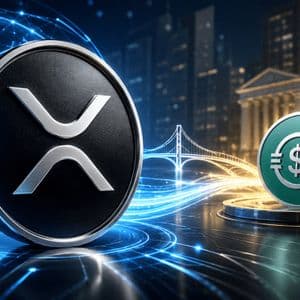
Evernorth Chief Business Officer Sagar Shah has pushed back on the idea that Ripple’s dollar-backed stablecoin RLUSD could replace XRP, arguing that the two assets are designed for different roles in on-chain finance. In a May 20 blog post , Shah said RLUSD can serve as a high-quality digital dollar, while XRP remains the neutral routing asset for cross-asset settlement, liquidity and collateral on the XRP Ledger. The argument addresses a recurring question in the XRP community and among market observers: if RLUSD can move dollars on-chain and settle quickly, what function is still left for XRP? Shah’s answer is that RLUSD and XRP are not competing for the same job. RLUSD, he wrote, represents a dollar leg in transactions. XRP is the asset that can sit between markets when two parties do not naturally want to trade the same asset pair. Will RLUSD Replace XRP? To explain the distinction, Shah used a playground trading analogy in which children try to swap snacks at recess. Direct trading becomes inefficient when one child has Goldfish, another has fruit snacks, and the person with fruit snacks wants pretzels instead of Goldfish. As the number of snacks grows, the number of possible trading pairs expands rapidly. With ten different snacks, Shah noted, there are 45 possible pairs. With 100 snacks, there are nearly 5,000. That, he argued, mirrors the problem faced by real markets as tokenized assets proliferate. “The chance that two specific kids happen to want each other’s exact snack at the exact same moment gets smaller and smaller,” Shah wrote. “This is the same problem real markets have. The more assets there are, the harder direct trading becomes.” In the analogy, the solution is “the swap kid,” a participant who holds a little bit of every snack and allows everyone else to trade through him. Shah said this is the role XRP plays on the XRP Ledger. A trader may see a simple swap from a tokenized Treasury bill into a euro stablecoin, but the actual route could be tokenized Treasury bill to XRP to euro stablecoin . “The XRP step is invisible to the trader,” Shah wrote. “They see ‘Treasury bill in, euro stablecoin out.’ But the XRP in the middle is what makes the trade possible, instantly, without anybody having to find a specific buyer on the other side.” Shah framed RLUSD as “something entirely different.” It is a stablecoin, designed to be valued at $1 and backed by reserves held by its issuer. That makes it useful when one side of a trade wants a digital dollar. But it does not make RLUSD a universal routing asset across the ledger, he argued. “RLUSD isn’t trying to be the swap kid,” Shah wrote. “It’s trying to be a juice box — a specific thing, with a known value, useful whenever both sides of a trade want a dollar.” The distinction matters most in markets where there is no natural dollar leg. Shah cited examples such as tokenized Treasuries being swapped for tokenized euro money market funds, lending markets denominated in different assets, and other cross-asset activity that does not begin or end with dollars. In those cases, he said, the ledger needs a neutral bridge asset in the middle. Three Reasons Why RLUSD Is Not An XRP Killer Shah gave three reasons why he believes RLUSD cannot serve that function. The first is issuer risk. RLUSD exists because a company mints it and holds dollars in reserve. That is standard for stablecoins, but Shah argued it becomes a structural weakness if the stablecoin becomes the mandatory routing asset for all trades. “If any stablecoin issuer ever ran into trouble — a regulatory issue, a banking issue, a court order to freeze accounts, a problem with their license — the stablecoin could have a problem too,” he wrote, adding that this was a general point about issued stablecoins rather than a claim about any specific issuer. “That’s fine if the stablecoin is one asset among many. It’s a serious design flaw if the stablecoin is the asset every trade routes through.” The second issue is neutrality . Stablecoin issuers must comply with sanctions, court orders, blacklists and geographic restrictions. Shah said those controls are appropriate for a regulated stablecoin, but problematic if the same token is expected to route trades across a global permissionless ledger. “The router has to work for everybody across jurisdictions and counterparties, without an intermediary who can decide who’s allowed to trade,” Shah wrote. “Under the current protocol design, no party can freeze XRP or prevent it from settling a trade. That neutrality is a structural requirement for the routing role.” The third point is market structure. Liquidity pools and automated market makers require two different assets. There can be pools between RLUSD and euro stablecoins, or RLUSD and tokenized Treasuries. But Shah argued the broader question is which non-RLUSD asset becomes the common bridge across the ledger. In Evernorth’s view, that asset is XRP. “In a world with hundreds of tokenized assets , every pair can’t have its own pool,” he wrote. “There isn’t enough capital or enough market-maker attention. A few assets end up doing most of the bridging work.” Shah said XRP is positioned for that role because it is among the most liquid assets on the XRP Ledger across a wide range of other assets, because the protocol’s pathfinding routes through it by default, and because market makers concentrate capital on XRP pairs where volume exists. He also pointed to XRP’s lack of issuer, resistance to censorship under the current protocol design, and years of uninterrupted operation as relevant attributes for a bridge asset. The post also extended the argument beyond trading. Shah said XRP can function as collateral in on-chain lending because it is liquid, broadly accepted and not subject to an issuer that can interfere with the asset during the life of a loan. He also highlighted escrow, where XRP can be locked for release at a future time or upon certain conditions, with the ledger enforcing the rules. For Evernorth, the broader thesis is that on-chain finance will need both a digital dollar and a routing asset as more assets move on-chain. Shah was careful to frame that as a forward-looking view subject to uncertainty, but said the roles remain separate. “We’re not making the case that RLUSD is unimportant,” he wrote. “The growth of on-chain finance requires a high-quality digital dollar, and RLUSD is designed to be one. We hold a view that the dollar leg and the routing leg are two different functions, and both grow with the size of the system.” At press time, XRP traded at $1.37.
21 May 2026, 09:30
BTC/USDT Spot CVD Chart Analysis: Volume Heatmap and Trade Size Trends on May 21

BitcoinWorld BTC/USDT Spot CVD Chart Analysis: Volume Heatmap and Trade Size Trends on May 21 On May 21, the BTC/USDT spot Cumulative Volume Delta (CVD) chart provided traders with a detailed view of order book dynamics, highlighting key price levels where volume concentration may act as support or resistance. The analysis, based on data as of 9:00 a.m. UTC, breaks down trade activity by size, offering insights into the behavior of both retail and large-scale participants. Understanding the Volume Heatmap The top section of the chart displays a Volume Heatmap, which tracks the volume of trades executed at specific price levels. The background color intensifies when the price remains within a certain range for an extended period or moves significantly. Brighter areas on the heatmap often indicate zones where traders have concentrated activity, making them potential support or resistance levels. For Bitcoin traders, these zones can serve as key reference points for entry or exit decisions. Cumulative Volume Delta by Trade Size The lower section of the chart features the Cumulative Volume Delta (CVD) indicator, which categorizes buy and sell orders by trade size. As buy orders increase, the corresponding colored line rises. The yellow line represents orders between $100 and $1,000, typically associated with retail traders. In contrast, the brown line tracks large orders between $1 million and $10 million, often linked to institutional or high-net-worth participants. Divergences between these lines can signal shifts in market sentiment or potential accumulation or distribution phases. Implications for Bitcoin Traders Monitoring CVD by trade size allows traders to distinguish between retail-driven movements and institutional activity. A rising brown line alongside a flat or declining yellow line may suggest that large players are accumulating, which could precede a breakout. Conversely, if retail buying dominates while large orders decline, the move may lack conviction. The heatmap further refines this picture by identifying price levels where volume clusters, helping traders set stop-losses or profit targets with greater precision. Conclusion The BTC/USDT spot CVD chart as of May 21 offers a granular look at market structure through volume concentration and trade-size distribution. For traders, combining the Volume Heatmap with CVD data provides a clearer understanding of where buying and selling pressure originates, and at what price levels the market is most active. As always, these tools are best used alongside broader market analysis and risk management strategies. FAQs Q1: What does the Volume Heatmap show in BTC/USDT trading? The Volume Heatmap displays the concentration of trading volume at specific price levels. Brighter areas indicate higher activity, which can act as potential support or resistance zones. Q2: How is the Cumulative Volume Delta (CVD) different from regular volume? Regular volume shows total trades, while CVD tracks the net difference between buy and sell orders, broken down by trade size, revealing the direction and strength of market participation. Q3: Why are trade sizes important in CVD analysis? Different trade sizes represent different types of traders. Small orders (yellow line) often reflect retail activity, while large orders (brown line) indicate institutional moves. Divergences can signal shifts in market sentiment. This post BTC/USDT Spot CVD Chart Analysis: Volume Heatmap and Trade Size Trends on May 21 first appeared on BitcoinWorld .

